
Memory Stocks in 2026: Who Supplies the AI Buildout?

Memory has become an increasingly important part of the AI infrastructure buildout. More powerful processors need greater memory capacity and faster access to data, while the systems around them require storage, specialized components, and increasingly complex manufacturing technology.
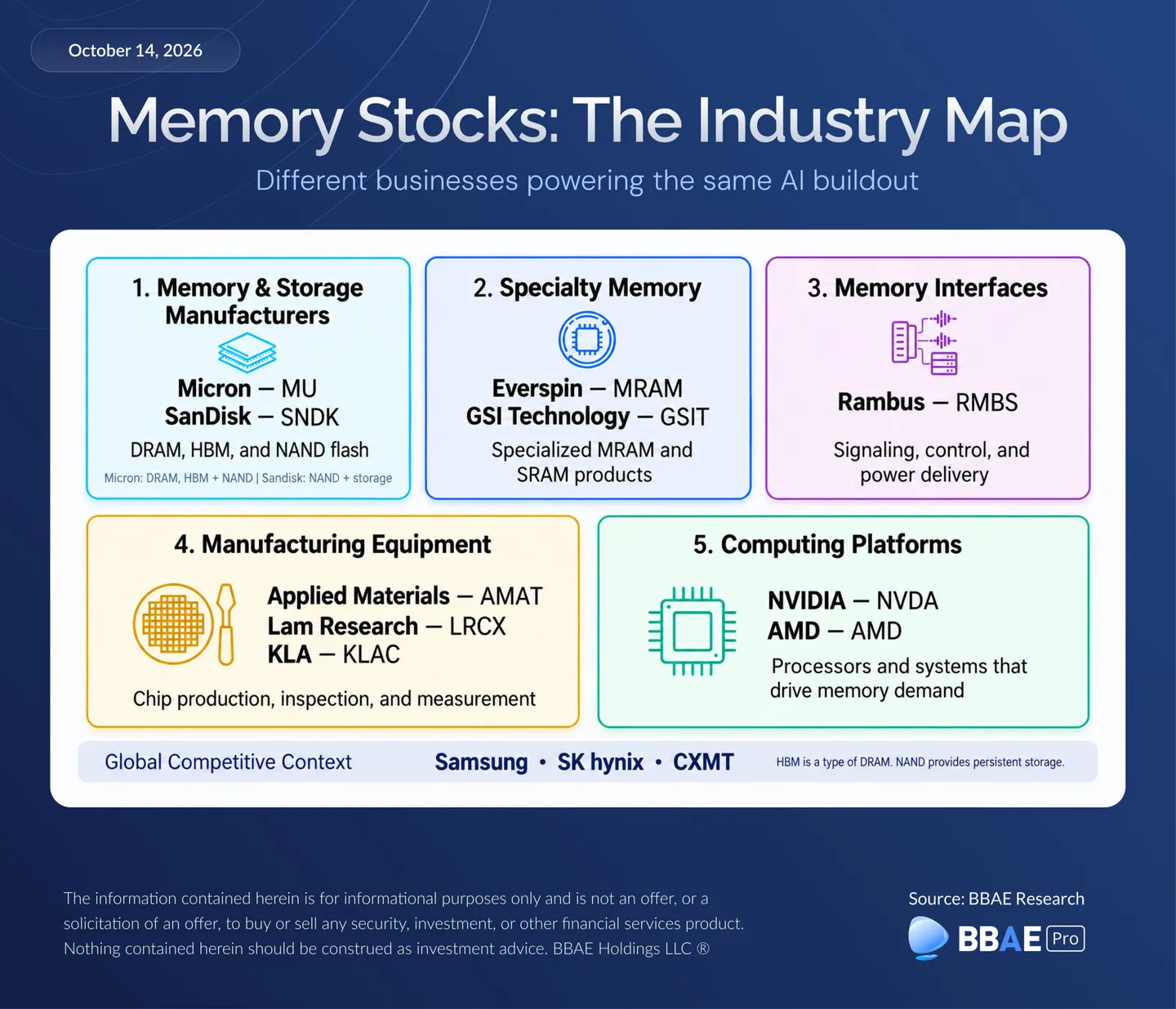
For investors, that creates several distinct business models. Micron manufactures DRAM and NAND. Sandisk focuses on flash storage. Rambus supplies memory-interface chips and related technology. Applied Materials, Lam Research, and KLA provide manufacturing and inspection equipment. NVIDIA and AMD drive demand through computing platforms that use these products.
The same growth in AI spending reaches all of them, but through different revenue streams and risks. A memory producer depends on demand, pricing, and manufacturing efficiency. An interface supplier depends on design adoption. An equipment company depends on customers investing in capacity and new processes. Understanding those differences is the starting point for reviewing the sector.
Memory and Storage: What Is the Difference?
DRAM and NAND flash serve different functions. DRAM provides the working memory used by processors while applications run. It is fast, but requires power to retain data. NAND flash provides persistent storage in solid-state drives, smartphones, and other devices.
AI infrastructure needs both. DRAM supplies the capacity and bandwidth required to process large workloads, while NAND stores models, datasets, and results. Growth in one category does not necessarily produce the same supply, pricing, or competitive dynamics in the other.
Several terms describe different kinds of DRAM:
- DDR5: A generation of working memory used in PCs and servers.
- LPDDR: Low-power memory, widely used in mobile devices and increasingly in other computing systems.
- HBM: High-bandwidth memory, built by stacking DRAM chips and connecting them through a very wide data interface. It supplies data rapidly to demanding processors such as AI accelerators.
HBM is therefore a type of DRAM, while NAND flash is a different technology. “Memory stock” can refer to either, which is one reason companies with very different businesses sometimes get grouped together.
A Map of U.S.-Listed Memory Businesses
The companies below participate in different parts of the industry. This is a selection of relevant businesses, rather than an exhaustive list.
Memory Manufacturers: Selling Capacity and Performance
Micron ($MU): DRAM, HBM, and NAND in One Business
Micron provides exposure to several parts of the memory market. Its DRAM products serve PCs, mobile devices, conventional servers, and AI accelerators, while its NAND products address persistent storage. These categories share manufacturing expertise, but their demand and pricing can move differently.
In March, Micron reported volume shipments of 36GB, 12-layer HBM4, designed for NVIDIA Vera Rubin. It also reported samples of a 48GB, 16-layer version. Volume shipments indicate a commercial product, while samples allow customers to evaluate a subsequent design.
Server memory is advancing separately. In May, Micron announced sampling of a 256GB DDR5 server module, with partners working to validate it on their platforms. The product addresses capacity requirements around server processors, alongside the accelerator-memory opportunity represented by HBM.
For investors, the questions extend beyond shipment growth. Watch the balance between conventional DRAM, HBM, and NAND; manufacturing efficiency; and whether pricing and margins hold as suppliers expand output. A strong AI product cycle does not guarantee that every memory category will remain equally profitable.
Sandisk ($SNDK): Flash Storage for the AI Data Cycle
Sandisk operates on the NAND side of the industry. Its FMS 2026 announcement highlighted advanced NAND, enterprise solid-state drives, and high-bandwidth flash technology for AI applications.
The business serves the need to store and access growing volumes of data. AI models, datasets, and generated content require persistent storage, while inference workloads create additional requirements for capacity, speed, and endurance—the ability to withstand repeated data writes.
Sandisk also discussed high-bandwidth flash, or HBF, as an emerging NAND-based technology. The similar name should not obscure the difference from HBM: HBF uses flash technology, while HBM uses DRAM. Development plans and demonstrations should be assessed separately from products already shipping commercially.
The operating questions are specific to storage: enterprise adoption, NAND pricing, manufacturing costs, and how new technology translates into customer demand. DDR5 developments provide context, but do not define Sandisk’s competitive position.
Samsung and SK hynix: Essential Global Comparisons
A U.S.-listed review still needs the Korean manufacturers as competitive context. Their technology, output, and investment decisions affect the global markets in which Micron operates.
Samsung announced commercial HBM4 shipments in February 2026, emphasizing the combination of DRAM, a logic base chip, and advanced packaging. SK hynix announced HBM4 development and production preparation in September 2025 and later outlined a next-generation memory relationship with NVIDIA.
These announcements show how closely advanced memory development is tied to customer platforms. HBM competitiveness depends on chip performance, reliable stacking and interconnections, power and thermal management, and customer qualification. Capacity alone does not capture the full competitive picture.
Interface Suppliers: Supporting the Memory Module
Rambus ($RMBS): Signaling, Control, and Power Delivery
Rambus supplies memory-interface chips and related technology used to manage signaling, control, and power delivery in memory systems.
Its 2026 SOCAMM2 announcement introduced a chipset for low-power server-memory modules. The functions include module identification, monitoring, and power delivery.
Its broader interface portfolio includes chipsets for server and client memory modules. The opportunity depends on adoption of those designs and the supporting components each generation requires. Investors should watch customer design wins and product transitions rather than applying a DRAM-pricing thesis directly to the company.
Equipment Suppliers: Enabling More Complex Memory
Applied Materials ($AMAT): Materials Engineering and Packaging
Applied Materials supplies systems used in semiconductor production, including DRAM and advanced packaging. Its June 2026 release introduced equipment targeting manufacturing steps for advanced memory and chip stacking.
More demanding chip structures can require additional processing and tighter control. The company’s opportunity depends on customers adopting equipment and investing in production, rather than on selling finished memory chips.
Lam Research ($LRCX): Etching and Deposition
Lam supplies equipment for etching and deposition: removing material to create chip structures and adding precise material layers. Its DRAM technology discussion describes how denser memory-cell layouts and future architectures increase those manufacturing demands.
The business therefore relates to technology complexity as well as factory expansion. Tool demand remains exposed to manufacturers’ capital budgets and the timing of process transitions. More memory sales do not necessarily produce immediate equipment orders.
KLA ($KLAC): Inspection and Process Control
KLA supplies tools that identify defects and measure whether manufacturing steps meet specifications. Its inspection portfolio includes applications for DRAM and NAND production.
As memory structures become more complex, identifying the causes of defects matters to yield—the proportion of chips that meet required specifications. KLA helps manufacturers control that process. Its business should be assessed through inspection needs, technology investment, and customer spending rather than memory prices alone.
Across these equipment companies, watch investment in new capacity and upgrades to existing production, alongside export restrictions. Timing, technology requirements, and customer mix determine how much spending reaches each supplier.
Specialty Memory: Smaller Markets With Different Requirements
Everspin ($MRAM): Persistent Memory for Specialized Applications
Everspin focuses on magnetoresistive RAM, which retains data without power. Its applications emphasize endurance, reliability, and persistent data, with requirements different from those of high-volume server DRAM.
The relevant questions concern adoption in target applications, customer programs, and commercial production. Its position should be assessed through those markets rather than assuming it shares the same demand cycle as HBM suppliers.
GSI Technology ($GSIT): SRAM and Specialized Computing
GSI Technology develops high-performance SRAM and specialized computing products, including memory for space and defense applications. SRAM is another form of working memory with different design characteristics and uses from DRAM.
Its customer requirements and commercialization milestones need separate analysis. Broad AI demand or changes in conventional DRAM prices do not establish an equivalent effect on its business.
The Demand Side: NVIDIA ($NVDA) and AMD ($AMD)
NVIDIA and AMD are on the processor side of the industry. Their systems use memory supplied by other companies, and their platform requirements help shape what suppliers develop.
NVIDIA’s Rubin platform materials describe an integrated system of GPUs, CPUs, and networking. Samsung and AMD’s March 2026 memorandum of understanding outlined cooperation on HBM4 for AMD accelerators and DDR5 for its server processors.
Their roadmaps influence the bandwidth, capacity, and power requirements memory suppliers must meet. For investors following manufacturers, platform transitions are important demand indicators. They also create qualification requirements: memory must work reliably with the intended processor and system before it can be deployed at scale.
Emerging Competition: Where CXMT Fits
China’s CXMT is one development to watch within this broader industry. In September, it announced mass production of its fifth-generation DRAM platform, alongside new LPDDR5X products. Its previous DDR5 announcement also showed PC and server-module designs.
That progress creates the clearest direct overlap with the conventional DRAM businesses of Micron, Samsung, and SK hynix. Among the U.S.-listed companies in this review, Micron has the closest product overlap. If CXMT expands reliable output and gains customer qualification, it could increase sourcing options and pricing pressure where its products compete. That is a potential market effect, not evidence that oversupply is imminent.
HBM remains a separate assessment. The official announcements reviewed here do not establish comparable CXMT HBM supply for leading NVIDIA platforms. Its DRAM progress also does not directly add competing NAND supply or make it a substitute for memory-interface chips and manufacturing equipment.
What Should Investors Watch Next?
The industry’s central question is how rising memory requirements translate into profitable production and customer adoption. For manufacturers, watch product mix, shipments, pricing, production yield, and capacity additions. For interface suppliers, watch platform adoption and design wins. For equipment companies, watch spending on factories, process upgrades, and advanced packaging.
Commercial status matters across the sector. A demonstrated technology, a sample sent for testing, a qualified product, and volume shipments represent different stages. The same applies to manufacturing: an announced facility does not immediately create saleable output.
Memory stocks offer several ways to follow the AI buildout, but each captures a different part of the economics. Micron and Sandisk sell memory and storage; Rambus supplies interface technology; Applied Materials, Lam Research, and KLA enable production; and specialty suppliers serve narrower requirements. A useful sector review starts with those roles and then asks what is changing in each business.
This article is for informational purposes only and is neither investment advice nor a solicitation to buy or sell securities. All investment involves inherent risks, including the total loss of principal, and past performance is not a guarantee of future results. Always conduct thorough research or consult with a financial expert before making any investment decisions. BBAE has no position in any investment mentioned.