AI Data Center Stocks in 2026: Who Is Building the Boom?

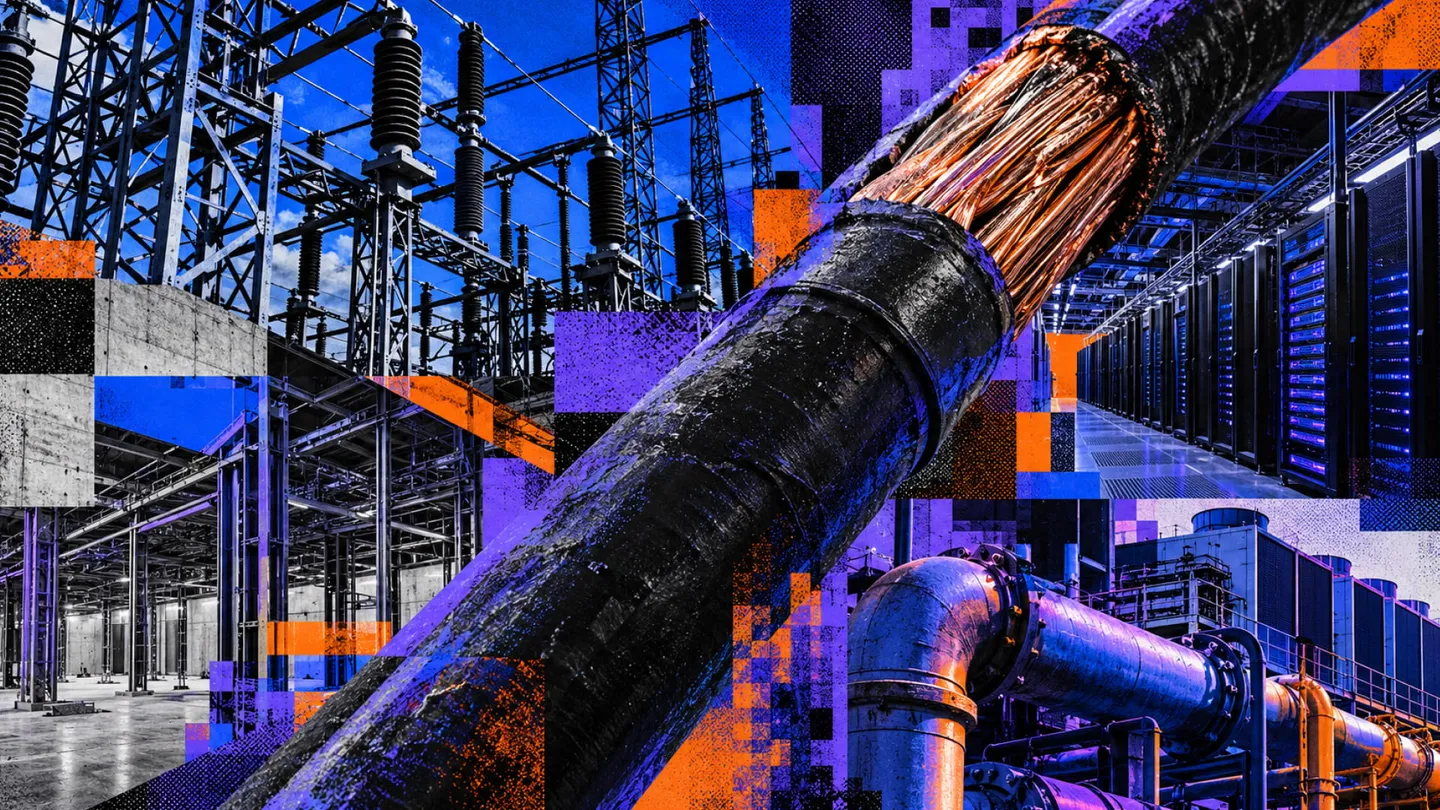
AI data centers have become one of the largest construction projects in technology. The newest facilities need more than GPUs: they need large blocks of reliable electricity, specialized cooling, high-speed networking, and buildings that can support unusually dense computing equipment. The International Energy Agency projects that data centers could use about 945 terawatt-hours of electricity worldwide by 2030, more than twice their 2024 consumption.
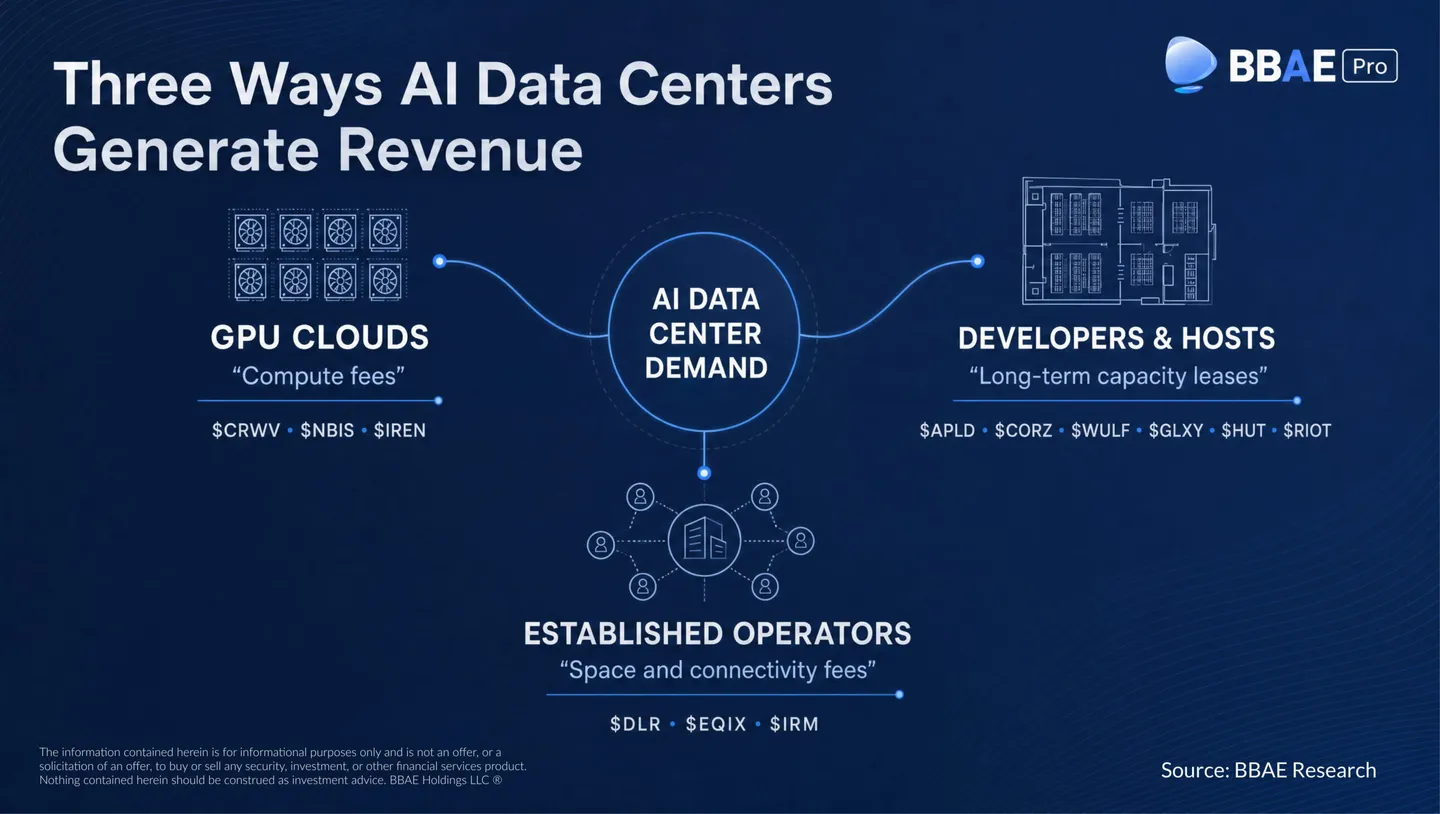
For investors, the phrase “AI data center stock” can be misleading. CoreWeave sells access to GPU computing. Applied Digital builds facilities and leases them to customers. Core Scientific and TeraWulf convert power-rich sites into high-density hosting. Digital Realty and Equinix are established data-center operators adding AI workloads to much broader businesses. The same demand for AI compute reaches all of them, but it does so through different contracts, capital requirements, and risks.
The most useful distinction is between capacity already operating, capacity leased to a customer but still being built, and power or land that might support a future project. A planned gigawatt is not a gigawatt of revenue-generating AI infrastructure.
What Does an AI Data Center Company Actually Sell?
An AI cloud buys or finances GPUs and sells computing capacity to model developers and other customers. Its economics depend on GPU utilization, hardware costs, financing, and the price it can charge for compute. A data-center landlord develops the building, power systems, and cooling, then leases capacity to a cloud company or large technology customer. A hosting operator supplies and runs the physical environment while the customer generally supplies or controls the servers. Traditional colocation providers rent space, power, connectivity, and related services to many tenants.
These lines sometimes overlap. Bitdeer and IREN, for instance, are developing facilities while also building their own AI-cloud businesses. Former Bitcoin miners are another important part of the story: their access to land and power connections can be valuable, but a mining site still needs major upgrades to host advanced AI clusters.
Capacity announcements also use different measures. Gross power includes electricity for cooling and other building systems; critical IT load measures power available to computing equipment. Neither tells us by itself how many GPUs are installed or how much revenue a site earns. That is why the figures below should be read as project milestones, not added into a single sector total.
AI Clouds: Selling the Computing Itself
CoreWeave ($CRWV): The GPU Cloud at Scale
CoreWeave is the clearest public example of a specialized AI cloud. It sells GPU compute, storage, networking, and software to customers rather than primarily collecting rent on buildings. The company surpassed 1 gigawatt of active power in the first quarter of 2026. In a September update, it said contracted power had reached roughly 4.2 gigawatts as of August 11.
That gap shows both the opportunity and the execution challenge. CoreWeave has secured far more future capacity than it currently has running, and it must finance equipment and bring projects online to turn those commitments into cloud revenue. Many of the buildings themselves come from partners, including companies elsewhere in this article. CoreWeave is the compute provider on the other side of several landlords’ leases.
Nebius ($NBIS): A Full-Stack Cloud with a Large Buildout
Nebius also sells AI compute, combining its cloud software and GPU infrastructure with owned, leased, and partner-built sites. It ended 2025 with roughly 170 megawatts of active power. Its subsequent expansion has been driven by large customer commitments and new capacity under development.
The Meta agreement announced in March illustrates how to read those headlines. It includes $12 billion of dedicated capacity over five years, with deployments starting in 2027, plus purchases of other available capacity worth up to $15 billion. Those are future compute-service arrangements; they do not describe servers already operating today. Nebius has also raised its year-end 2026 contracted-power target to 5 gigawatts, a target rather than live capacity.
IREN ($IREN): From Bitcoin Mining to AI Cloud
IREN is moving further up the value chain than a miner simply leasing a building. It owns AI infrastructure and intends to sell GPU computing directly. At June 30, 2026, its operating AI-cloud capacity was about 40 megawatts. Its five-year Microsoft contract has an approximate $9.7 billion value and calls for NVIDIA systems across facilities supporting roughly 200 megawatts of critical IT load at Childress, Texas.
The distinction is unusually sharp here: 40 megawatts was operating at fiscal year-end, while the much larger Microsoft deployment was being built in phases. IREN’s extensive power portfolio can support additional growth, but it is not the same as a fleet of running AI servers.
Bitdeer ($BTDR): Both Cloud Provider and Landlord
Bitdeer is pursuing two models at once. It has deployed GPUs for its own AI-cloud customers, while its 16-year Tydal, Norway agreement leases 121 megawatts of critical IT capacity to a Volta subsidiary for an AI-lab end customer. In that project, Bitdeer is providing the site and infrastructure; its own GPU cloud is a separate business. Investors therefore need to look at each project to see whether Bitdeer earns cloud-service revenue or facility and hosting revenue.
Developers and Hosts: Turning Power into Leased AI Capacity
Applied Digital ($APLD): The AI Data-Center Landlord
Applied Digital builds and operates facilities for customers including CoreWeave and large hyperscalers. Its fiscal 2026 results showed about 1.4 gigawatts of contracted critical IT load across five campuses. On October 2, the company brought Polaris Forge 1 to 250 megawatts of operational capacity, against 400 megawatts contracted at that campus.
Applied Digital’s product is the powered, cooled facility, not access to a GPU cloud. Long leases provide visibility, but construction schedules, financing costs, and getting power to each site determine how quickly signed contracts become rent-producing buildings.
Core Scientific ($CORZ): Converting Mining Sites for CoreWeave
Core Scientific has about 590 megawatts of leased customer power committed to CoreWeave. A later AMD agreement added approximately 530 megawatts across five sites, taking total leased customer power to about 1.1 gigawatts. Its role is high-density colocation: Core Scientific supplies the physical infrastructure while customers deploy or sell the computing. The conversion is taking place in stages, with Bitcoin mining continuing during the transition.
The arrangement also shows why related companies should not be counted as separate end-demand. A megawatt leased by CoreWeave from Core Scientific appears in both companies’ disclosures, but it is one physical facility serving one chain of customers.
TeraWulf ($WULF): Operating Capacity and a Larger Pipeline
TeraWulf had 102 megawatts of revenue-generating critical IT capacity at its Lake Mariner campus by July 2026. It had 438 megawatts contracted at that site, with further delivery planned. A separate roughly 401-megawatt Anthropic lease at its Kentucky campus belongs to a later development phase. TeraWulf is further along than a company with only proposed sites, but most of its announced AI capacity still lies ahead.
Galaxy Digital ($GLXY): An Operating Helios Campus
Galaxy is better known for digital assets, but its Helios site in West Texas has become a substantial AI-data-center project. It delivered 133 megawatts of critical IT load to CoreWeave in the second quarter of 2026. CoreWeave has committed to 526 megawatts across three phases under long-term leases. Galaxy also has more approved power at Helios, but approved power beyond those leases should not be treated as contracted AI revenue.
Former Miners: How Far Has Each Conversion Gone?
The former-miner group ranges from operating AI sites to projects whose first data halls are still years away. We covered the contracts and stock-market reaction in The 2026 Bitcoin Miner to AI Data Center Boom. Here, the key question is how much of each company’s announced capacity is actually running.
Hut 8 ($HUT) reported 949 megawatts of contracted AI data-center IT capacity by July, backed by 1,330 megawatts of utility capacity. Its major AI campuses are construction projects, with future delivery milestones rather than an equivalent amount of operating AI capacity today. Hut 8 is increasingly a developer and landlord built around its power portfolio.
Cipher Digital ($CIFR), formerly Cipher Mining, has a 300-megawatt gross-power AWS project and a Fluidstack agreement covering 168 megawatts of critical IT load. Those figures use different power definitions and should not be compared directly. Cipher develops and leases the facilities; its tenants handle the customer-facing compute business.
Riot Platforms ($RIOT) delivered 25 megawatts to AMD in May 2026, with another 25 megawatts under construction. A separate 191-megawatt lease with a frontier AI lab is scheduled for later phases, taking its total contracted critical IT capacity with those customers to 241 megawatts. Riot has a live project, but most of that contracted total is future delivery.
CleanSpark ($CLSK) signed a 20-year lease for 175 megawatts of critical IT load in Sandersville, Georgia, with first delivery expected in late 2027. That is a meaningful commercial commitment, but it is a development project rather than an operating AI campus today.
MARA ($MARA) is at an earlier stage. Its Starwood partnership targets roughly 1 gigawatt of near-term IT development and a potential path beyond 2.5 gigawatts. MARA has also acquired control of Exaion, an HPC and AI-infrastructure operator. The proposed Starwood capacity is a development plan, not a signed lease for a gigawatt of operating AI data centers.
The Next Potential Public Names
The public-company map may expand. Nscale filed an S-1 in September 2026 and applied to list as NSCL. It combines large AI facilities with a developing GPU-cloud business; for its contracts, financials, and proposed offering, see our Nscale IPO guide. DayOne Data Centers, formerly GDS International, filed an F-1 on October 5 and applied for the DODC symbol. As of October 6, filings and proposed ticker symbols do not mean either IPO has completed. Private operators such as Crusoe and Lambda are also significant builders of AI compute capacity but are not presently direct public-stock choices.
What Should Investors Watch Next?
The industry’s central question is whether companies can turn scarce power access and long customer contracts into operating capacity at the cost and pace they have promised. For a GPU cloud, watch installed GPUs, utilization, financing, and the spread between compute revenue and hardware costs. For a landlord or host, watch construction milestones, energized critical IT load, lease commencement, tenant concentration, and the cost of funding the buildout. For a former miner, check how much AI revenue exists today before assigning value to an announced development pipeline.
AI demand may support all of these businesses, but their risks sit in different places. CoreWeave and Nebius are selling compute; Applied Digital and Galaxy are building capacity for customers; Core Scientific and TeraWulf are delivering high-density hosting; and traditional operators are adding AI to diversified data-center portfolios. The sector will be easier to understand if every large number is paired with a simple question: Is it operating, contracted for delivery, or still a possibility?
This article is for informational purposes only and is not investment advice or a solicitation to buy or sell securities. It reflects publicly available information as of October 6, 2026. All investments involve risk, including loss of principal. Readers should conduct their own research or consult a financial advisor before making investment decisions.