Nscale ($NSCL) IPO: An Investor’s Guide to the AI Hyperscaler

Tornike Laghidze
BBAE Contributor
· 8 min read
Category: Investing · Market Trends · Investment Tactics
Nscale ($NSCL), a UK-based AI infrastructure company that builds and operates GPU data centers, filed its S-1 with the SEC on September 18, 2026, ahead of a planned New York Stock Exchange listing under the ticker symbol $NSCL. The IPO has clear similarities to CoreWeave ($CRWV), with both companies built around large-scale GPU infrastructure, hyperscaler customers, long-term AI compute contracts, and heavy capital spending. Nscale’s IPO share count and price range have not yet been announced. In this article, we will review the company’s business model, the enormous contracted backlog at the center of its pitch, its financial performance, its relationships with Microsoft, Anthropic, and NVIDIA, and the structure of the offering.
Business Model
Nscale calls itself a full-stack AI hyperscaler. In practice that means it is trying to own more of the AI infrastructure chain than a typical cloud provider: land, power generation, data centers, networking, GPUs, and the software layer that manages AI workloads on top.
The business splits into two products. Nscale Infrastructure, which accounts for the vast majority of contracted business, provides dedicated GPU clusters and AI data-center capacity to large customers such as hyperscalers and frontier AI labs. These are liquid-cooled facilities with high-performance networking, and in some cases power infrastructure Nscale develops or controls directly. Nscale Cloud sits above that, selling managed AI compute, training, fine-tuning, and inference as a service, the layer where the company hopes to capture more economics per GPU rather than just supplying the hardware underneath someone else’s platform.
Customers generally pay by GPU-hour, with storage priced separately per gigabyte per month. Most infrastructure revenue comes from long-term take-or-pay contracts, meaning the customer commits to paying for specified capacity once it has been built and accepted. The weighted-average contract life was approximately 5.7 years as of August 31, 2026. Contracts of that length can deliver far better revenue visibility than on-demand cloud computing, provided the capacity actually gets delivered.
The company also has an unusual history. Nscale was spun out of Arkon Energy in May 2024, and in 2024 most of its revenue still came from colocation arrangements serving institutional cryptocurrency miners. Those activities ended at the end of that year, making 2025 its first full year focused on AI workloads. Investors are therefore looking at a company that changed business models and began scaling aggressively at more or less the same moment, which leaves a short track record for judging what mature economics might look like.
Where the $103 Billion Backlog Fits In
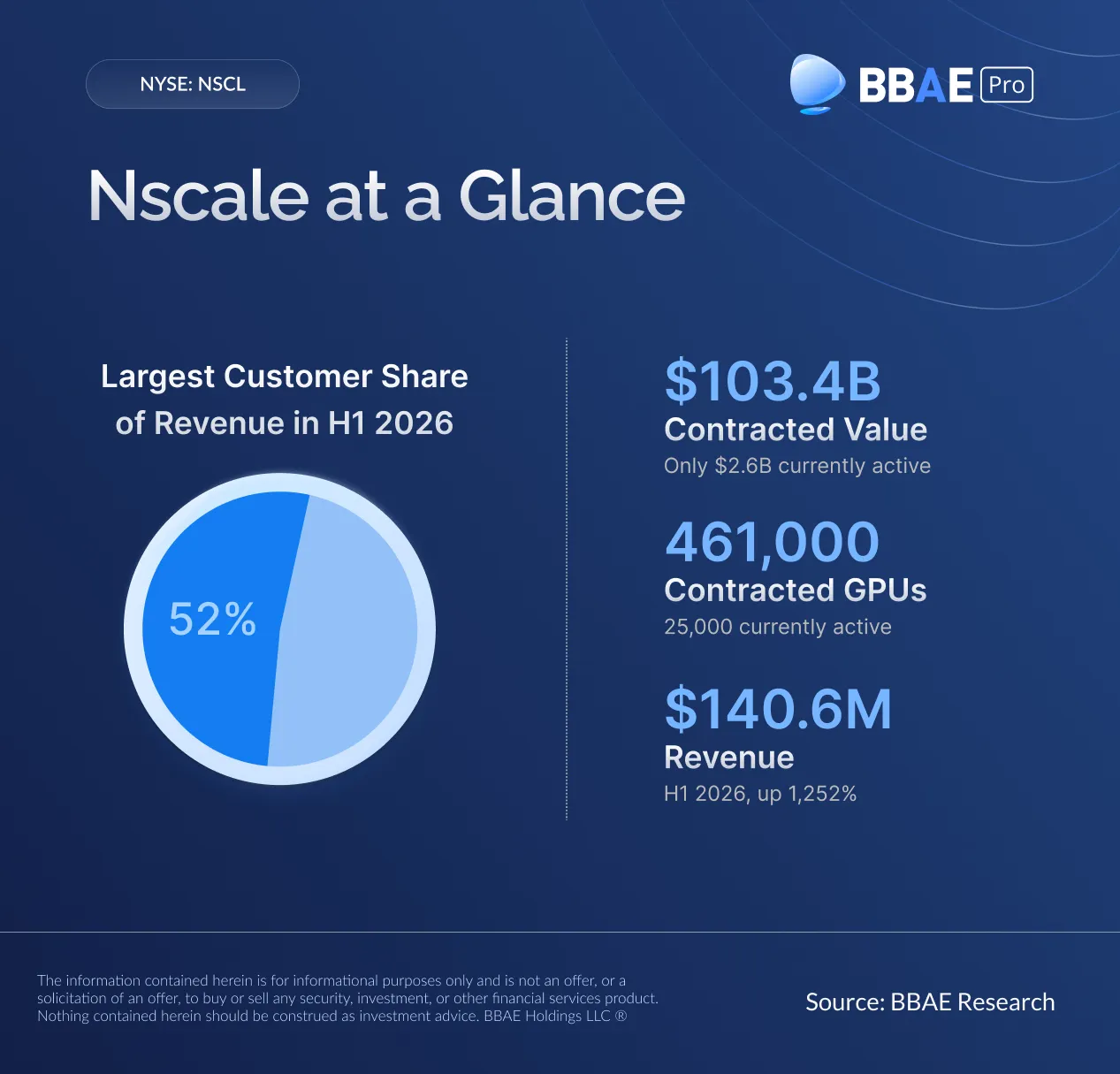
The headline number in the filing is total contract value. As of August 31, 2026, Nscale reported approximately $103.4 billion of active and contracted TCV, up from $38.0 billion at the end of 2025, supporting as many as 461,000 active or contracted GPUs.
That figure needs context. Only about $2.6 billion of that TCV was classified as active at the end of August, roughly 2.5% of the headline. The GPU count tells a similar story: approximately 25,000 GPUs were actually active, against 461,000 active and contracted, or about 5.4%. The rest represents capacity Nscale has sold but has not yet built, financed, or delivered.
Key operating stats (as of August 31, 2026):
- Approximately $103.4 billion of active and contracted TCV, up from $38.0 billion at year-end 2025
- Approximately $2.6 billion of that classified as active
- 461,000 active or contracted GPUs, of which roughly 25,000 were active
- Weighted-average contract life of approximately 5.7 years
- Approximately 1.37 gigawatts of active and contracted power capacity
Power is a central part of the strategy, because electricity is becoming as much of a bottleneck for AI data centers as chip supply. Of that 1.37 GW, 1 GW sits at owned sites, 200 MW at leased sites, and 165 MW at colocation facilities. The company says it has line of sight to roughly 10 GW of potential capacity across sites it owns or controls. The centerpiece is the Monarch Compute Campus in West Virginia, acquired through Nscale’s purchase of American Intelligence & Power Corporation in March 2026, which the company says could eventually support more than 6.5 GW of IT load and over 8 GW of gross power generation. Nscale has since created an Energy & Power division to develop behind-the-meter generation dedicated to its own campuses.
Financial Numbers and Key Metrics
At a glance:
- H1 2026 revenue: $140.6 million, up 1,252% from $10.4 million a year earlier
- Full-year 2025 revenue: $33.0 million, up 73% from $19.1 million in 2024
- H1 2026 net loss: $1.02 billion, versus $368.9 million a year earlier
- H1 2026 Adjusted EBITDA loss: $199.2 million
- Cash: approximately $1.48 billion as of June 30, 2026
Revenue growth is extraordinary, but it is growth from a very small base, and the company is nowhere near profitable. The H1 2026 net loss of $1.02 billion dwarfs the $140.6 million of revenue that produced it. Operating loss was $492.0 million and the Adjusted EBITDA loss, a measure of operating profitability before interest, taxes, depreciation, and certain one-time items, was $199.2 million.
Some of the GAAP loss is non-cash or financing-related. The period included $457.1 million of fair-value adjustment losses, $174.0 million of depreciation and amortization, $113.8 million of stock-based compensation, and $95.1 million of net interest expense. But even stripping those out, the company loses money at the gross level: cost of revenue excluding depreciation and amortization reached $189.6 million, more than the $140.6 million of revenue it generated.
The cash-flow statement looks strange at first glance and deserves a close read. Nscale generated approximately $1.69 billion of cash from operating activities in H1 2026 despite the billion-dollar loss. That is not operating profitability. It comes from upfront customer prepayments tied to the long-term take-or-pay contracts, cash collected before the corresponding services are delivered. Meanwhile the company spent $3.29 billion on investing activities, mostly GPUs and technology equipment, and raised another $1.63 billion through financing. It ended June with approximately $1.48 billion in cash, $17.25 billion in assets, and $12.36 billion in liabilities.
Key Partnerships
Two customers dominate the contracted book. Between September 2025 and April 2026, Nscale signed statements of work with Microsoft that could produce payments of up to approximately $43.8 billion through December 2033, excluding optional extensions, covering GPU infrastructure, colocation, and cloud services with individual terms generally running five to six years. Then on August 25, 2026, Nscale signed agreements with Anthropic potentially worth another $44.6 billion, covering dedicated GPU infrastructure at the Monarch campus built on NVIDIA’s next-generation Vera Rubin NVL72 systems. Together those two relationships account for roughly $88.4 billion of maximum payments.
The concentration is the flip side. Nscale’s largest customer represented 52% of revenue in H1 2026 and 73% in 2025, and a single customer accounted for substantially all revenue in 2024. The company expects Microsoft and Anthropic to remain significant customers going forward.
There is an important disclosure attached to the Anthropic deal. As of the filing date, Nscale said it had not obtained binding financing commitments for the funding required to perform under those agreements, describing the financings as in process across multiple sources. That captures the central tension in the story: demand is not the constraint, capital and construction are.
NVIDIA is involved on the capital side as well. Days before filing, Nscale entered into subscription agreements covering at least $3.1 billion of convertible financing: $2.1 billion of unsecured convertible loan notes plus a $1.0 billion investment from NVIDIA in either convertible notes or non-voting shares depending on timing. The notes are scheduled to convert into equity when the IPO closes, which means the final prospectus will be necessary to understand the fully diluted share count.
Separately, Nscale announced in July that it is acquiring Anyscale, the company founded by the creators of Ray, the open-source framework used to distribute AI workloads across clusters. According to the filing, Ray has reached 740 million cumulative downloads, including roughly 174 million in the second quarter of 2026 alone, and about 200 Anyscale employees are expected to join. Strategically, it is a route toward selling customers software and inference services rather than only the infrastructure underneath them.
A CoreWeave-Like IPO Story
For public-market investors, the closest recent comparison to Nscale may be CoreWeave ($CRWV), which went public in 2025 after scaling rapidly from crypto-mining infrastructure into a major provider of GPU-based AI compute. The similarities are notable: both companies built their growth around NVIDIA GPUs, large hyperscaler and AI customers, long-term infrastructure contracts, heavy capital spending and significant customer concentration. The key difference is that Nscale is coming to market at an earlier stage of deployment. CoreWeave had already reached multi-billion-dollar annual revenue before its IPO, while Nscale generated $140.6 million of revenue in the first half of 2026 and still has only a relatively small portion of its $103.4 billion contracted pipeline operating today. That makes Nscale a similar AI infrastructure story, but one where execution, financing and converting contracted capacity into live revenue are even more central to the investment case.
Conclusion
Nscale is one of the clearest examples of how the AI trade is broadening beyond chip designers into power, real estate, and construction. The company went from $19.1 million of revenue in 2024 to $140.6 million in the first half of 2026 and has accumulated more than $103 billion of active and contracted TCV, with NVIDIA, Microsoft, and Anthropic all attached to the story in one form or another.
But the most instructive number may be the smallest one. Only about $2.6 billion of that backlog is active, and only about 25,000 of 461,000 contracted GPUs are running. Nscale has sold a vision of infrastructure to some of the largest AI buyers in the world, and now has to finance and build it, with a billion-dollar half-year loss, cost of revenue running above revenue, heavy customer concentration, and, by its own disclosure, no binding financing yet in place for the Anthropic contracts. For investors weighing this IPO, the key questions will be the eventual valuation, how quickly contracted TCV converts into active TCV, and whether margins improve as facilities come online.
This article is for informational purposes only and is neither investment advice nor a solicitation to buy or sell securities. All investments involve inherent risks, including the total loss of principal, and past performance is not a guarantee of future results. Investing in initial public offerings (IPOs) carries additional risks, such as volatility, limited operating history, lack of liquidity, and potential overvaluation. IPO stocks may experience significant price fluctuations and may not perform as expected. Always conduct thorough research or consult with a financial expert before making any investment decisions. BBAE has no position in any investment mentioned.