AI Disruption Fears Hit Cybersecurity Stocks


AI Disruption Fears Hit Cybersecurity Stocks
Last week, Anthropic introduced Claude Code Security, a new feature built directly into its Claude Code web platform. Announced on February 20, 2026 as a limited research preview, the tool is designed to scan software code for security vulnerabilities and suggest fixes for human review. It does not replace developers. Instead, it flags potential issues, assigns severity and confidence ratings, and requires human approval before any changes are implemented.
The market reaction was immediate.
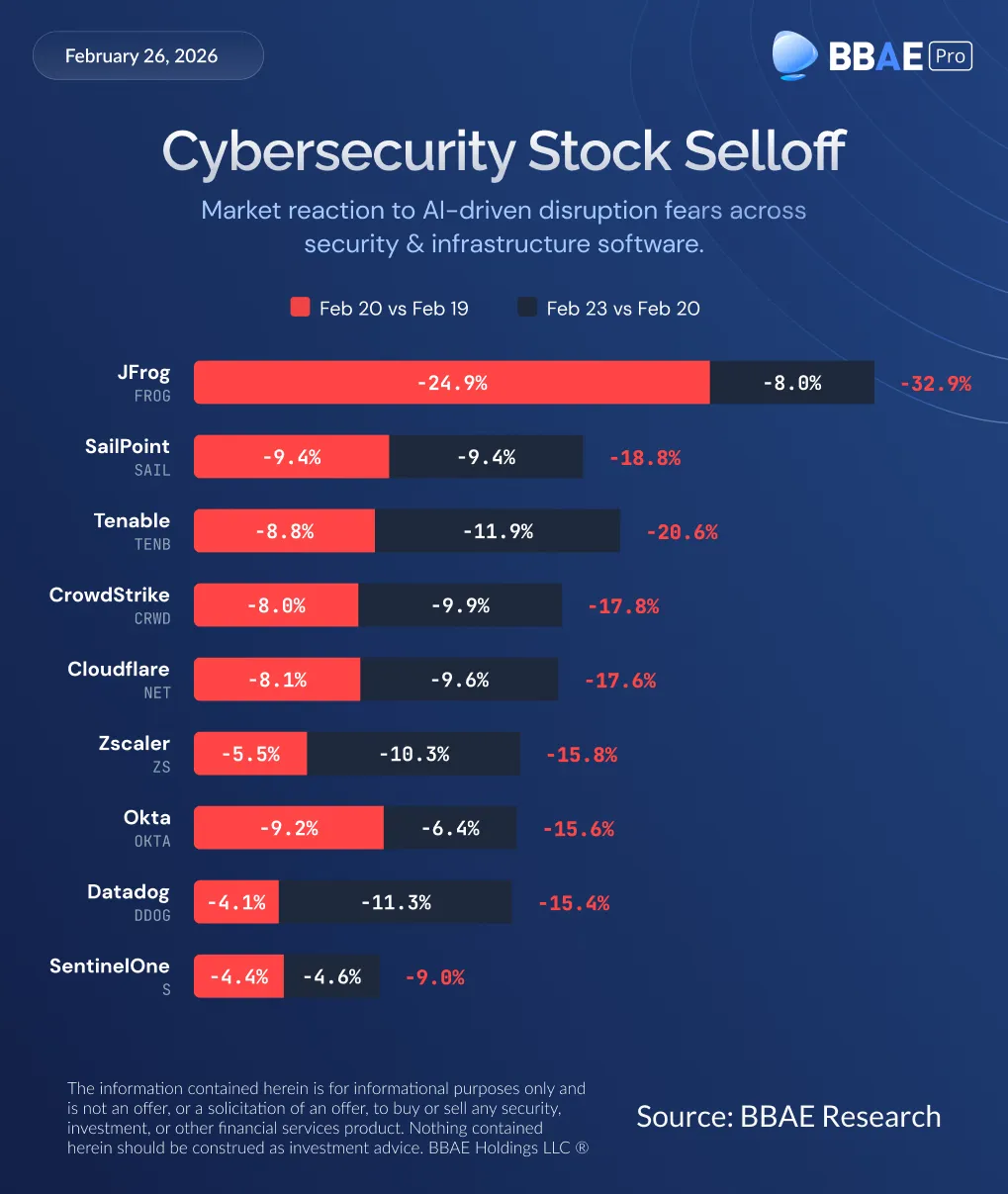
Following the announcement, cybersecurity and security-related software stocks sold off sharply over two U.S. trading sessions, February 20 and February 23. Investors appeared to worry that large AI models are starting to move beyond being productivity tools and into directly competing with established security software products.
This reaction fits a broader pattern that has been visible in recent months. Earlier in February, several software stocks declined amid generative AI concerns, a trend we discussed in our article on software stocks tumbling amid AI fears.
In this article, we will break down which cybersecurity and security-adjacent companies were hit the hardest.
What Claude Code Security Is and Why It Looked Disruptive
Claude Code Security is being introduced as a built-in security feature inside Anthropic’s Claude Code platform.
In simple terms, it scans a company’s software code, looks for potential security weaknesses, and suggests fixes. Those fixes are not automatically applied. Human engineers still have to review and approve everything before any change goes live.
The feature is currently available only in a limited research preview, mainly for Enterprise and Team customers, with faster access offered to open-source maintainers.
According to Anthropic, the system uses large language model reasoning to understand how different parts of a codebase interact. Instead of just matching patterns like traditional security scanners, it attempts to follow data flows across systems and identify vulnerabilities that rule-based tools might miss. The system also re-checks its own findings, assigns severity and confidence scores, and presents everything in a dashboard for human review.
Anthropic connected this launch to broader claims about its models’ cybersecurity performance. The company has previously stated that its team identified and validated more than 500 high-severity vulnerabilities in open-source codebases using Claude Opus 4.6, and that modern AI models can now detect serious vulnerabilities at scale.
So why did the market react?
From a headline perspective, this feature sits directly in areas traditionally served by cybersecurity vendors. It touches application security workflows, such as scanning code, prioritizing vulnerabilities, and suggesting patches. At the same time, it is embedded inside a broader AI coding assistant. If security scanning becomes a built-in feature of AI developer tools, investors may worry that companies could be less willing to pay separately for standalone security products.
That said, the actual product description suggests limits. It is still in a limited preview phase. It focuses on code scanning and patch suggestions. And it requires human approval before any change is made. On a technical reading, this does not immediately replace full cybersecurity platforms. But markets often react first to the potential direction of technology, not just its current state.
Which Cybersecurity Stocks Were Hit the Hardest
JFrog ($FROG) saw the sharpest move, falling more than 30% across the two sessions, including a nearly 25% drop on February 20 alone. Tenable ($TENB) declined over 20% during the same window, while SailPoint ($SAIL) fell close to 19%. These companies are more directly associated with vulnerability discovery and developer security workflows, which likely amplified investor concerns about overlap with AI-powered code scanning.
Larger, well-known cybersecurity platforms also moved lower, though to a lesser degree in percentage terms. CrowdStrike ($CRWD) declined roughly 18% across the two sessions. While not the biggest percentage drop, it was one of the most significant in dollar terms due to its size and premium valuation. Cloudflare ($NET) fell around 18%, Zscaler ($ZS) dropped nearly 16%, and Datadog ($DDOG) declined about 15%.
Identity-focused names such as Okta ($OKTA) also fell more than 15%, while SentinelOne ($S) declined about 9%.
The pattern suggests that investors treated the announcement as a sector-wide risk event. Even companies without direct overlap in code scanning were pulled into the selloff, reflecting broader concerns that foundation AI models are steadily expanding into categories once considered defensible.
AI Narratives and Market Repricing
The cybersecurity selloff comes against a backdrop of several early-2026 episodes in which investors responded quickly to product news from Anthropic as if it were a sign of broader industry disruption. Earlier in February, announcements about Claude’s legal research and collaboration tools helped trigger sharp single-day drops in legal-tech and professional-services stocks, as market participants repriced long-term revenue expectations amid fears that AI could let firms do more with fewer people. At the time, some analysts described these reactions as driven by headlines and sentiment more than immediate changes to fundamentals, noting that established companies continue to benefit from existing client relationships and specialized expertise.
A more dramatic example occurred with IBM, whose stock fell sharply after Anthropic highlighted new capabilities in its Claude Code tool related to modernizing COBOL, a legacy programming language widely used on IBM mainframe systems. On February 23, IBM experienced its largest single-day percentage decline in over 25 years, with shares dropping around 13% in response to concerns that AI-driven code automation could reduce demand for long-standing services tied to system modernization and consulting. The swift move erased a significant amount of market value in hours and served as a clear illustration of how AI-related narratives can amplify volatility across the software and technology space.
Taken together, these episodes highlight a market environment where each incremental “LLM adds a new capability” announcement can act as a catalyst for trading flows, even when the fundamental revenue impact may take quarters or years to play out.
Conclusion
The reaction to Claude Code Security illustrates how quickly public markets can respond to shifts in the AI landscape. Even though the feature is in limited preview and requires human oversight, investors interpreted the announcement as another signal that large language models are expanding into application-layer workflows that have traditionally supported standalone cybersecurity products.
The selloff does not necessarily imply that existing cybersecurity platforms face immediate revenue disruption. Most of the affected companies operate across broader security domains that extend well beyond code scanning and patch suggestions. At the same time, the speed and scale of the declines show that markets are increasingly sensitive to signs that AI tools may reduce the need for incremental software spending or compress margins in high-growth categories.
For investors, the key question going forward is not whether AI will influence cybersecurity, but how quickly and to what extent it changes buying behavior, product bundling, and competitive positioning. Some incumbents may integrate similar capabilities into their own platforms, while others may benefit from complementary demand as AI adoption increases overall software complexity.
In the near term, episodes like this suggest that volatility tied to AI headlines is likely to remain a feature of the market. Longer term, fundamentals such as customer retention, revenue growth, product differentiation, and execution will ultimately determine which companies adapt successfully to an AI-driven shift in software workflows.
This article is for informational purposes only and is not investment advice or a solicitation to buy or sell securities. The content is based on publicly available information and reflects the author’s opinions as of the publication date, which may change without notice. All investments carry inherent risks, including the potential loss of principal, and past performance is not indicative of future results. Readers should conduct their own research or consult a financial advisor before making investment decisions. BBAE holds no position in the securities mentioned, nor are they compensated by the companies mentioned.