Cerebras Systems ($CBRS) IPO: An Investor’s Guide to the AI Chipmaker


Cerebras Systems ($CBRS) IPO: An Investor’s Guide to the AI Chipmaker
Cerebras Systems ($CBRS), an AI infrastructure company building an alternative to GPU-based computing, filed its S-1 with the SEC this month, ahead of a planned Nasdaq listing under the ticker symbol $CBRS. The IPO share count and price range have not yet been announced.
Business Model
Cerebras is not simply a chip company. It sells AI compute across four layers: on-premises AI supercomputers built around its proprietary wafer-scale processor, cloud computing capacity through its own Cerebras Cloud and partner clouds, software subscriptions and support tied to those deployments, and professional services such as model training, inference optimization, and ongoing cluster management.
The company’s flagship product is the Wafer-Scale Engine (WSE), a processor that is physically much larger than a conventional chip. According to the company, the WSE-3 contains 900,000 compute cores and delivers significantly more on-chip memory and memory bandwidth than competing GPU-based systems — key advantages for fast AI inference, the process of running AI models to generate outputs in real time.
On-premises customers buy systems outright through standard purchase orders, with each sale including a separate renewable software subscription. Cloud customers can either reserve capacity in advance through take-or-pay contracts or use the service on demand, paying per token or per computing period. The combination is designed to create more predictable, recurring revenue over time.
Financial Numbers and Key Metrics
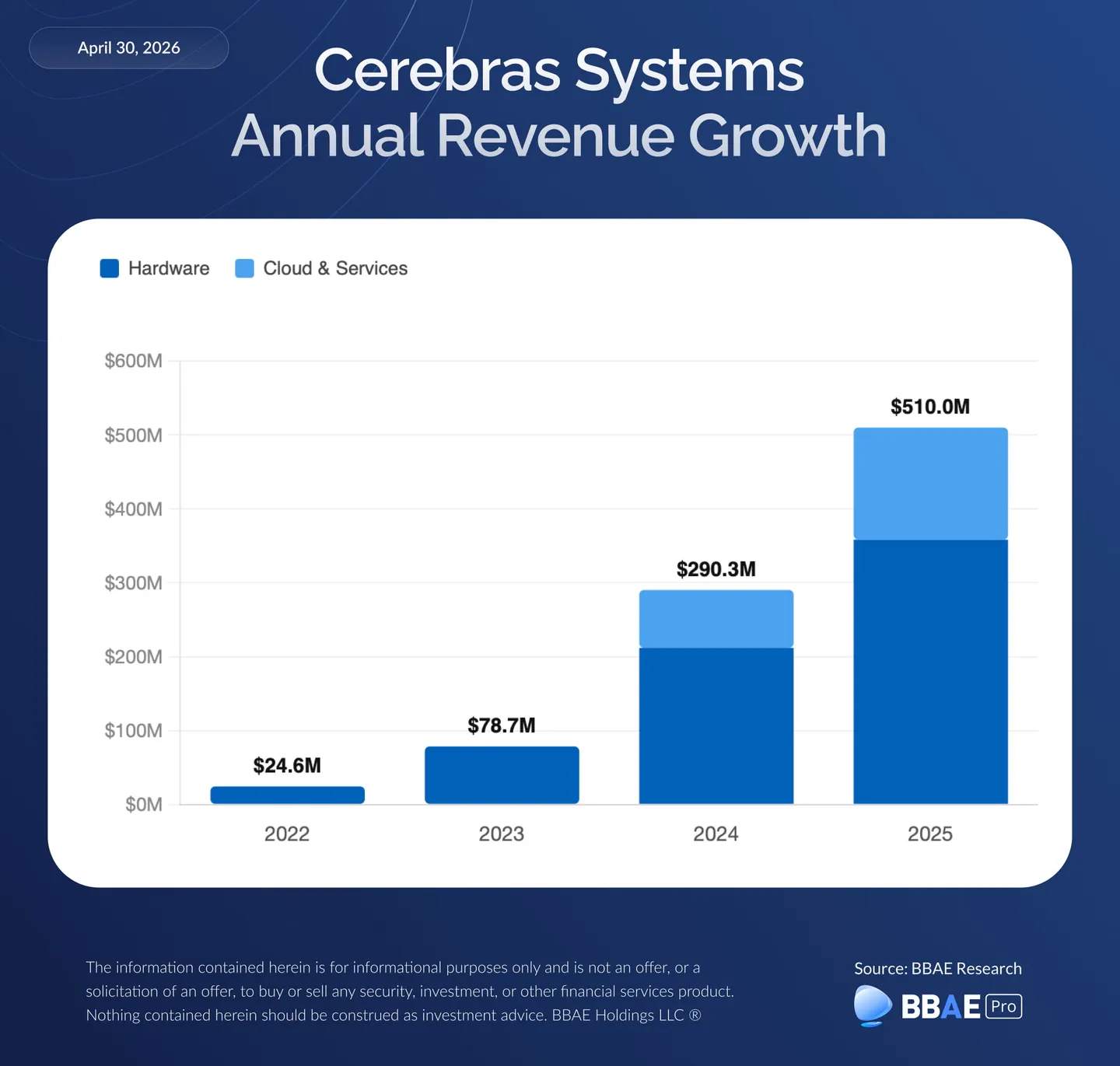
Cerebras has grown quickly. Revenue rose from $78.7 million in 2023 to $290.3 million in 2024 and $510.0 million in 2025, a 76% increase year over year. Hardware accounted for $358.4 million of 2025 revenue, while cloud and other services contributed $151.6 million, or roughly 30% of the total.
Gross margin was 39.0% in 2025, down from 42.3% in 2024, as the company ramped up cloud infrastructure spending. The operating loss widened to $145.9 million, and on a non-GAAP basis the company reported a net loss of $75.7 million. The 2025 GAAP net income figure of $237.8 million is not a clean profitability signal — it was driven largely by a $363.3 million one-time gain on the extinguishment of a financial contract, which inflated reported earnings.
Capital spending jumped sharply, from $23.4 million in 2024 to $382.7 million in 2025, as the company built out cloud inference capacity. As of year-end 2025, Cerebras held $930.4 million in cash and restricted cash plus $406.5 million in marketable securities and carried no debt. In January 2026, the company raised an additional $2.0 billion through a Series H preferred financing round and a working capital loan from OpenAI.
Customer concentration is the biggest near-term financial risk. In 2025, two Abu Dhabi-linked customers — Mohamed bin Zayed University of Artificial Intelligence (MBZUAI) and G42 — accounted for approximately 62% and 24% of revenue respectively, meaning 86% of total revenue came from just two buyers.
Key Partnerships
The most significant commercial relationship in the filing is with OpenAI. In December 2025, the two companies signed a Master Relationship Agreement under which OpenAI committed to purchase 750 megawatts of inference capacity from Cerebras, with an option to acquire an additional 1.25 gigawatts by the end of 2030. OpenAI also provided the roughly $1.0 billion working capital loan and received a warrant to purchase up to 33.4 million non-voting shares, vesting against commercial and market-capitalization milestones. OpenAI is simultaneously a customer, a lender, and a potential shareholder.
In March 2026, Cerebras signed a binding term sheet with Amazon Web Services (AWS), making AWS the first major cloud provider to deploy Cerebras systems in its own data centers. The deal includes agreed pricing, exclusivity provisions, minimum capacity commitments, and an initial multi-year lease. AWS also received a warrant for up to 2.7 million shares.
Existing strategic customers include G42 and MBZUAI, which are sovereign AI buyers linked to the United Arab Emirates. Beyond these relationships, Cerebras distributes through developer marketplaces and self-serve APIs, though the revenue base remains heavily anchored by a small number of large accounts.
IPO Structure and Governance
Cerebras plans to list on Nasdaq under the ticker $CBRS. The share count and price range were not set at the time of the S-1 filing. After the IPO, the company will have three classes of common stock: Class A shares with one vote each, Class B shares with 20 votes each, and non-voting Class N shares. This structure concentrates voting control with pre-IPO insiders and significantly limits the influence of new public shareholders.
Dilution risk is meaningful. As of year-end 2025, the company had 28.4 million options outstanding at a weighted-average exercise price of approximately $5 per share. The OpenAI warrant alone covers up to 33.4 million shares at a near-zero exercise price. In early 2026, the board also granted performance-based stock awards to two co-founders totaling 9.0 million shares tied to market-capitalization milestones.
Conclusion
Cerebras is entering the public markets at a time when demand for fast, efficient AI inference is accelerating. The company has a distinctive technology architecture, strong revenue growth, and validated strategic relationships with OpenAI and AWS. At the same time, customer concentration is unusually high, the core business is still operating at a loss, capital spending is rising quickly, and dilution from warrants and equity awards is substantial. For investors considering the IPO, the key questions will be the eventual valuation, how quickly the OpenAI and AWS relationships broaden the revenue base, and whether cloud margins recover as infrastructure buildout matures.
This article is for informational purposes only and is neither investment advice nor a solicitation to buy or sell securities. All investments involve inherent risks, including the total loss of principal, and past performance is not a guarantee of future results. Investing in initial public offerings (IPOs) carries additional risks, such as volatility, limited operating history, lack of liquidity, and potential overvaluation. Always conduct thorough research or consult with a financial expert before making any investment decisions. BBAE has no position in any investment mentioned.