
Holtec Nuclear ($HNUC) IPO: Everything You Need to Know

Holtec Nuclear ($HNUC) IPO: Everything You Need to Know
Holtec Nuclear Corporation ($HNUC), the company behind the restart of the Palisades nuclear plant and the SMR-300 small modular reactor program, filed its S-1 with the SEC on July 10, 2026, ahead of a planned listing on The Nasdaq Stock Market and Nasdaq Texas under the ticker symbol $HNUC. Nuclear and SMR stocks have been treated as one of the biggest beneficiaries of AI-driven electricity demand over the past couple of years, and that enthusiasm has made the group notably volatile, with sharp swings common across the sector on both good and bad news. The IPO share count and price range have not yet been announced. In this article, we’ll review the company’s business model, its Palisades restart and SMR strategy, financial performance, balance sheet, and the structure and governance of the offering.
Business Model
Holtec is not a single-product company. It operates through two segments: the Nuclear Power Division (NPD), a mature, decades-old franchise, and Palisades, the restart and future SMR platform in Michigan.
NPD is the broader of the two. It designs, engineers, manufactures, and services spent-fuel storage racks, dry-cask and transport systems, and other nuclear equipment, and it provides site services, decommissioning work, and engineering consulting. Revenue here comes from a mix of sources:
- Equipment sales (dry casks, wet-fuel storage, heat-exchange systems) under long-term, mostly fixed-price contracts
- Site services, such as removing, transporting, and storing spent fuel, often under multi-year or multi-decade customer relationships
- Decommissioning work at shutdown nuclear sites, some of which is tied to reimbursement claims against the Department of Energy for its failure to accept commercial spent fuel under a decades-old federal contract
- Engineering and consulting services
Palisades is the newer, capital-intensive half of the story. Holtec acquired the shuttered 800-megawatt plant in 2022 and expects it to begin generating electricity again in 2026, ahead of a March 2027 commitment deadline. All of the plant’s output is already contracted under fixed-price power purchase agreements (PPAs) with Wolverine Power Supply Cooperative and Hoosier Energy. One detail worth flagging: Holtec’s summary describes those PPAs as having an initial 28-year term, while a note elsewhere in the filing ties the term to the plant’s operating license, which the company intends to extend to at least 2051. Either way, Palisades’ long-term economics depend not just on the restart itself but on relicensing.
Palisades doubles as the launch site for the SMR-300, Holtec’s small modular reactor design. Holtec plans to build a dual-unit SMR-300 project there, with first commercial operation targeted for the early 2030s. SMR revenue today is effectively zero. The company expects future revenue from plant sales, licensing and construction milestones, and eventually electricity and capacity payments, but none of that has materialized yet.
Together, the two segments carry a large contracted backlog: roughly $10.8 billion for NPD and $10.4 billion for Palisades as of March 31, 2026. That backlog is real, but much of it is long-dated and shouldn’t be mistaken for near-term revenue.
Financial Numbers and Key Metrics
At a glance (full-year figures in USD millions unless noted):
- 2025 revenue: $576.6 million, down 24.7% from $765.5 million in 2024
- 2025 net income: $386.6 million; 2025 EBITDA: $497.8 million
- 2025 operating cash flow: negative $248.5 million; 2025 capex: $983.6 million
- Pro forma 2025 revenue: $893.4 million; pro forma net income: $200.3 million; pro forma EBITDA: $246.3 million
- Nuclear decommissioning trust funds: $2.8 billion (restricted, not spendable corporate cash)
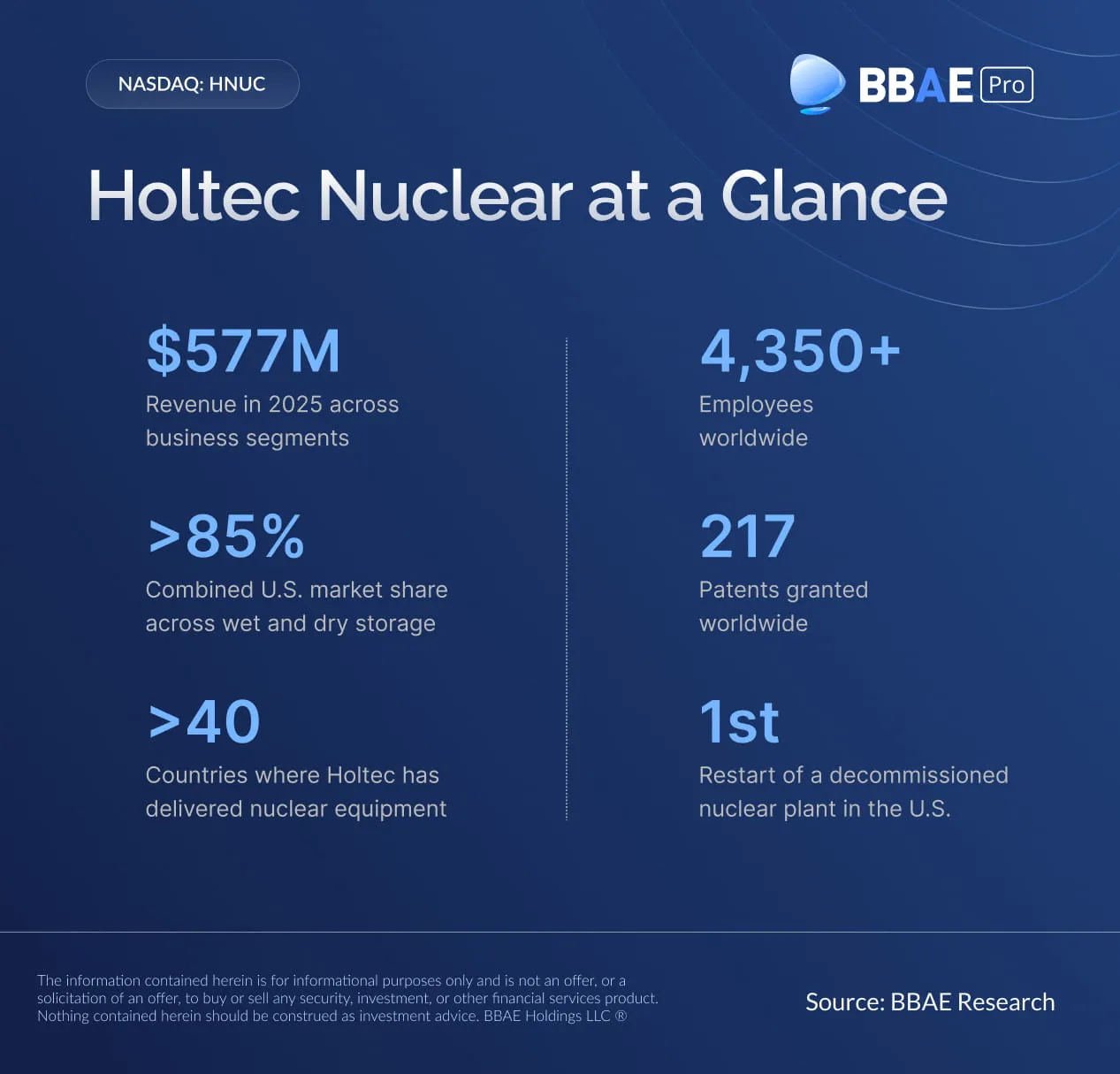
The headline numbers look unusually strong for an industrial company, and that’s the first thing to question. Holtec’s reported 2025 EBITDA margin was 86.3%, but that’s not because the underlying business is that profitable. It’s because Holtec’s non-GAAP EBITDA doesn’t strip out large, volatile gains tied to its nuclear decommissioning trust investments and asset-retirement accounting. In 2025 those items added roughly $407 million combined ($58.2 million in ARO settlement gains, $118.5 million in realized investment gains, and $230.0 million in unrealized gains), most of the company’s reported net income, none of it cash from selling equipment, services, or electricity.
The cash-flow picture is more sobering than the income statement suggests. Operating cash flow was negative $248.5 million in 2025 and negative $150.2 million in 2024, as capex rose 80% year over year to $983.6 million, mostly tied to the Palisades restart. Free cash flow was negative $1.23 billion in 2025.
That gap is why Holtec’s pro forma figures, reflecting a planned restructuring and UP-C reorganization, matter more than the raw historical numbers. On a pro forma basis, 2025 revenue rises to $893.4 million, but EBITDA falls to $246.3 million (a 27.6% margin) and net income to $200.3 million, a more conventional industrial profile. Pro forma operating cash flow turns positive too, at $158.2 million in 2025 and $172.8 million in the first quarter of 2026. Management says the restructuring should make the business more service-oriented and less exposed to trust-fund and ARO swings. For sizing up this IPO once pricing appears, those pro forma figures, not the flashier historical ones, are the numbers to use.
Balance Sheet and Cash Burn
Holtec’s balance sheet reflects a company mid-transition from unlevered to leveraged. It had no debt at the end of 2024 but carried $958.6 million in total debt by March 31, 2026. Cash and equivalents fell from $106.3 million at the end of 2024 to just $10.0 million at the end of the first quarter of 2026, and working capital turned negative, with a current ratio of 0.76x. Separately, the company holds $2.8 billion in nuclear decommissioning trust funds and roughly $1.71 billion in asset retirement obligations. Both are large balance-sheet items, but restricted or obligated rather than available for growth spending or debt service. The bottom line: Holtec’s near-term liquidity is thin relative to the scale of ongoing Palisades and SMR-300 capital spending, which puts real weight on execution and, eventually, on how much cash the IPO itself brings in.
IPO Structure, Use of Proceeds, and Governance
Holtec plans to list on Nasdaq and Nasdaq Texas under $HNUC, led by J.P. Morgan, Guggenheim Securities, Goldman Sachs, Citigroup, and BofA Securities. Share count, price range, and net proceeds are not yet disclosed.
Part of the raise will fund a cash distribution to pre-IPO holders rather than pure growth capital, and the company will pay 85% of certain future tax savings to those holders under a tax receivable agreement.
Control stays with the founders. Holtec Holdings will hold 100% of Class B shares, worth 10 votes each, and Dr. Krishna Singh and Martha Singh keep the sole right to elect their own board seats. Standard one-share-one-vote protections won’t apply.
Growth Story and Market Opportunity
Holtec operates in markets with real tailwinds. The DOE reports more than 95,000 metric tons of spent fuel stored across 79 U.S. sites, and the IAEA projects global nuclear capacity growing from 377 GW today to somewhere between 561 GW and 992 GW by 2050. Holtec’s own SMR pipeline totals roughly 47 GW.
Rising AI and data center electricity demand is part of that growth story too, and one reason cited for the Palisades restart, though it isn’t a standalone revenue line yet.
Competition is credible across the board: Orano and NAC International in dry storage, GE Vernova, Rolls-Royce SMR, NuScale, TerraPower, Oklo, Kairos, and Westinghouse in SMRs, and BWXT and KHNP in manufacturing. Holtec’s edge is its turnkey, in-house manufacturing footprint.
Conclusion
Holtec brings a real industrial core, a large backlog, and strong government backing, which gives this IPO a firmer foundation than many nuclear and SMR listings. At the same time, the profitability picture is still shaped by gains that won’t repeat, cash flow remains negative, and capital spending is heavy, so there’s real execution risk ahead.
As with most first-time filers, the fuller picture will come into focus once Holtec discloses its share count, price range, and underwriting terms. Until then, this is a story worth watching rather than a fully priced opportunity, and investors should weigh the long-term nuclear and SMR growth narrative against the near-term financial and governance risks before deciding whether it fits their portfolio.
Holtec is also going public at a moment when nuclear and energy stocks are trading with a lot of hype, Oklo being a prime example of a name that’s rallied well ahead of any meaningful revenue. That kind of enthusiasm can fade quickly once real numbers are on the table, and the market will ultimately decide whether $HNUC deserves that same premium or trades more like the industrial business its financials actually show.
This article is for informational purposes only and is neither investment advice nor a solicitation to buy or sell securities. All investments involve inherent risks, including the total loss of principal, and past performance is not a guarantee of future results. Investing in initial public offerings (IPOs) carries additional risks, such as volatility, limited operating history, lack of liquidity, and potential overvaluation. IPO stocks may experience significant price fluctuations and may not perform as expected. Always conduct thorough research or consult with a financial expert before making any investment decisions. BBAE has no position in any investment mentioned.