Oura ($OURA) IPO: An Investor’s Guide to the Smart Ring Maker


Oura ($OURA) IPO: An Investor’s Guide to the Smart Ring Maker
Oura ($OURA), the health-tracking company behind the Oura Ring, filed its S-1 with the SEC on September 3, 2026, ahead of a planned Nasdaq Global Select Market listing under the ticker symbol $OURA. The IPO share count and price range have not yet been announced. In this article, we will review the company’s business model, how the subscription layer works, its financial performance, the large share buybacks it completed shortly before filing, and the structure of the offering.
Business Model
Oura sells a titanium smart ring that tracks sleep, activity, readiness, stress, cardiovascular health, metabolic health, and women’s health metrics. The device is the visible product, but the business is built on two revenue lines that work together: hardware and a recurring membership subscription.
The company describes the model as a funnel. The ring acquires the customer and is priced to recover customer-acquisition costs at the point of sale. The membership, which costs $5.99 per month or $69.99 per year in the U.S., then generates high-margin recurring revenue for as long as the customer stays. New buyers get a 30-day trial, and according to the filing, more than 94% of ring activations have historically converted into paid memberships. About 63% of new members chose the annual plan during the first nine months of fiscal 2026.
Key operating stats (as of June 30, 2026):
- Approximately 5.0 million Paid Members
- 3.6 million rings sold in the trailing 12 months
- Roughly 85% weighted-average 12-month member retention
- Members wore the ring a median of about 23 hours per day in fiscal Q3 2026
- Approximately 72% of members are women
- Nearly 42 billion hours of accumulated biometric data
- 1,140 patents and patent applications
Distribution has shifted meaningfully. Direct-to-consumer sales fell from about 73% of revenue in fiscal 2024 to roughly 60% in the first nine months of fiscal 2026, with wholesale, which includes retail partners such as Amazon, Best Buy, and Target plus enterprise customers including the U.S. Department of Defense, taking up the difference. That broadens reach but hands more pricing leverage to large retailers. Roughly 80% of revenue still comes from the United States, which the company frames as an international growth opportunity.
Where AI and the Subscription Fit In
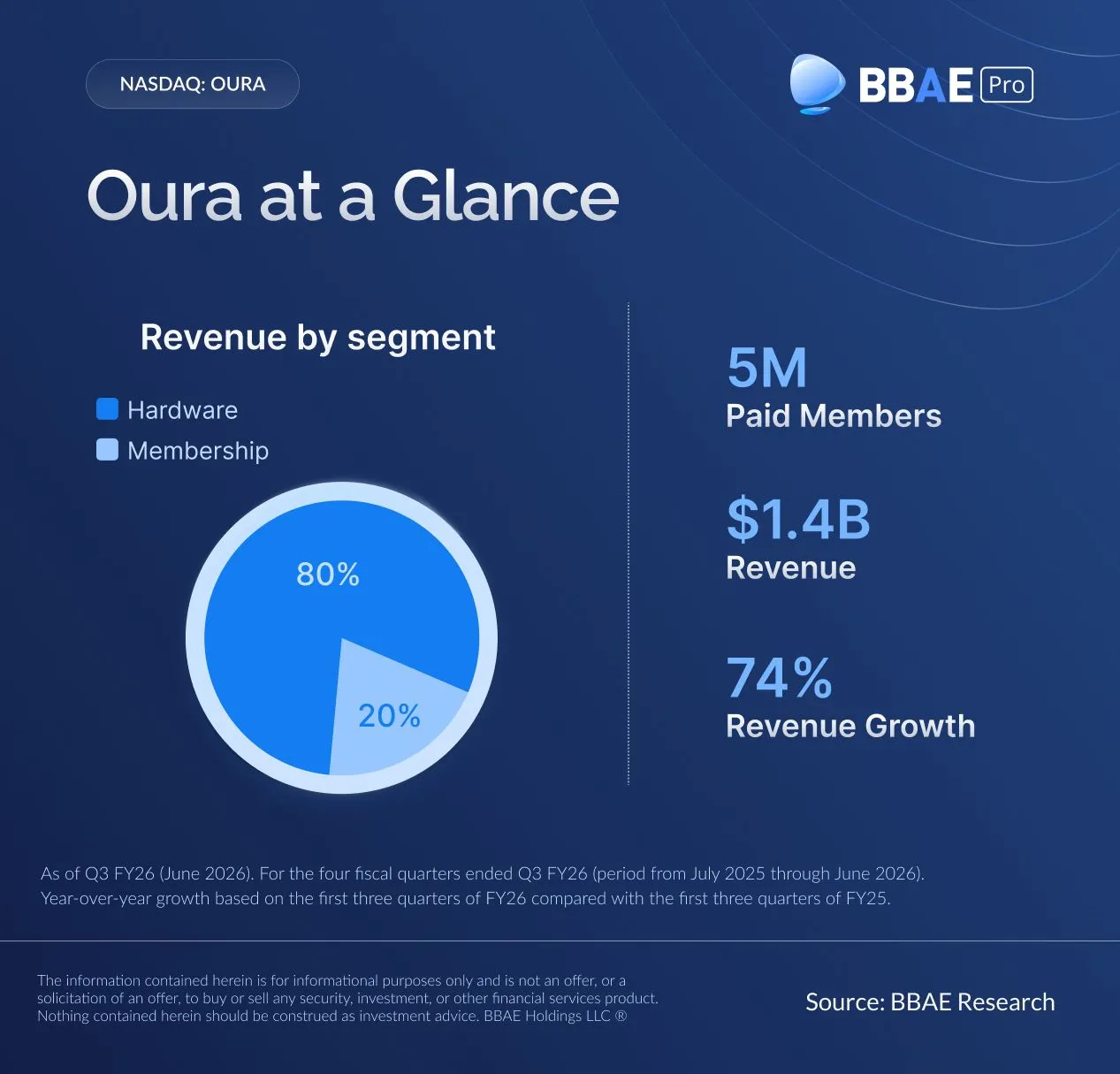
The subscription is where the economics get interesting. Membership revenue carried an 89% gross margin in the first nine months of fiscal 2026, versus a consolidated gross margin of about 55%. Working backward from the company’s reported figures, that implies a hardware gross margin closer to the mid-40s. Membership grew 121% year over year, well ahead of hardware’s 65%, and now accounts for just under 20% of total revenue.
AI is what the subscription is meant to pay for. Oura describes three model layers: proprietary health foundation models trained on its longitudinal biometric data rather than primarily on text, domain-specific models for areas like cardiovascular and women’s health, and health-focused language models that power features such as Oura Advisor, a conversational tool that lets members ask questions about their own data. The company states it does not plan to sell or license members’ personal health data, so the value of that dataset is indirect: better personalization, stickier membership, and more useful features.
The company has also chosen to partner rather than build everything itself. The filing cites more than 1,200 integrations, including Dexcom for glucose sensing, Quest for blood panels, Natural Cycles for women’s health, Resmed for sleep care, and Counsel Health for clinical navigation. Eli Lilly is notable on both sides of the ledger: LillyDirect is a connected-care partner, and Lilly funded a $50 million SAFE in July 2026 that converts into common stock immediately before the IPO.
Financial Numbers and Key Metrics
At a glance:
- Nine-month fiscal 2026 revenue: $1.215 billion, up 74% year over year
- Full-year fiscal 2025 revenue: $907.9 million, up 123% from $406.8 million
- Nine-month operating income: $71.2 million, up 18%
- Nine-month Adjusted EBITDA: $106.7 million, up 28%
- Nine-month operating cash flow: $328.0 million
- Cash: $371.8 million against $380.1 million of debt as of June 30, 2026
Oura is one of the rare consumer-hardware IPO candidates that arrives profitable. Net income was $60.8 million for the nine months ended June 30, 2026, on revenue of $1.215 billion, and operating cash flow was $328.0 million. Adjusted EBITDA, a measure of operating profitability before interest, taxes, depreciation, and certain one-time items, reached $106.7 million.
Two things complicate that picture. First, the headline loss. The filing shows a $924.3 million net loss attributable to common stockholders for the nine-month period, which is not an operating figure — it reflects deemed dividends to preferred holders created by the company’s pre-IPO share repurchases. Second, operating leverage has not shown up yet. Revenue grew 74% while operating income grew only 18%, because R&D more than doubled to $206.8 million and sales and marketing reached $257.9 million. Management is reinvesting rather than harvesting margin.
Margins have also proven vulnerable to hardware problems. Gross margin fell from about 65% in fiscal 2024 to 52% in fiscal 2025 after battery-performance issues on certain Ring 4 units pushed warranty expense up by $84.4 million. It recovered to roughly 55% in the first nine months of fiscal 2026, but the accrued warranty reserve still stood at $132.3 million at June 30, up from $98.3 million nine months earlier. Ring 5, which launched June 4, 2026, at $399 to $499, is the test of whether that is behind the company.
One metric worth watching is average revenue per ring, which has slipped from $332 in fiscal 2024 to $326 in fiscal 2025 and $311 in the first nine months of fiscal 2026 — a roughly 6% decline while volumes surged. Volume and subscription growth more than offset it today, but cheaper smart rings that carry no subscription fee are a live competitive threat.
The Pre-IPO Buybacks
This is the part of the filing that deserves the closest reading. During the first nine months of fiscal 2026, Oura spent approximately $1.17 billion repurchasing common and preferred stock, including a February tender offer in which 13.3 million preferred shares were bought back for $534.2 million. To help fund that, the company drew $375 million on its revolving credit facility — borrowings management says went primarily toward those repurchases and general corporate purposes. It repaid $25 million in August, leaving $350 million outstanding.
That sequence matters because Oura raised roughly $908 million in a Series E round in September 2025 and then, within months, used cash and new debt to provide liquidity to existing shareholders. Buybacks are not inherently bad, and these were disclosed and approved. But new public investors will want to compare what insiders were paid for those private shares against what the IPO eventually asks the public to pay.
IPO Structure and Governance
Oura plans to list on Nasdaq under $OURA, with Goldman Sachs acting as representative of an unusually large underwriting syndicate that includes Morgan Stanley, J.P. Morgan, Allen & Company, Jefferies, BofA Securities, and Barclays, among others.
Almost every economic term is still blank. The price range, the number of primary and secondary shares, total offering size, post-offering share count, underwriting fees, lock-up duration, and the beneficial-ownership percentages for its 5% holders — entities affiliated with FMR LLC, Forerunner Ventures, Bedford Ridge, and Lifeline Ventures — are all left to a later amendment. That means no market capitalization, no enterprise value, and no valuation multiple can be calculated from this document. The one anchor the S-1 does provide is private: Series E priced at $53.57 per share, which the company says implied an enterprise value of $9.656 billion as of June 27, 2026.
Investors should also track the litigation. Samsung filed an ITC complaint in December 2025 alleging infringement of four patents and seeking remedies that could include import restrictions on certain Oura products, which would be operationally more serious than a damages award. Omni MedSci is separately seeking roughly $120 million in the Eastern District of Texas, and former CEO Harpreet Singh Rai has sued over a 2024 equity repurchase. Oura says all of these claims lack merit. As an emerging growth company, Oura presents only two audited fiscal years, so the track record on offer is short.
Conclusion
Oura is arriving with a stronger fundamental profile than the typical consumer-device IPO: 74% revenue growth, a subscription line growing at 121% with an 89% gross margin, five million paid members, a conversion rate above 94%, positive operating income, and $328 million of nine-month operating cash flow. The strategic question is whether the data flywheel is genuinely defensible, or whether Apple, Google, Samsung, Garmin, and Whoop can compete for the same consumer health budget through other form factors.
The counterweights are equally concrete. About 80% of revenue is still hardware, gross margin has already shown how fast a bad product cycle can hurt, revenue per ring is declining, two customers account for 22% of revenue, and more than $1.17 billion left the business to buy back private shares just before filing. For investors weighing this IPO, the business is analyzable but the stock is not yet priceable. The key questions will be the eventual valuation relative to the still hardware-heavy revenue mix, whether membership keeps climbing above 20% of the total, and whether Ring 5 avoids the warranty problems that hit its predecessor.
This article is for informational purposes only and is neither investment advice nor a solicitation to buy or sell securities. All investments involve inherent risks, including the total loss of principal, and past performance is not a guarantee of future results. Investing in initial public offerings (IPOs) carries additional risks, such as volatility, limited operating history, lack of liquidity, and potential overvaluation. IPO stocks may experience significant price fluctuations and may not perform as expected. Always conduct thorough research or consult with a financial expert before making any investment decisions. BBAE has no position in any investment mentioned.