Quantum Computing Stocks: Where the Sector Stands in 2026


Quantum Computing Stocks: Where the Sector Stands in 2026
The quantum computing sector has seen a lot of highs and lows over the past few years. It is still a young part of the public market. IonQ was the first pure-play quantum stock to go public, back in 2021 through a SPAC merger, and most of the others followed later. After an initial quiet stretch, quantum stocks staged a big rally in 2024 that pulled them into the spotlight of many traders. That rally was followed by heavy volatility, including a sharp crash in early 2025 and an uneven recovery. The sector started 2026 lower as well, but then posted three strong sessions that recovered most of the year’s losses.
What is different this time is what is driving the move. The 2024 run was fueled by qubit-count headlines and “quantum supremacy” claims. The 2026 rally is more about the software and plumbing around quantum machines. Investors are now focused on things like calibration (keeping qubits working properly), error correction (fixing the mistakes that quantum computers naturally make), the fiber-optic style links between quantum systems, and the hybrid setups where quantum and regular computers work together.
The catalyst that reignited the trade was NVIDIA’s April 14, 2026 launch of Ising, an open AI model family built specifically for quantum calibration and error correction. This is the same company whose CEO, Jensen Huang, punctured the sector in January 2025 by suggesting practical quantum computing was decades away. Eighteen months later, NVIDIA is positioning itself as a core enabler of the quantum stack.
Key Developments in 2026
NVIDIA’s Ising Model Family
NVIDIA’s Ising launch is the most important sentiment catalyst the sector has seen since Google’s Willow chip. Based on NVIDIA’s announcement and accompanying technical blog, Ising’s key achievements include:
- Ising Calibration cuts continuous calibration time from days to hours
- Ising Decoding is up to 2.5 times faster and 3 times more accurate than pyMatching, the leading open-source tool used as a baseline
- At one more challenging benchmark, Ising delivers a 3x improvement in the rate of logical errors
- Already in use by IonQ, Infleqtion, IQM, the U.K. National Physical Laboratory, and Lawrence Berkeley National Laboratory’s Advanced Quantum Testbed
Ising extends NVIDIA’s broader quantum strategy, which includes the Accelerated Quantum Research Center announced in March 2025 and its CUDA-Q and NVQLink infrastructure. The practical takeaway: AI is now being positioned as the “control plane” for quantum machines, making today’s systems more useful even before fully reliable, error-proof quantum computing arrives.
IonQ’s Platform Expansion
IonQ has emerged as the clearest scaled platform story in the public quantum market. Key 2025 and 2026 developments include:
- 2025 revenue of $130.0 million, with more than 60% from commercial customers
- $3.3 billion in cash, cash equivalents, and investments at year-end 2025
- 2026 revenue guidance of $225 million to $245 million
- Pending acquisition of SkyWater Technology, which would give IonQ access to a trusted U.S. chip foundry
- Selection for DARPA’s HARQ program on April 14, 2026
- First demonstration of two commercial trapped-ion quantum computers linked together using light-based connections
D-Wave’s Dual-Platform Pivot
D-Wave reshaped its investment thesis in 2026 with the $550 million acquisition of Quantum Circuits. The deal added gate-model technology with built-in error correction to D-Wave’s existing annealing business, making D-Wave the first and only company offering both main approaches to quantum computing in one platform. Core financial and operational milestones include:
- 2025 revenue of $24.6 million
- $884.5 million in cash and marketable securities at year-end
- Fourth-quarter 2025 bookings of $13.4 million, with an additional $32.8 million of 2026 bookings by February 25
- A $20 million system purchase by Florida Atlantic University and a $10 million two-year enterprise Quantum Computing as a Service deal with a Fortune 100 customer
- Advantage2 annealing system usage up 314% year over year; Stride hybrid solver usage up 114% in six months
Rigetti’s 108-Qubit Modular System
Rigetti is much earlier commercially but delivered one of 2026’s clearest hardware proofs. The company launched its 108-qubit Cepheus-1-108Q system, available through its own cloud and Amazon Braket. Rigetti calls it the industry’s largest modular quantum system. Key metrics include:
- 99.1% median two-qubit gate fidelity at launch, with a target of 99.5% later in 2026
- Gate speeds of roughly 60 nanoseconds
- 2025 revenue of $7.1 million
- $589.8 million in cash, cash equivalents, and available-for-sale investments at year-end
Two New Public Quantum Companies in 2026
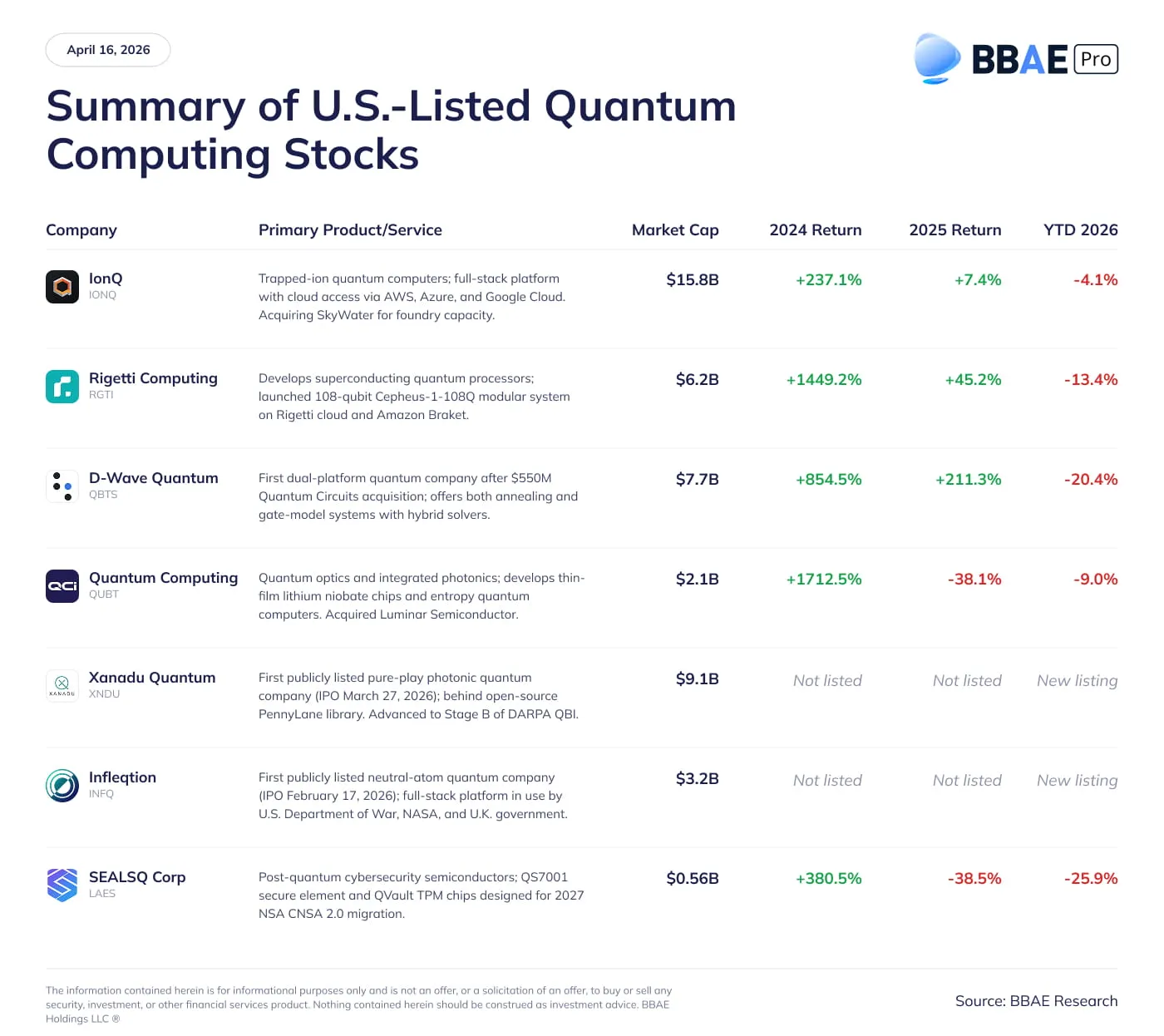
The investable universe in quantum computing got meaningfully bigger in 2026 with two notable IPOs. Infleqtion ($INFQ) became the first publicly listed neutral-atom quantum company on February 17, 2026, raising more than $550 million through its SPAC merger with Churchill Capital X. The company is already working with the U.S. Department of War, NASA, and the U.K. government, and has an active collaboration with NVIDIA.
Xanadu Quantum Technologies ($XNDU) followed on March 27, 2026, becoming the first publicly listed pure-play photonic quantum company through its merger with Crane Harbor Acquisition Corp. Xanadu raised roughly $302 million in gross proceeds and is negotiating for up to C$390 million in additional funding from the Canadian federal and Ontario governments. The company is behind the open-source PennyLane software library and was advanced to Stage B of DARPA’s Quantum Benchmarking Initiative. Xanadu has been trading with elevated volatility since its debut, which is typical for a freshly listed name that is still finding its market price, and investors should expect wider price swings than the more established names in the group.
Looking Forward
The 2026 quantum story is maturing. The sector’s center of gravity has shifted away from raw hardware headlines and toward the full stack required to make quantum systems commercially useful. That includes AI-based calibration, error correction, fiber-optic style networking between machines, combined quantum and high-performance computing setups, trusted foundry access, and early enterprise contracts. DARPA’s Quantum Benchmarking Initiative frames the timeline clearly. It aims to determine whether an industrially useful quantum computer can be built by 2033. DARPA’s HARQ program is built around mixing different qubit types precisely because no single approach yet scales well enough on its own.
That longer timeline is why NVIDIA’s role matters. By shipping software that improves the usefulness of existing quantum machines, NVIDIA is extending the commercial runway for specialist names that need to survive long enough to reach full reliability. Expect more activity in the layers between qubits and real-world workloads: software tooling, networking, foundry partnerships, and government-backed programs.
2026 Valuation Reality Check
Despite the renewed momentum, public-market valuations remain extraordinary relative to current fundamentals. As of April 16, 2026:
- IonQ’s market capitalization was approximately $15.8 billion, roughly 120x 2025 revenue
- D-Wave was valued at approximately $7.7 billion, roughly 310x 2025 revenue
- Rigetti was valued at approximately $6.2 billion, more than 870x 2025 revenue
These are not standard software multiples or even aggressive semiconductor multiples. They reflect a market pricing in long-term potential rather than current earnings power.
The quantum sector continues to represent both meaningful long-term opportunity and substantial near-term risk. The more durable winners from here are unlikely to be decided by one-day stock moves. They will be the companies that convert 2026’s momentum into customer adoption, credible roadmaps, and revenue growth that starts to narrow the gap with valuation. A disciplined, research-driven approach with proper risk management remains essential for anyone considering exposure to this sector.
This article is for informational purposes only and is not investment advice or a solicitation to buy or sell securities. The content is based on publicly available information and reflects the author’s opinions as of the publication date, which may change without notice. All investments carry inherent risks, including the potential loss of principal, and past performance is not indicative of future results. Readers should conduct their own research or consult a financial advisor before making investment decisions. BBAE holds no position in the securities mentioned, nor are they compensated by the companies mentioned.