The 2026 Photonics Stocks Rally


The 2026 Photonics Stocks Rally
By spring 2026, photonics stocks had become one of the market’s standout groups. A strong rally had spread across the sector, but it was not driven by just one trend. The biggest winners were companies benefiting from three main areas: AI data-center optics, fiber and connectivity infrastructure, or LiDAR and sensing technology tied to robotics and autonomous systems.
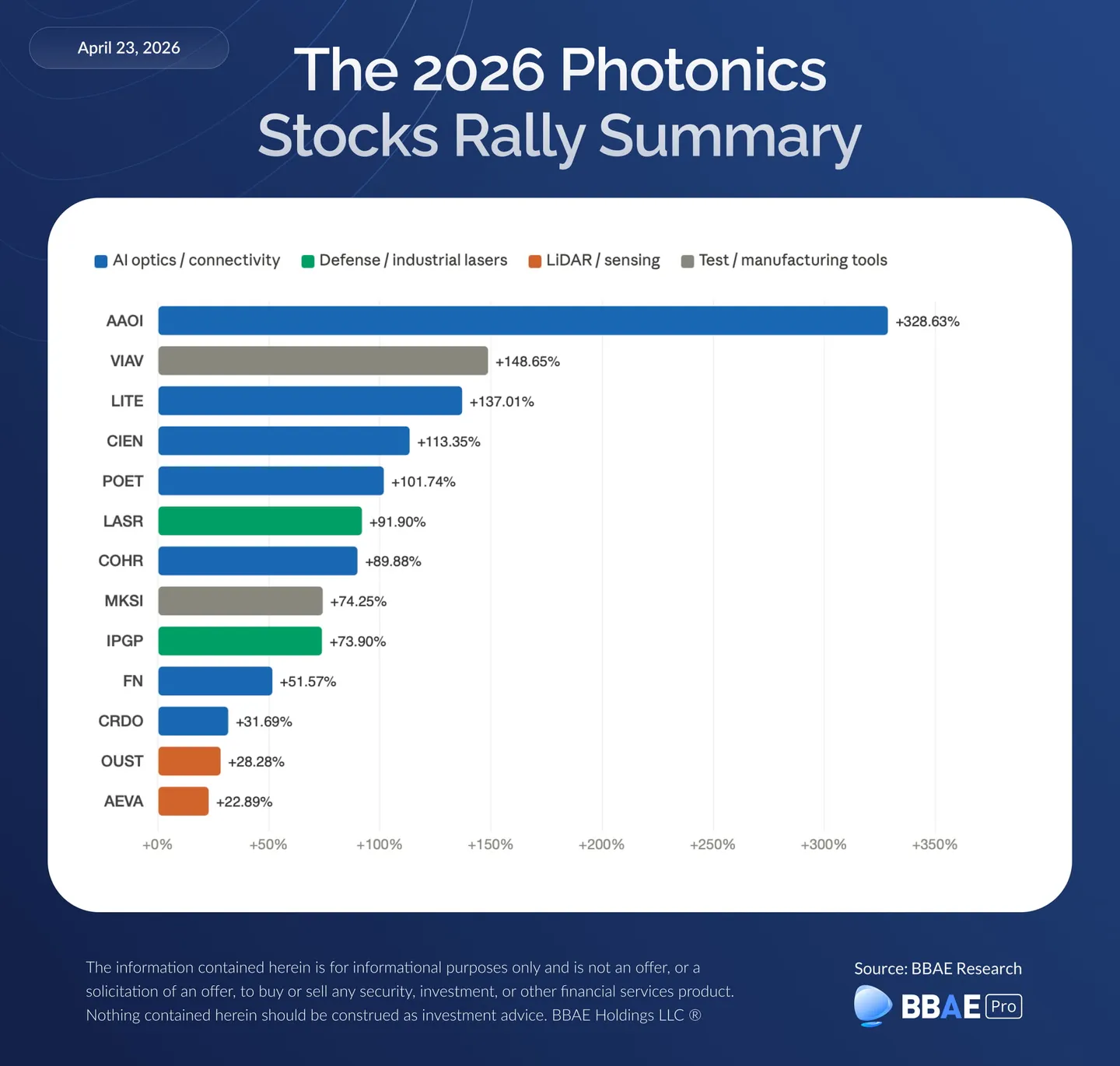
As of April 22, 2026, the sector had delivered some of the largest year-to-date returns in the entire U.S. equity market. Applied Optoelectronics ($AAOI) led all names with a +328.63% gain. Viavi Solutions ($VIAV) returned +148.65%, Lumentum Holdings ($LITE) rose +137.01%, Ciena Corp. ($CIEN) gained +113.35%, and POET Technologies ($POET) crossed the 100% threshold at +101.74%.
The market had largely stopped treating photonics as a slow-moving telecom supply chain and began pricing it as enabling infrastructure for AI, autonomy, and defense. That shift appeared to be supported by improving financial results, growing order books, and a series of notable corporate announcements rather than speculation alone.
What Is Photonics?
Photonics covers technologies that generate, guide, switch, amplify, detect, and package light for practical use. In 2026, the subsectors drawing the most investor attention were:
- Lasers: industrial, telecom, and defense/directed-energy systems
- Optical components: transceivers, modulators, and subsystems for data centers
- Photonic integrated circuits: multiple optical functions on a chip-scale platform
- LiDAR and sensing: light-based ranging for autonomous vehicles and robotics
- Fiber optics: the physical networking layer AI clusters depend on
- Manufacturing tools: equipment for photonics production and advanced packaging
An important structural shift in 2026 was that the sector was no longer seen as purely telecom optics. Industry commentary described scale-out data-center networks as the new economic center of optical interconnects, with bandwidth pressure, manufacturability, and supply-chain resilience as central concerns. That broadened photonics from a narrow carrier-spending cycle into a wider capital spending ecosystem driven by hyperscalers, AI clusters, autonomous systems, defense, robotics, and smart infrastructure.
Why Did Photonics Stocks Rally in 2026?
The Nvidia Catalyst and AI Optics
The dominant catalyst was AI data-center expansion. Hyperscalers and AI-system vendors require more optical links per unit of compute because copper interconnects face difficult power, distance, and bandwidth limits as clusters scale. This created a direct and immediate revenue opportunity for companies across the photonics supply chain, and the market re-rated them accordingly.
The single most important event of the year came on March 2, 2026, when Nvidia announced a $2 billion strategic investment in Lumentum Holdings ($LITE) alongside multi-year, multi-billion-dollar purchase commitments for advanced laser and optical components. Nvidia simultaneously committed an additional $2 billion to Coherent Corp. ($COHR), bringing its total photonics sector investment to $4 billion. That announcement lifted the entire sector and reframed optical components as core AI infrastructure rather than peripheral telecom hardware.
Lumentum ($LITE) finished the period up +137.01%. Beyond the Nvidia investment, the company reported 65.5% year-over-year revenue growth in fiscal Q2 2026, with an optical circuit switch backlog above $400 million and a multi-hundred-million-dollar co-packaged optics order. Lumentum was added to the S&P 500 in March 2026, triggering mandatory index-fund buying. Management stated the order book runs through 2028 and described OCS and CPO as still being at an early stage. Revenue is projected by analysts to rise 76.7% to $2.91 billion in fiscal 2026, then another 62.2% to $4.71 billion in fiscal 2027.
Coherent Corp. ($COHR), up +89.88% YTD, reported fiscal Q2 2026 revenue of $1.69 billion, with its datacenter and communications segment up 34% year-over-year. Like Lumentum, Coherent was added to the S&P 500 in March 2026, contributing index-driven buying pressure on top of its earnings momentum. CEO Jim Anderson projected continued strong growth through the second half of fiscal 2026 and into 2027.
Applied Optoelectronics: The Biggest Percentage Winner
Applied Optoelectronics ($AAOI) was the single biggest year-to-date return in the group at +328.63%, moving from $34.86 at the end of 2025 to $149.42 by April 22. The surge was built on a series of escalating order announcements from a single unnamed hyperscale customer: a $53 million order for 800G single-mode transceivers for AI-focused GPU cluster expansion, followed by a $200 million-plus order for next-generation 1.6T transceivers. Management issued full-year 2026 revenue guidance of $1 billion, representing more than a doubling from $455 million in 2025. The company also announced a Pearland, Texas facility acquisition on top of its Sugar Land expansion, increasing domestic manufacturing capacity for high-speed optical components and targeting more than triple its Texas laser capacity by mid-2027.
Ciena and the AI Networking Layer
Ciena Corp. ($CIEN) gained +113.35%, moving from $233.87 to $498.97. The company reported a blowout fiscal Q1 2026 earnings result with 33.1% year-over-year revenue growth, direct cloud provider revenue surging 76%, and a raised full-year outlook. At the OFC 2026 conference, Ciena showcased new 1.6T AI networking and quantum-secured communication technologies, drawing strong institutional buying. The stock was also added to the S&P 500 alongside Lumentum and Coherent. Management guided full-year 2026 revenues to approximately $5.9 billion, supported by a $5 billion backlog.
Viavi Solutions: The Unexpected Outperformer
Viavi Solutions ($VIAV) was the rally’s most surprising outperformer relative to its market profile, gaining +148.65%, moving from $17.82 to $44.31. The company sits in optical test, network assurance, and 3D sensing rather than direct component manufacturing, but its role as a quality gatekeeper for AI networking infrastructure made it a direct beneficiary of rising network complexity. Key catalysts included the launch of the TestCenter D2 1.6T Appliance for hyperscale data centers at OFC 2026, the debut of the Observer Threat Forensics cybersecurity platform developed with CrowdStrike, and a series of analyst upgrades. JPMorgan disclosed a new stake in the stock, and fiscal Q2 2026 results showed 36.4% revenue growth with a 57% gross margin. Fiscal Q3 2026 results are scheduled for April 29.
POET Technologies: Development Stage to First Production Order
POET Technologies ($POET) gained +101.74%, moving from $6.33 to $12.77. The key catalyst was the company’s first meaningful production order for POET Infinity optical engines, valued at more than $5 million, representing a shift from development to commercial execution. Management projected more than 30,000 optical engines to ship in 2026, targeting 400G to 800G-plus links in AI and data-center markets. POET entered 2026 with approximately $430 million in cash following multiple financing rounds, providing manufacturing runway in Malaysia. The stock remains early-stage in revenue terms, but the production order marked the transition the market had been waiting for.
Defense and Industrial Lasers
nLIGHT ($LASR) gained +91.90%, moving from $37.51 to $71.98. The move combined sector-wide AI enthusiasm with company-specific defense news: nLIGHT announced a new 70kW-class directed energy laser system, a significant capability milestone. The announcement coincided with the Nvidia $4 billion photonics investment, which lifted defense-adjacent laser names alongside pure AI-optics plays. Record fourth-quarter and full-year 2025 results driven by aerospace and defense program wins provided the fundamental foundation.
MKS Instruments ($MKSI) gained +74.25% and IPG Photonics ($IPGP) gained +73.90%. Both benefited from the sector re-rating alongside direct exposure to advanced manufacturing, semiconductor packaging, and industrial laser demand. Both companies flagged tariffs as a margin watchpoint but maintained constructive outlooks on secular demand tied to AI manufacturing buildout.
Fiber Infrastructure and Manufacturing
Beyond individual stocks, the broader physical infrastructure story reinforced the sector thesis. Corning Incorporated and Meta Platforms announced a multi-year agreement worth up to $6 billion for U.S.-made fiber and connectivity products for AI data centers, including domestic capacity expansion in North Carolina. Retail investors often focus on semiconductor chips first, but photonics can become a bottleneck when networks scale faster than the physical layer beneath them.
Fabrinet ($FN) gained +51.57% and printed record quarterly revenue of $1.13 billion in fiscal Q2 2026, reflecting manufacturing demand for complex optical products across the customer base. Credo Technology Group ($CRDO) gained +31.69% on top of a one-year return already above 200%, posting 201.5% year-over-year revenue growth in fiscal Q3 2026 with a 68.5% GAAP gross margin.
LiDAR and Sensing
The LiDAR segment saw shifting investor sentiment. Aeva Technologies ($AEVA) gained +22.89% year-to-date, supported by a global passenger OEM production contract and selection as the Nvidia DRIVE Hyperion reference LiDAR sensor. Ouster ($OUST) gained +28.28%, with 107% total revenue growth in Q4 2025 and the Stereolabs acquisition expanding its product stack toward full perception for robotics and physical AI. Market commentary projected the automotive LiDAR market at roughly $3.56 billion by 2030, with penetration at approximately 3% of vehicles worldwide as of 2025.
Year-to-Date Performance Summary
Dec 31, 2025 to Apr 22, 2026 closing prices. Sorted by YTD return.
This article is for informational purposes only and is not investment advice or a solicitation to buy or sell securities. The content is based on publicly available information and reflects the author’s opinions as of the publication date, which may change without notice. All investments carry inherent risks, including the potential loss of principal, and past performance is not indicative of future results. Readers should conduct their own research or consult a financial advisor before making investment decisions. BBAE holds no position in the securities mentioned, nor are they compensated by the companies mentioned.