China’s New Model: How Kimi K3 Spooked AI Stocks
China’s New Model: How Kimi K3 Spooked AI Stocks
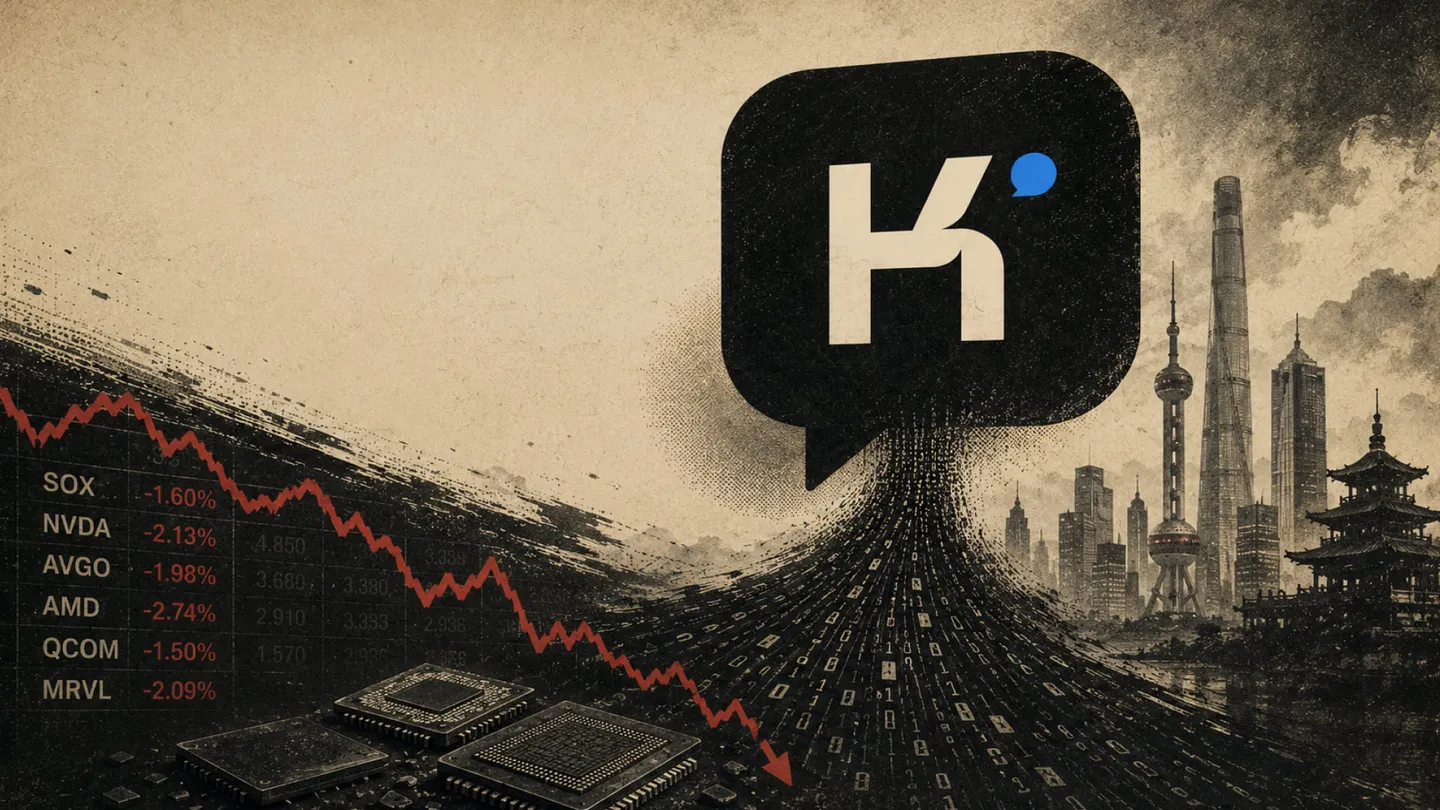
On July 17, 2026, Chinese AI lab Moonshot AI released Kimi K3, and markets treated it as a lighter echo of last year’s DeepSeek scare. The model checked every box investors get nervous about all at once: frontier-level capability, aggressively low pricing, and an open-weight release coming out of China. The reaction was real but fairly contained. The Philadelphia Semiconductor Index (SOX) closed down 1.6%, leaving it 20% below its June 22 record, while the Nasdaq slipped 1.40% on the session.
It’s worth being precise, because “Kimi crashed the market” would overstate it. AI and semiconductor stocks had already been drifting lower for several days on worries about stretched valuations and how sustainable hyperscaler spending really is. Kimi K3 didn’t create that mood. It simply became the catalyst that sharpened it.
That’s why the DeepSeek comparison resonates, even though the scale was very different. My 2025 DeepSeek piece walked through steep, broad losses across semiconductors, data centers, power utilities, and small modular reactor names. This week’s Kimi K3 reaction looks similar in psychology but much narrower and milder in spread. The pressure concentrated in semiconductors and rival AI names rather than triggering the broad power-and-utility panic we saw last time. In this article, I’ll break down what Kimi K3 actually is, why its pricing caught the market’s attention, which stocks felt it, and which company is best positioned to quietly benefit.
What Kimi K3 Actually Is
According to Moonshot’s own launch note, Kimi K3 is its most capable model to date, a 2.8 trillion-parameter system built for long-horizon coding, knowledge work, and reasoning, with native vision and a 1 million-token context window. One detail matters for how you read the selloff: the company says the model’s full weights won’t be released until July 27, 2026. In other words, the market sold on the announcement, not on months of proven enterprise deployment.
The strongest evidence for the “another DeepSeek moment” framing isn’t that Kimi K3 is the best model in the world. It’s that the model looks unusually strong exactly where investors expected U.S. labs to keep their pricing power: advanced coding and agentic software work. On Arena.ai’s WebDev leaderboard dated July 16, 2026, Kimi K3 ranked first with a score of 1679, ahead of Claude Fable 5 at 1631 and GPT-5.6 Sol-xhigh at 1618. Arena’s cost view also lists Kimi K3 among the top performers per dollar, so it isn’t just strong, it’s strong and cheap.
Here’s the nuance, and it actually makes the story more credible rather than less: Kimi K3 is not clearly first overall. On Arena.ai’s broader Text Arena ranking, also dated July 16, Kimi K3 sat at No. 9 with a score of 1486, behind several Anthropic models and roughly alongside GPT-5.6 Sol. Moonshot itself admits the model still trails the most powerful proprietary systems, specifically Claude Fable 5 and GPT-5.6 Sol, on overall performance.
So the accurate takeaway for investors isn’t “China now has the best model.” It’s closer to: China now has a much cheaper model that is good enough to threaten premium pricing in important workloads, especially coding. That’s a subtler claim, but a more dangerous one for the companies that assumed those workloads were safe.
The Pricing Shock
Pricing is a big part of why this release hit markets so fast. Moonshot’s official launch note lists Kimi K3 at $0.30 per million cached-input tokens, $3.00 per million cache-miss input tokens, and $15.00 per million output tokens.
Stack that against the incumbents. Anthropic’s official pricing for Claude Fable 5 is $10 input / $50 output per million tokens, and OpenAI’s pricing for GPT-5.6 Sol is $5 input / $30 output. That puts Kimi K3 at roughly 30% of Claude Fable 5’s output cost and 50% of GPT-5.6 Sol’s output cost, while still ranking above both on Arena’s frontend coding board.
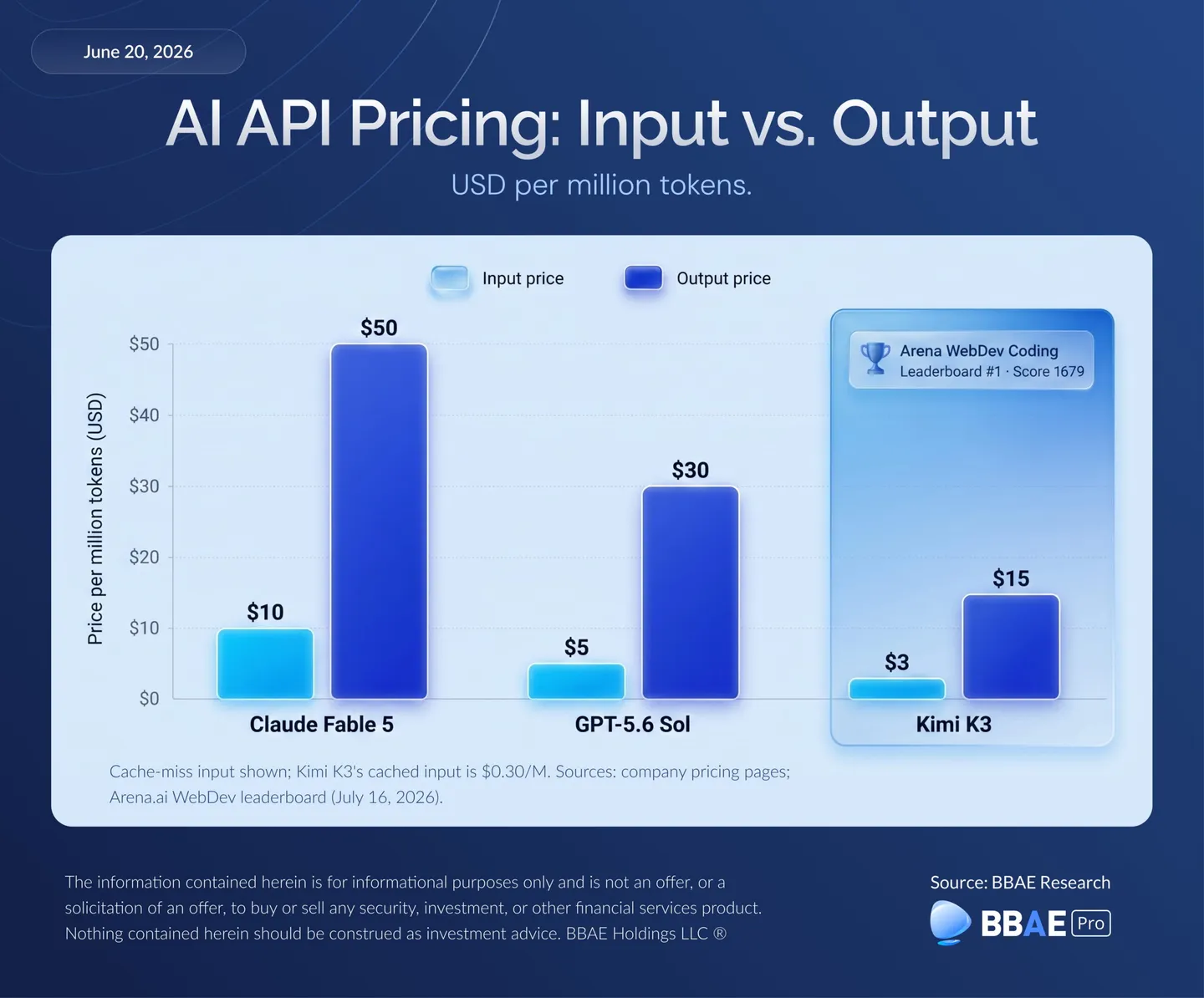
That combination is exactly the kind of signal that unsettles equity markets. If a lower-cost model can win, or nearly win, in coding-heavy use cases, investors start to question whether the AI winners are really the labs and chipmakers with the biggest capital budgets, or whether value shifts toward cheaper model suppliers, routing layers, and the cloud platforms that let enterprises arbitrage model costs. It fits a broader theme, too: Moonshot, Z.ai, and MiniMax are all shipping increasingly capable models at sharply lower cost, challenging the long-held Western assumption that Chinese developers lag by many months.
One important caveat before anyone declares the closed-model business dead: open-weight does not mean “free to run.” Kimi K3’s sheer size means very few users will realistically host it themselves. By most estimates, running a 2.8T model locally would require hundreds of thousands of dollars of compute equipment. So the real threat isn’t “everyone will run Kimi on a laptop.” It’s that enterprises may get frontier-adjacent performance through lower-cost hosted inference, which compresses the premium that closed-model vendors thought they could charge.
Why the Market Sold First and Asked Questions Later
The pullback makes sense once you map it onto what was already priced in. Semiconductor and AI infrastructure names had been trading on a thesis that better AI would keep requiring enormous capital intensity, with protected margins for the top closed-model vendors and the chipmakers feeding them. Kimi K3 added to existing worries about rich valuations and the sustainability of AI capital-spending growth. It didn’t have to prove that future chips are unnecessary. It only had to make investors a little less confident that the current spending path is the only winning path.
The softness showed up right where you’d expect. Moonshot’s release helped extend a third straight day of chip weakness, and it was enough that Nvidia ($NVDA) slipped far enough on Friday for Apple ($AAPL) to briefly reclaim the title of the world’s most valuable company. The repricing wasn’t limited to Western chip names, either. Hong Kong-listed Chinese AI rivals Zhipu and MiniMax fell 27.7% and 16.5%, respectively, near the July 17 close, a sign investors were also repricing the Chinese AI field itself around the idea that Moonshot had suddenly jumped ahead in the “cheap, frontier-ish model” race.
This is why I’d frame Kimi K3 as a valuation reaction, not yet an earnings shock. The weights weren’t even out yet, and several Kimi K3 rankings were still labeled preliminary. The move was about narrative and expected future pricing pressure, not a quarter of hard revenue displacement. That distinction matters, because it suggests the initial move was directionally reasonable but probably a bit too fast and too broad, much like several of the AI dislocations we’ve seen over the past eighteen months.
Which Company Could Benefit: Alibaba
The most direct listed beneficiary appears to be Alibaba ($BABA), and this is stronger than rumor, because it’s in the filings. Alibaba’s FY2025 Form 20-F discloses that during the year ended March 31, 2024, Alibaba invested approximately $0.8 billion for an approximately 36% equity interest in Moonshot AI, held in preferred stock and accounted for using the measurement alternative.
Alibaba can benefit in two separate ways. The first is the equity exposure itself. The second is more operational and more near-term: Moonshot already runs on Alibaba Cloud infrastructure, and Alibaba Cloud already exposes Kimi through its model ecosystem. Alibaba Cloud published a case study on how Moonshot uses its solutions for Kimi data preprocessing and infrastructure elasticity, and Alibaba Cloud’s own documentation shows a live Kimi API path inside Model Studio. That makes Alibaba more than a passive shareholder. It’s part of the distribution and infrastructure layer around Moonshot.
There’s an accounting caveat retail investors should keep in mind. Because the Moonshot investment is held under the measurement alternative, don’t assume every positive Moonshot headline flows cleanly into Alibaba’s near-term reported earnings. It’s a real strategic asset, not a quarterly mark-to-market line. That makes Alibaba a better strategic beneficiary than a clean short-term accounting trade. For publication-grade precision, the careful phrasing is simply: Alibaba disclosed in its FY2025 Form 20-F that it had acquired an approximately 36% stake in Moonshot AI. That avoids overstating what can shift in a private company’s cap table.
Beyond Alibaba, the broader beneficiaries are more thematic than name-specific. If open-weight models keep improving while remaining impractical to self-host, value should migrate toward the cloud and software layers that help enterprises access, route, host, and optimize lower-cost models: AI gateways, multi-model platforms, and cloud providers, rather than toward DIY local deployment.
The Names More Obviously at Risk
The stocks on the wrong side of this are the same ones my DeepSeek piece trained readers to watch: premium closed-model vendors, semiconductor names whose multiples depend on uninterrupted AI-capex expansion, and high-beta AI infrastructure stocks priced for a one-way demand ramp.
But the nature of the threat has shifted. Last year’s DeepSeek fear was roughly “maybe AI doesn’t need this much compute.” This year’s Kimi fear is subtler and, I’d argue, more durable: maybe AI becomes good enough, open enough, and cheap enough that the profit pool simply gets redistributed, away from the most expensive closed models and toward whoever can deploy capable models most efficiently.
This article is for informational purposes only and is neither investment advice nor a solicitation to buy or sell securities. All investment involves inherent risks, including the total loss of principal, and past performance is not a guarantee of future results. Always conduct thorough research or consult with a financial expert before making any investment decisions. BBAE has no position in any investment mentioned.