
CLARITY Act Crypto Bill: Stocks That Could Be Impacted

CLARITY Act Crypto Bill: Stocks That Could Be Impacted
The U.S. is closer than it has been in years to passing a real market-structure law for crypto, and investors are starting to take notice. The CLARITY Act is designed to settle one of the industry’s oldest fights: which regulator, the SEC or the CFTC, actually oversees which parts of the crypto market, and under what rules exchanges, brokers, dealers, custodians, and token issuers have to operate.
If enacted, the bill would create a new CFTC registration regime for digital commodity exchanges, brokers, dealers, and custodians, open up a lighter-touch fundraising path called “Regulation Crypto” for certain token offerings, protect self-custody wallets and software development, and confirm that banks can use digital assets and blockchain rails for activities they’re already permitted to do. It also folds in anti-money-laundering requirements for regulated crypto platforms and a provision that would restrict paying customers interest or yield simply for holding a payment stablecoin.
The bill has already cleared its first big hurdle. The House passed H.R. 3633 back in July 2025 by a wide bipartisan margin, 294-134. The Senate Banking Committee advanced its own version in May 2026 on a 15-9 vote, picking up support from Democrats Ruben Gallego and Angela Alsobrooks along the way. As of this writing, H.R. 3633 sits on the Senate Calendar as Calendar No. 423, eligible for a floor vote, but not yet officially scheduled for one. With the Senate’s state work period set to begin August 10, the window to get it done before recess is real, but it’s narrowing.
Market Reaction and Stocks to Watch
Unlike the GENIUS Act, which mainly moved stablecoin issuers and payment rails, CLARITY touches nearly the entire crypto stack: exchanges, brokerages, custodians, derivatives venues, and bank tokenization platforms. That’s why the stocks most directly tied to trading, custody, and settlement infrastructure are the ones to watch first.
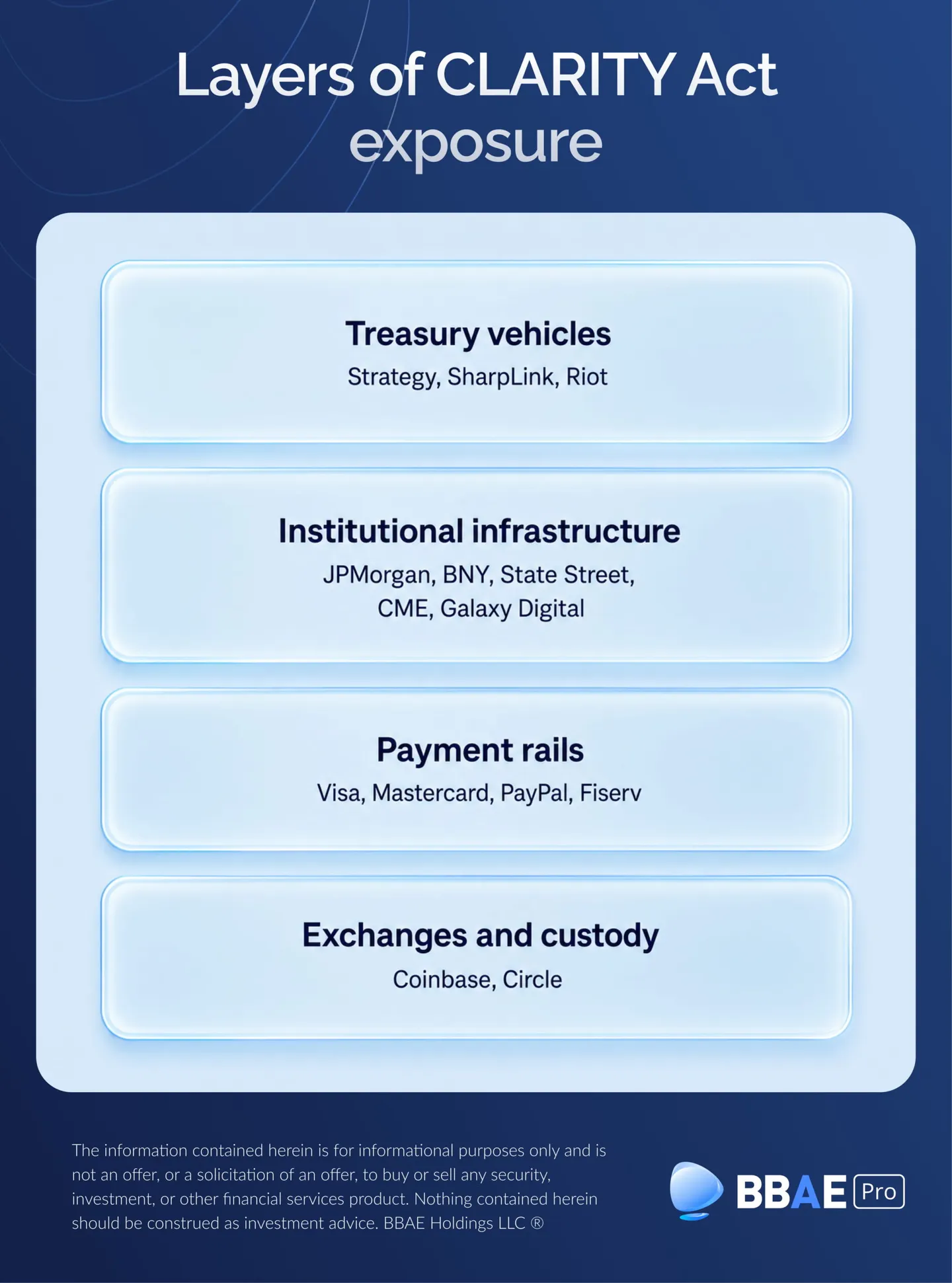
Coinbase ($COIN) is the most obvious beneficiary. The exchange already runs a full-stack platform built around custody, exchange liquidity, stablecoin infrastructure, and global settlement, and clearer rules would reduce a lot of the regulatory overhang that’s dogged the stock for years. The wrinkle is that Coinbase currently rewards customers for holding USDC, and CLARITY’s stablecoin-yield restriction could force a redesign of that program if the language survives in its current form.
Circle ($CRCL) looks like one of the cleanest winners because USDC already sits in the middle of the rails other companies are building. Visa’s stablecoin settlement program runs on USDC, Mastercard’s expanded settlement framework includes it, and Fiserv has named Circle as an infrastructure partner for its own stablecoin rollout. For Circle, CLARITY isn’t just a sentiment boost, it’s a distribution story across payments and banking.
PayPal ($PYPL) is more of a mixed bag. Its PYUSD stablecoin is fully backed and already built into PayPal’s wallet and merchant tools, but PayPal also advertises a yield for customers who hold PYUSD balances. That kind of “hold-to-earn” model is exactly what the bill’s stablecoin-yield restriction appears aimed at, so PayPal could gain regulatory legitimacy while losing part of a product hook it currently uses to attract balances.
Visa ($V) and Mastercard ($MA) offer a steadier way to play the theme. Visa has already launched USDC settlement in the U.S. with broader access planned through 2026, and Mastercard has been expanding on-chain settlement using regulated stablecoins across its network. Both companies are already piloting the use cases CLARITY would formally green-light, which tends to matter more to investors than a press release.
Fiserv ($FI) may be the most underappreciated name in the group. Its FIUSD stablecoin push is aimed squarely at banks and merchants, and the company already has relationships with roughly 10,000 financial institutions and six million merchant locations. If regulated stablecoins move deeper into everyday banking and merchant payments, Fiserv has one of the largest distribution networks in the market to carry them.
Broader Crypto Boost
A second tier of names stands to benefit as the “adult supervision” layer of crypto market structure. JPMorgan ($JPM)already runs its Kinexys platform for tokenized deposits and programmable payments. BNY ($BK) and State Street ($STT) have both built out digital-asset custody and tokenized-finance platforms for institutional clients. CME Group ($CME) continues to post strong growth in crypto futures and options volume, and Galaxy Digital ($GLXY) already offers trading, lending, staking, and custody services built for institutions. None of these stocks is likely to move as sharply as Coinbase on headline day, but they’re well positioned if CLARITY turns crypto infrastructure into a more normal part of mainstream finance.
Crypto Treasury Companies
If CLARITY reduces regulatory risk and draws more institutional money into crypto, one of the more direct ways that shows up in stock prices is through crypto treasury companies, the group of public vehicles built to hold large amounts of Bitcoin, Ether, or other tokens on their balance sheets. Strategy ($MSTR), whose equity is dominated by its bitcoin treasury, SharpLink Gaming ($SBET), which positions itself as an institutional Ethereum treasury and staking platform, and Riot Platforms ($RIOT), a bitcoin miner and data-center operator, all fall into this camp.
These names don’t get a direct legal or operating benefit from CLARITY the way Coinbase or Circle would. Instead, they’re a more leveraged, higher-beta way to express the same trade: if clearer rules push more capital into crypto and lift token prices, treasury vehicles that hold those tokens tend to move even harder in both directions, since their stock prices layer investor sentiment about the company on top of the price of the underlying coin. That’s also why they carry more risk than the infrastructure names above. We covered this dynamic in detail in The Rise and Fall of Crypto Treasury Public Vehicles, including how several of these stocks fell harder than the coins they were built to track once crypto prices turned lower and the premiums investors had been paying for these vehicles compressed. A regulatory tailwind from CLARITY could help rebuild some of that premium, but it doesn’t remove the underlying volatility that comes with owning a stock whose value is tied so closely to crypto prices.
Bottom Line
Markets hate regulatory ambiguity, and the CLARITY Act is aimed squarely at removing it. If Congress gets it across the finish line, the clearest winners are likely to be crypto exchanges, stablecoin infrastructure, payment networks that already have pilots running, and the custody and tokenization rails at major banks, names like Coinbase, Circle, Visa, Mastercard, Fiserv, JPMorgan, BNY, State Street, CME, and Galaxy Digital.
But this is still a legislative trade, not settled law. The House has acted, the Senate Banking Committee has acted, and updated Senate text is already out. What’s missing is an official floor schedule, which is the signal that would actually turn this into a tradeable catalyst. Until that shows up, the smart framing for retail investors is bullish, but conditional.
This article is for informational purposes only and is not investment advice or a solicitation to buy or sell securities. The content is based on publicly available information as of the publication date and is subject to change without notice. All investments carry risk, including potential loss of principal, and past performance does not guarantee future results.
Digital-asset-linked equities can be especially volatile and speculative. Prices can move sharply on regulatory news, shifts in investor sentiment, and broader crypto-market swings, and legislative outcomes remain uncertain until a bill is signed into law.
Readers should do their own research or speak with a qualified financial advisor before making investment decisions, particularly those involving crypto-linked securities.
BBAE has no financial interests, business relationships, or affiliations with the companies mentioned in this article, has not received compensation from them, and holds no position in the securities discussed.