
The Rise and Fall of Crypto Treasury Public Vehicles


The Rise and Fall of Crypto Treasury Public Vehicles
Last year, we published The Rise of MicroStrategy-Inspired Public Vehicles, a look at how a small group of companies were reshaping themselves, or being built from scratch, around crypto. The whole trend traced back to one company. MicroStrategy, now known as Strategy, pioneered the corporate Bitcoin treasury model in 2020, and nearly every vehicle that followed was essentially running its playbook. At the time we wrote, the trade was still mostly an idea. We covered Janover’s pivot into what became DeFi Development, the freshly announced Twenty One launch, and a proposed SPAC deal that would turn TLGY into an Ethena-linked token vehicle.
A lot has changed since then. Several of those deals actually closed. Several more companies rebranded themselves into crypto-native public wrappers. And the playbook that once belonged almost entirely to Bitcoin escaped into Ether, Solana, and a long tail of smaller tokens. In other words, the category moved from novelty to crowding, from rich premiums to compression, and from pure accumulation stories to more complicated financing and liquidity stories.
Then the market turned. As crypto prices rolled over through late 2025 and into 2026, many of these stocks fell harder than the coins they were built to track.
From a handful of experiments to a crowded category
The clearest sign of how far the theme traveled is simply how many of these vehicles reached public markets.
On the Solana side, DeFi Development Corp. completed Janover’s transformation. The company changed its name to DeFi Development effective April 17, 2025, its Nasdaq ticker became $DFDV on May 5, 2025, and by 2026 it was describing itself as the first U.S. public company built to accumulate and compound SOL.
On the Bitcoin side, the deals we flagged as “proposed” largely got done. Twenty One Capital completed its merger with Cantor Equity Partners in December 2025 and began trading on the NYSE under the ticker $XXI, arriving with more than 43,500 BTC on its balance sheet. ProCap Financial completed its combination with a Columbus Circle SPAC and started trading on Nasdaq under $BRR. Strive merged with Asset Entities in September 2025 and later absorbed Semler Scientific, ending up with roughly 12,800 BTC. Nakamoto (formerly KindlyMD) closed its merger with Nakamoto Holdings and rebranded outright. And the token-native structure we described a year ago finally arrived: the old TLGY/Ethena concept closed in June 2026 as StablecoinX, trading on Nasdaq under USDE.
Overseas, Japan’s Metaplanet became the region’s flagship Bitcoin-treasury story, and the U.K.’s The Smarter Web Company IPO’d and then adopted a Bitcoin strategy that sent its shares sharply higher before they fell back just as sharply.
Not every deal crossed the finish line. As of this writing, the planned merger between BSTR Holdings and Cantor Equity Partners I is still not done. The shareholder vote to approve it has been postponed more than once, most recently to July 10, 2026.
Why the boom turned into a pullback
The simplest reason is that the crypto backdrop reversed hard. Bitcoin pulled back from its all-time high of about $126,000, reached last October, to current levels around $60,000, a drop of roughly 52%. Ether fell even further over the same stretch.
But there’s a more important, equity-specific reason these stocks fell so far. A crypto treasury company is not simply “a coin with a ticker.” Its business model often depends on trading at a premium to the value of the coins it holds. That premium is what lets the company issue new shares at a rich price, use the proceeds to buy more crypto, and lift its crypto-per-share. That flywheel only works while the stock trades above the value of its holdings.
We flagged this premium-to-NAV risk in last year’s article, and it became the central problem. That premium was always more about leverage and fundraising ability than about scarce access to the coins, which meant it could evaporate quickly once sentiment turned. And it did: by late 2025 and into 2026, most crypto treasury companies had slipped below the net asset value of their holdings, meaning the market valued them at less than the coins sitting on their balance sheets. Once the premium disappears, issuing stock stops being accretive, preferred securities get more expensive to sell, and fixed obligations like dividends and interest start to squeeze common shareholders. That’s why the equity often fell more than the coin underneath it.
The altcoin vehicles added another layer of fragility. Many non-Bitcoin treasury assets aren’t “digital gold” analogues so much as speculative protocol tokens whose value depends on ecosystem adoption. As the trade spread into lesser-known and more controversial assets, it raised a fair question: were some of these companies real operating businesses, or just public wrappers for token speculation?
Stocks Versus the Coins
The chart below shows each company’s stock return from last year’s highs, which also marked all-time highs for each of these names. It covers a group of pure-play crypto treasury companies across Bitcoin, Ether, and Solana, alongside the coins themselves.
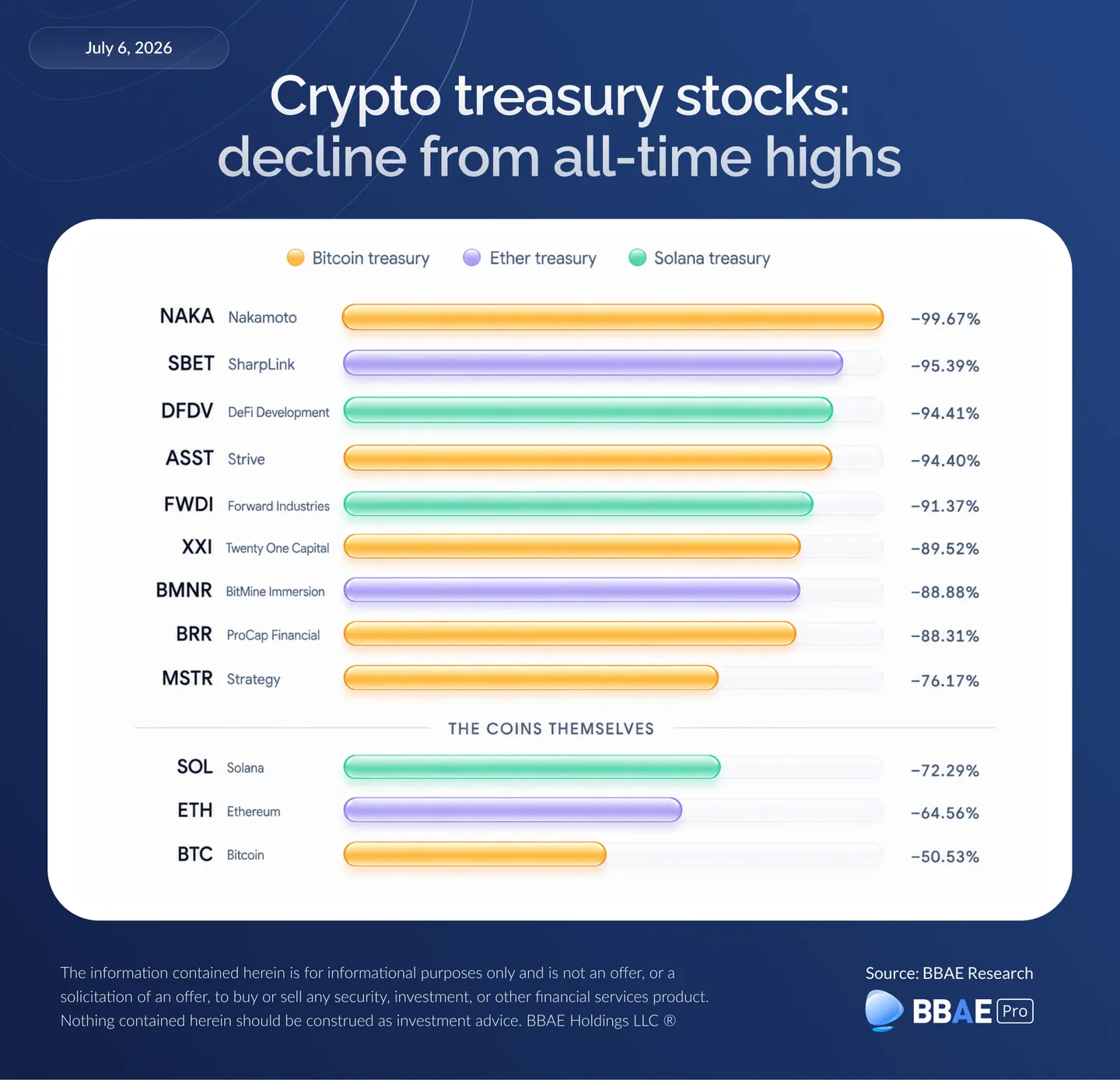
Most stocks reached their all-time highs before their mergers officially closed, in thin pre-combination trading.
Strategy: from “never sell” to active management
Even the original template changed since our last article, and its evolution is the cleanest illustration of the whole shift.
MicroStrategy rebranded itself as Strategy in early 2025, later changed its legal name to Strategy Inc., and now describes itself to investors as the world’s first and largest Bitcoin Treasury Company. More importantly, its capital structure became far more hybrid. Rather than just holding Bitcoin, Strategy now offers investors a range of securities, including common equity plus several series of preferred stock it calls “Digital Credit,” all designed to provide varying degrees of Bitcoin exposure. In 2026 it announced multiple new multibillion-dollar issuance programs to keep that machine running.
The most symbolic change, though, was on the selling side. For years, Michael Saylor’s signature promise was that the company would simply never sell. That ended in 2026. It’s worth getting the nuance exactly right: this was not Strategy’s first-ever Bitcoin sale, but its first since 2022. Between May 26 and May 31, 2026, the company sold 32 BTC for about $2.5 million at an average of roughly $77,135 per coin, saying the proceeds would help fund distributions on its preferred stock.
Then, on June 29, 2026, Strategy went further and formally authorized a BTC Monetization Program as part of a broader capital framework. The program lets the company sell Bitcoin to build a U.S. dollar reserve, cover preferred dividends and interest, and fund buybacks when management judges repurchases more attractive than issuing new securities. CEO Phong Le framed it as evolving from one-way capital issuance to active capital management. That is about as clean an admission as you’ll find that the old “never sell” ethos has given way to something more pragmatic.
This matters for retail investors because many treat Strategy as if it were a simple leveraged Bitcoin ETF. It isn’t. Its preferred securities aren’t collateralized by its Bitcoin, and the stock now reflects a genuinely complicated corporate capital structure, including reserve management, dividend obligations, debt repurchases, and buybacks, all layered on top of the coin price.
What this means for a retail investor
The most useful way to think about these companies is that they are not simple substitutes for owning BTC, ETH, or SOL directly. They’re a layered bet: first on the token price; second on whether the stock trades above or below the value of its holdings; third on whether management can keep raising capital without crushing the common shares; and fourth on whether there’s a real business underneath the treasury story to survive a long crypto drawdown. Once prices weakened and the premium narrowed, that entire “issue stock, buy more coins, issue again” loop became much harder to sustain.
So the honest takeaway is probably that the market overextended itself. Some deals closed, but we are not sure what the future holds even for big players like $MSTR, and some smaller ones flooded the market with copycat structures. And still others pushed into speculative tokens or leaned on thin operating businesses and aggressive fundraising. The category didn’t disappear. It crowded itself and repriced. They stumbled because the premium, financing, and dilution assumptions behind the wrapper proved far less durable than the crypto narrative itself.
This article is for informational purposes only and is not investment advice or a solicitation to buy or sell securities. The content is based on publicly available information and reflects the author’s opinions as of the publication date, which may change without notice. All investments carry inherent risks, including the potential loss of principal, and past performance is not indicative of future results. Investments in Bitcoin and other cryptocurrencies are highly volatile and speculative, with the potential for significant loss of principal. Market prices for digital assets can fluctuate widely due to changes in investor sentiment, regulatory developments, technological innovations, and other macroeconomic factors. Digital-asset investments are also subject to liquidity risks and regulatory uncertainties that may impact their value and availability. Readers should conduct their own research or consult a qualified financial advisor before making any investment decisions, particularly those involving digital assets. BBAE has no financial interests, business relationships, or affiliations with the companies mentioned in this article, nor have they received any compensation from these companies. BBAE holds no position in the securities mentioned, nor are they compensated by the companies mentioned.