
CoVolt Power ($KVLT) IPO: Everything You Need to Know

Tornike Laghidze
BBAE Contributor
· 6 min read
Category: Investing · Market Trends · Investment Tactics
CoVolt Power ($KVLT) IPO: Everything You Need to Know
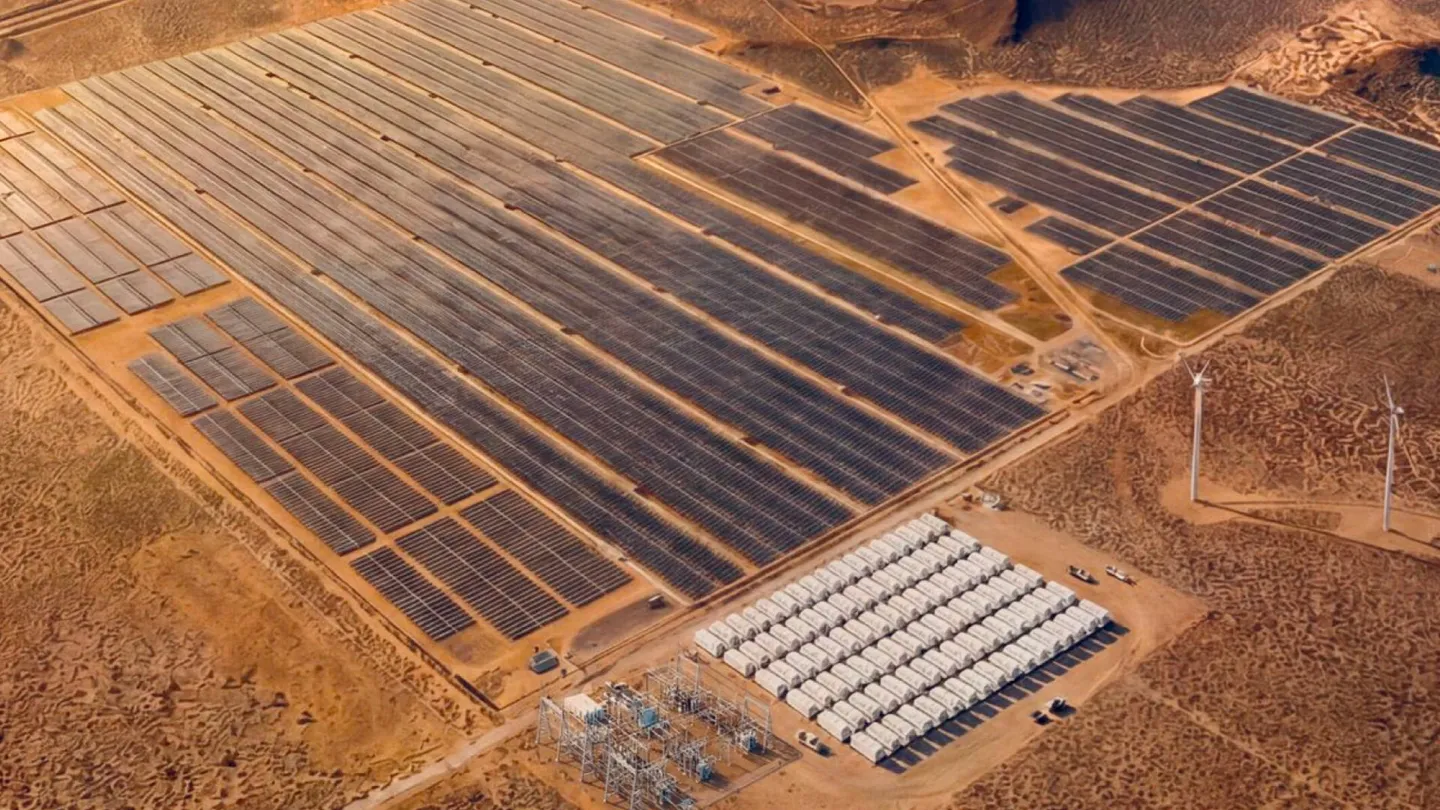
CoVolt Power ($KVLT), an engineering and construction company focused on utility-scale solar, battery storage and high-voltage power infrastructure, filed its S-1 with the SEC on August 21, 2026. The company plans to list its common stock on the New York Stock Exchange under the ticker symbol $KVLT.
Formerly known as Signal Energy, CoVolt arrives with an appealing headline story: revenue increased 67% in 2025, profitability improved sharply, and total backlog reached $3.6 billion by June 2026. It also has exposure to two themes investors currently care about—renewable energy infrastructure and the rising electricity needs of data centers.
There are important qualifications, however. Most of the reported backlog is not yet covered by definitive EPC contracts, customer concentration is extremely high, and the initial S-1 does not include an IPO price range, share count or proposed valuation. In this article, we’ll review CoVolt’s business model, financial performance, backlog, AI and data-center angle, and the structure and risks of the offering.
Business Model and Revenue Streams
CoVolt is not a solar-panel or battery manufacturer. It is an engineering, procurement and construction, or EPC, contractor that helps customers build large energy and electrical-infrastructure projects.
The company says it has constructed more than 7.3 gigawatts of generation capacity, approximately 1.7 gigawatt-hours of battery storage and transmission and distribution infrastructure connecting more than 26.4 gigawatts of generation since 2005.
Its business has two main revenue categories:
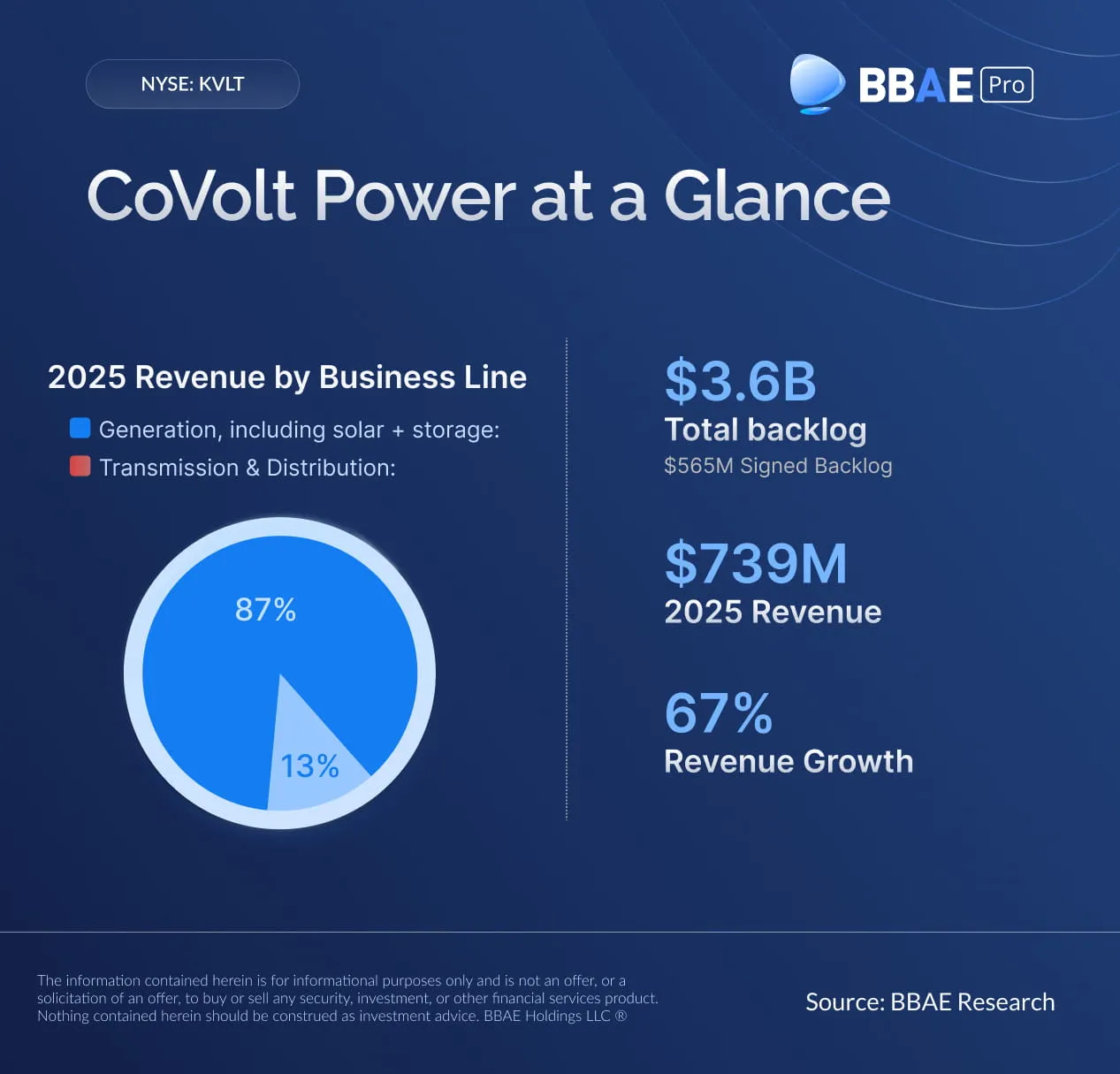
- Generation: Utility-scale solar and hybrid solar-plus-storage projects generated $643 million in 2025, up 58% from 2024. This remained the core business at roughly 87% of total revenue.
- Transmission and distribution: High-voltage transmission, substations and related grid infrastructure generated $96 million, up 160%. This segment is smaller, but it is growing much faster and could help diversify the business.
CoVolt handles engineering, procurement, construction, commissioning and testing. It also self-performs substantial parts of the work through its own labor force. Customers generally purchase the solar modules and batteries directly, while CoVolt procures foundations, racking, inverters, cables, transformers and other equipment. Company-procured equipment represents approximately 40% of a typical EPC contract’s value.
Projects normally begin with a limited notice to proceed, under which the customer funds early engineering, site work or long-lead equipment purchases. Once a full EPC contract is signed, CoVolt generally receives a mobilization payment equal to 5% to 10% of the contract value and then bills monthly as work progresses.
This customer-funded model limits how much of CoVolt’s own capital becomes tied up in projects. The tradeoff is that full EPC contracts are generally fixed-price agreements lasting 12 to 18 months. If labor, materials, weather or site conditions cost more than expected, CoVolt may have to absorb the difference.
Backlog: $3.6 Billion, but Only Part Is Signed
The most eye-catching number in CoVolt’s filing is its $3.614 billion backlog as of June 30, 2026, up from $709 million one year earlier. That represents growth of approximately 410%.
But the composition matters more than the headline:
- Signed Backlog: $565 million, or about 16% of the total
- Awarded Backlog: approximately $3.0 billion, or more than 80% of the total
Signed Backlog represents work covered by executed contracts or limited notices to proceed. Awarded Backlog generally means that a customer has selected CoVolt as the contractor, but the customer may not yet be obligated to enter into a definitive EPC agreement.
The financial statements provide a useful cross-check. CoVolt reported $565 million of remaining performance obligations under GAAP, almost exactly matching Signed Backlog rather than the full $3.6 billion headline figure.
Awarded projects can still become real revenue, and the rapid growth suggests strong demand. But projects must often clear financing, permitting, interconnection and other development hurdles before construction begins. Investors should therefore view the $3.6 billion figure as a pipeline rather than fully contracted future sales.
Financial Numbers and Key Metrics
At a glance (USD millions unless noted):
- 2025 revenue: $739.4 million, up 67% from $442.7 million in 2024
- 2025 gross profit: $102.3 million, up from $31.6 million
- 2025 gross margin: 13.8%, up from 7.1%
- 2025 operating income: $59.7 million, versus a $6.9 million loss
- 2025 net income: $60.6 million, versus a $9.0 million loss
- 2025 Adjusted EBITDA: $80.5 million, up from $17.0 million
- 2025 free cash flow: $77.8 million
- June 2026 cash: $119.2 million
- June 2026 total backlog: $3.614 billion
The 2025 improvement was substantial. Revenue rose 67%, while gross margin nearly doubled and operating income moved from a loss to a meaningful profit. Management attributes much of the margin improvement to better field productivity and project execution.
The first half of 2026 was more complicated. Revenue fell 31.7% to $308.3 million as policy and tariff uncertainty delayed project mobilizations. Gross margin nevertheless increased from 13.6% to 17.6%, while net income declined 18% to $35.4 million.
Management says the revenue decline reflects project timing rather than an expected full-year contraction. That may prove correct, but it also illustrates how uneven a project-based construction business can be. A few delayed starts can move significant revenue from one reporting period to another.
CoVolt recognizes revenue using percentage-of-completion accounting, which depends on estimates of total project costs and expected profitability. If those estimates worsen, the company may have to recognize a negative catch-up adjustment. The 17.6% first-half gross margin may therefore not represent a steady long-term level.
AI and the Data-Center Power Opportunity
CoVolt has an AI angle, but it is an infrastructure story rather than a software story.
The company is evaluating third-party AI, drone and robotics tools to improve design, quantity verification, quality assurance and construction productivity. It names Microsoft 365 Copilot for Enterprise and AI Clearing among the tools it uses, but explicitly says it has not begun developing proprietary AI technology.
The more relevant opportunity is indirect. AI data centers require large quantities of electricity, new generation capacity, substations, transmission connections and other high-voltage infrastructure. CoVolt’s growing transmission and distribution operation could benefit if hyperscaler and data-center investment continues.
The company is positioning data-center power infrastructure as an expansion opportunity, but the filing does not identify a separate material AI or data-center revenue stream today. Investors should not value CoVolt like an AI software company; its competitive advantages are project execution, engineering expertise, customer relationships and high-voltage capabilities.
Key Risks for Retail Investors
Beyond the IPO structure, several operating risks stand out:
- Customer concentration: CoVolt’s top ten customers generated 96% of 2025 revenue. One customer represented 45% of first-half 2026 revenue, and the two largest represented 59%.
- Fixed-price contracts: Cost overruns, labor shortages, weather, supply constraints or delays can reduce project margins.
- Backlog quality: More than 80% of reported backlog is awarded rather than signed.
- Project timing: Revenue can move sharply between periods as customers delay mobilization, financing or construction.
- Policy exposure: Renewable-energy tax incentives, tariffs, permitting and trade restrictions can affect project economics and timing.
Conclusion
CoVolt brings a credible operating business to the public market. Revenue grew rapidly in 2025, margins improved dramatically, free-cash-flow conversion has been strong, and the company has useful exposure to solar, battery storage, grid investment and potentially data-center power demand.
The $3.6 billion backlog makes the growth opportunity look especially large, but investors should not treat the entire amount as contracted revenue. Only $565 million was signed backlog at the end of June, while approximately $3 billion consisted of projects awarded to CoVolt without necessarily having definitive EPC contracts.
There are also questions around customer concentration, fixed-price execution risk, pre-IPO cash distributions and the insider-controlled Up-C structure. Most importantly, the filing does not yet disclose the price range, share count, valuation, dilution or full tax receivable agreement economics.
Until those figures appear in a later amendment, investors can evaluate CoVolt as a business but not yet determine whether $KVLT is attractive as a stock. The next version of the filing—particularly the valuation, primary-versus-secondary share mix and use of proceeds—will be more important than the headline backlog number in deciding whether this IPO is worth considering.
This article is for informational purposes only and is neither investment advice nor a solicitation to buy or sell securities. All investments involve inherent risks, including the total loss of principal, and past performance is not a guarantee of future results. Investing in initial public offerings (IPOs) carries additional risks, such as volatility, limited operating history, lack of liquidity, and potential overvaluation. IPO stocks may experience significant price fluctuations and may not perform as expected. Always conduct thorough research or consult with a financial expert before making any investment decisions. BBAE has no position in any investment mentioned.