Csquare ($CSQR) IPO: An Investor’s Guide to the Data Center Operator

Csquare ($CSQR), a carrier-neutral data center and interconnection company backed by Brookfield, filed its S-1 with the SEC on June 16, 2026, ahead of a planned New York Stock Exchange listing under the ticker symbol $CSQR. The IPO share count and price range have not yet been announced. In this article, we will review the company’s business model, financial performance, how Brookfield built the business, its debt and capital structure, and the structure and governance of the IPO.
Business Model
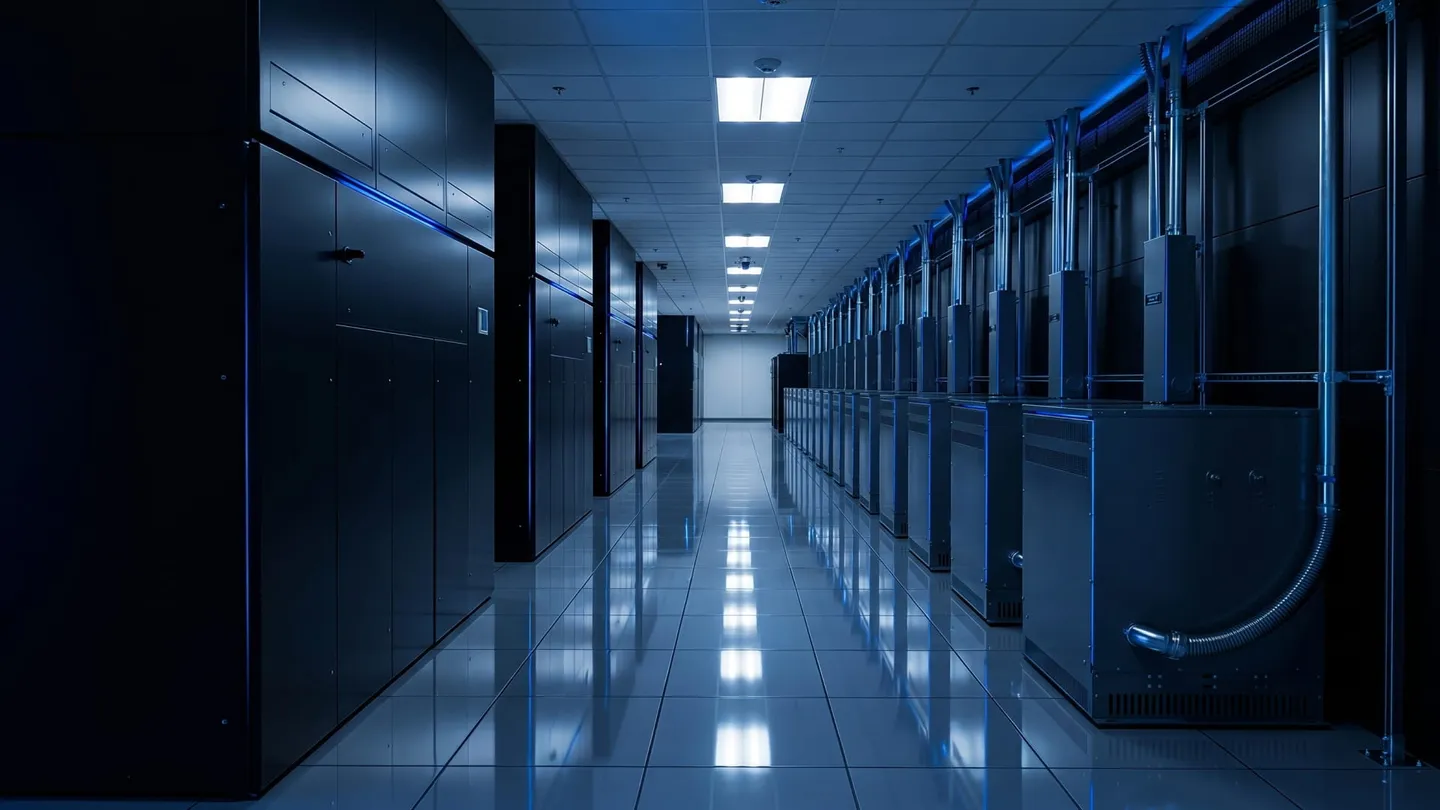
Csquare is a colocation provider, which means it owns and operates data centers and rents out secure space, power, cooling, and connectivity to customers who install their own computing equipment. The company describes itself as carrier-neutral, meaning customers can connect to many different networks and cloud providers within its facilities rather than being tied to a single one.
Key operating stats (as of March 31, 2026):
- 64 data center sites across 21 metropolitan markets in the U.S., Canada, and the U.K.
- About 389 megawatts of sellable power capacity
- More than 36,600 interconnection products
- Over 1,700 enterprise, network, cloud, and technology customers
- Power densities of up to 150 kW per rack, able to support AI inference workloads
Csquare breaks its business into three main revenue streams. Enterprise colocation, which means renting secure space, power, and cooling, is the core offering, with most customers taking deployments under 5 MW. Interconnection, the cross-connects that let customers link directly to networks, cloud platforms, and one another, accounted for roughly 10% to 13% of recurring revenue in recent years and is described by the company as a key driver of customer “stickiness.” Additional services, such as remote technical support, cabling, and equipment installation, are billed per use and add higher-margin revenue on top of the core contracts.
Pricing generally falls into two buckets: “all-in” contracts that bundle power into a single charge (about 71% of recurring revenue) and “metered power” contracts that bill electricity separately (about 29%). According to the company, most contracts pass higher utility costs through to customers and include annual price escalators, which limits its exposure to swings in power prices.
Most of this revenue is recurring and contracted, typically over terms of one to seven years. According to the company, the average remaining contract term was about 33 months as of the most recent quarter, no single customer represented more than 7% of 2025 revenue, and net revenue churn (the share of existing recurring revenue lost to cancellations after accounting for upgrades) was under 2% in the first quarter of 2026. That diversified, contracted base is the core of the business and the main source of revenue visibility.
Where AI Fits In
Csquare is not an AI company in the way a chip designer or model developer is. It does not build AI hardware or software. Instead, the company positions itself as a beneficiary of AI demand. According to the filing, rising AI use increases the need for higher power density and interconnection, and many of its existing facilities can already host higher-density, GPU-based deployments used for AI inference, the process of running trained models to generate outputs.
The company describes its exposure to enterprise AI and inference workloads as a competitive strength but frames its approach as “disciplined and targeted” rather than a wholesale bet on AI. In other words, AI is one of several demand drivers, alongside enterprise outsourcing, hybrid cloud, and latency-sensitive applications, that it expects to help fill capacity over time, not the centerpiece of the business. For investors, that means Csquare is best understood as digital-infrastructure “picks and shovels” that could benefit from the AI buildout, rather than as a direct AI play.
Financial Numbers and Key Metrics
At a glance:
- Full-year 2025 revenue: $987.0 million, up about 9% year over year
- Q1 2026 revenue: $270.5 million, up 16% year over year
- Full-year 2025 Adjusted EBITDA: $390.0 million, up from $288.7 million
- Q1 2026 net loss: $66.0 million, wider than the $34.9 million loss a year earlier
- Available liquidity: $357.6 million as of March 31, 2026
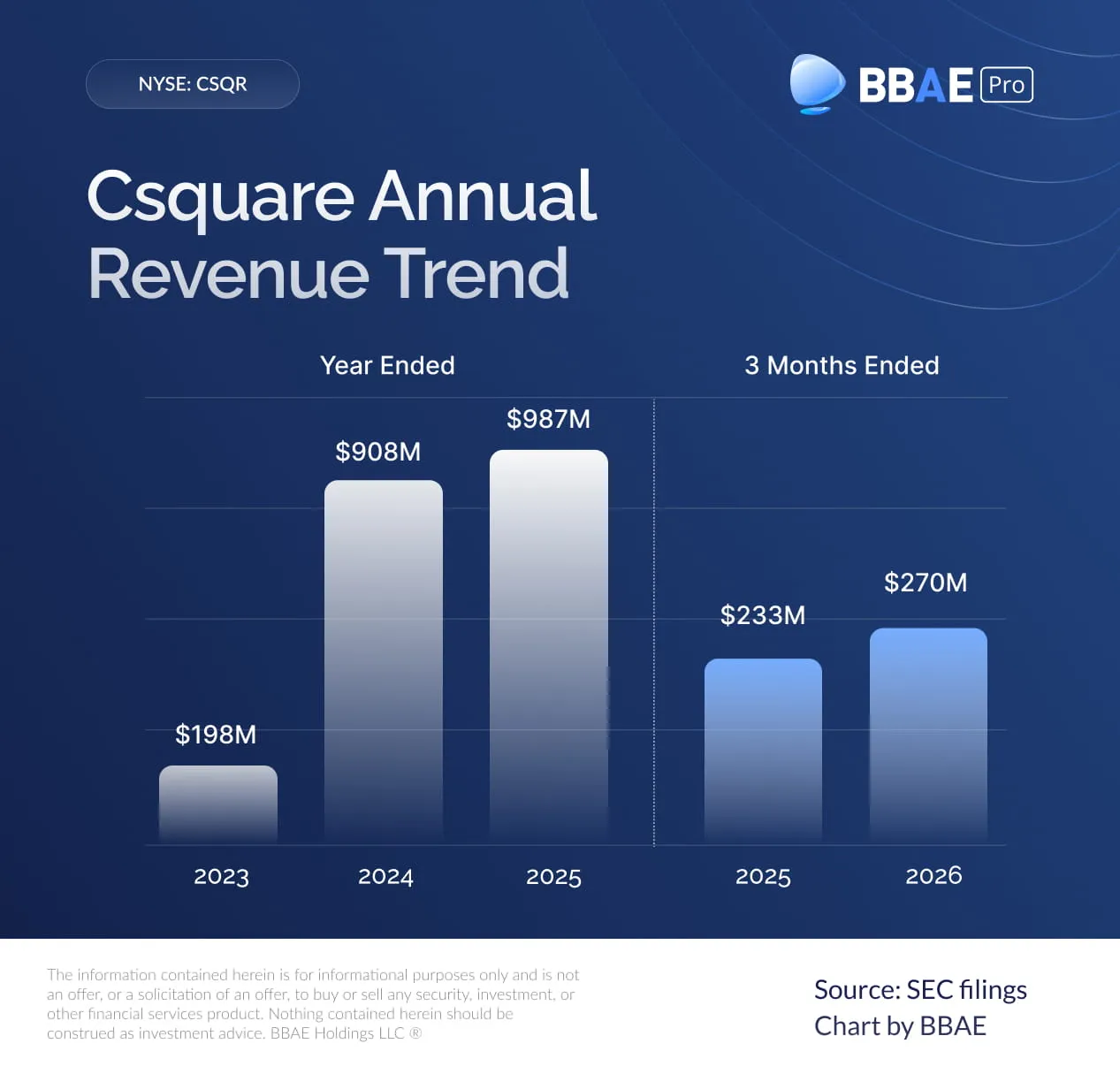
Csquare is a large, growing business that is profitable on an operating basis but still reporting net losses. For the year ended December 31, 2025, revenue was $987.0 million, up about 9% from $907.6 million in 2024. In the first quarter of 2026, revenue rose 16% year over year to $270.5 million from $232.8 million.
Adjusted EBITDA, a measure of operating profitability before interest, taxes, depreciation, and certain one-time items, was $390.0 million for full-year 2025, up from $288.7 million in 2024. In the first quarter of 2026 it reached $108.3 million, compared with $86.3 million a year earlier. The gap between healthy Adjusted EBITDA and the company’s bottom line is significant: Csquare reported a net loss of $119.9 million for full-year 2025 and $66.0 million in the first quarter of 2026, the latter wider than the $34.9 million loss a year earlier. Those losses reflect the heavy depreciation and interest costs that come with operating a large, debt-funded data center portfolio.
The company reported total available liquidity of $357.6 million as of March 31, 2026, including cash, restricted cash, and undrawn credit capacity. According to the filing, new bookings totaled $64.2 million in the first quarter of 2026 and $205.3 million for full-year 2025, and the company estimates it has roughly 670 megawatts of embedded expansion capacity it can build out over time.
How Brookfield Built Csquare
Csquare was assembled by Brookfield Infrastructure rather than grown from a single startup. According to public records, Brookfield bought Evoque Data Center Solutions from AT&T in 2019 for about $1.1 billion, then acquired Cyxtera Technologies in January 2024 for roughly $775 million, and combined the two into a platform called Centersquare in 2024. The business was renamed Csquare in early 2026 ahead of the IPO.
That history is relevant for investors because part of the portfolio traces back to Cyxtera, which had gone public through a SPAC merger in 2021 and later filed for bankruptcy in 2023 in a higher interest rate environment. In effect, the IPO is a test of whether stronger demand for data center capacity, including AI-related workloads, can support public-market value for a collection of assets that struggled under different conditions and ownership.
Debt and Capital Structure
Csquare carries a large, debt-heavy balance sheet, which is common for capital-intensive data center operators but matters for equity investors. Its main revolving credit facility grew from $200 million in early 2024 to $800 million by the end of 2025, and the company has issued at least $3.8 billion of securitized notes backed by data center revenue. According to the company, IPO proceeds will go mainly toward repaying its revolving facility, a promissory note, and a portion of its 2024 asset-backed notes, which makes the offering partly a debt-reduction event.
IPO Structure and Governance
Csquare plans to list on the New York Stock Exchange under the ticker $CSQR, led by underwriters Morgan Stanley and TD Securities. The share count and price range were not set at the time of filing, though Renaissance Capital estimated the offering could raise up to roughly $650 million.
The key point for investors is control. Brookfield will remain the controlling shareholder after the IPO, with the power to decide matters that require a stockholder vote and the right to nominate a majority of the board while it holds at least 50% of the stock. Csquare also expects to qualify as a “controlled company,” which exempts it from some NYSE governance requirements, so public shareholders will have limited influence.
Conclusion
Csquare is coming public into strong demand for data center capacity, with about $1.0 billion in annual revenue, roughly $390 million in Adjusted EBITDA, a recurring contracted customer base, and a stated plan to use IPO proceeds to reduce debt. At the same time, the company is still reporting net losses, carries a large multi-layered debt load, will remain firmly under Brookfield’s control after the offering, and includes assets that struggled the last time part of the business was publicly traded. For investors weighing the IPO, the key questions will be the eventual valuation relative to peers such as Equinix, how quickly the company can reduce leverage and move toward net profitability, and how much the ongoing Brookfield control and potential future share sales weigh on minority shareholders.
This article is for informational purposes only and is neither investment advice nor a solicitation to buy or sell securities. All investments involve inherent risks, including the total loss of principal, and past performance is not a guarantee of future results. Investing in initial public offerings (IPOs) carries additional risks, such as volatility, limited operating history, lack of liquidity, and potential overvaluation. IPO stocks may experience significant price fluctuations and may not perform as expected. Always conduct thorough research or consult with a financial expert before making any investment decisions. BBAE has no position in any investment mentioned.