Getting Exposure to Private Tech Giants in 2026


Getting Exposure to Private Tech Giants in 2026
Private companies are reaching record valuations, and everyone wants a piece of it. OpenAI closed a funding round at an $852 billion valuation in March 2026. Anthropic followed at $965 billion in May. Stripe changed hands at $159 billion, Databricks is weighing a raise above $165 billion, and names like Scale AI and Revolut have repriced higher. The problem for most investors is simple: you still cannot walk into a brokerage account and buy shares of any of them directly.
The list of public-market ways to get economic exposure to these private leaders is broader than it was even a year ago, spread across large public companies that hold disclosed stakes, listed fund vehicles that warehouse private positions, and strategic partnerships that are economically meaningful without being ownership. The catch is that not all exposure is the same. A disclosed equity stake plus a major commercial contract is a very different thing from a 2% weight in an ETF or a customer relationship, and treating them as equivalent is the most common mistake retail investors make in this corner of the market.
This article walks through the most realistic public routes to the best-known private companies, ranked by how much of the upside actually flows through to the investor.
The Three Routes to Private-Company Exposure
There are broadly three ways the public market lets you touch a private company, and they are not created equal.
The first is a disclosed equity stake held by a public operating company. When Microsoft reports a roughly 27% as-converted position in OpenAI, or Meta buys 49% of Scale AI, the economics are real and material. This is the closest a retail investor gets to owning the cap table, even if it arrives wrapped inside a much larger business.
The second is a listed or retail-accessible fund vehicle that holds private shares directly or synthetically. Interval funds like ARK Venture Fund ($ARKVX), listed venture funds like Fundrise Innovation Fund ($VCX), closed-end vehicles like Destiny Tech100 ($DXYZ), and investment trusts like Scottish Mortgage ($SMT) all carry late-stage private positions. These can be more concentrated than an operating-company stake, but the wrapper itself introduces premiums and discounts to net asset value, limited liquidity, valuation lag, and sometimes opaque special-purpose-vehicle (SPV) structures.
The third is a strategic partnership or customer/supplier relationship. A venture-arm check or a cloud-distribution deal can matter to sentiment and usage, but it is usually a weak claim on the private company’s upside. This is theme exposure, not ownership exposure.
OpenAI: The Cleanest Large-Cap Route
OpenAI is the generative-AI platform behind ChatGPT and a fast-growing enterprise and API business. The company said it closed a $122 billion funding round at an $852 billion post-money valuation on March 31, 2026, and later confirmed a confidential S-1 submission to the SEC in June 2026.
The strongest public route is Microsoft ($MSFT). Microsoft disclosed that after OpenAI’s recapitalization, its investment was valued at about $135 billion, representing roughly 27% on an as-converted, diluted basis, alongside an incremental commitment from OpenAI to purchase $250 billion of Azure cloud services. That combination of a large equity stake and a deep commercial contract makes Microsoft the clearest equity-plus-revenue exposure in the entire market, and a High-strength route, even though OpenAI remains only one piece of Microsoft’s much larger earnings base.
For investors who want cap-table exposure rather than cloud-revenue exposure, SoftBank Group ($SFTBY) is the other high-conviction name. SoftBank said that after a follow-on investment, its cumulative position in OpenAI was expected to total $64.6 billion, representing approximately 13% ownership, with the new securities structured as preferred shares convertible upon a listing. That is an unusually direct claim on OpenAI’s value, and also a High route.
There are weaker large-cap routes through Amazon ($AMZN) and NVIDIA ($NVDA), which anchored OpenAI’s early-2026 financing with $50 billion and $30 billion commitments respectively, paired with distribution and compute partnerships. Because neither disclosed a specific ownership percentage, these are better treated as Medium routes.
Fund wrappers now matter here too. ARK Venture Fund ($ARKVX) disclosed OpenAI at 8.5% of assets; Fundrise Innovation Fund ($VCX) showed OpenAI at roughly 12% at the time of its NYSE listing; and Destiny Tech100 ($DXYZ) discloses OpenAI economic exposure through a vehicle structure. These are Medium routes: direct enough to matter, but mediated by fund expenses, premiums and discounts, and in some cases SPVs.
Anthropic: A Broad Public Ecosystem
Anthropic develops the Claude family of models and has become one of the largest enterprise AI vendors. The company said it raised $65 billion in Series H funding at a $965 billion post-money valuation on May 28, 2026, and confirmed a confidential S-1 submission days later.
The strongest operating-company route is Amazon ($AMZN). Amazon’s 2025 annual filing showed its investment activity was driven largely by convertible notes from Anthropic, including $2.7 billion in 2025, with prior Anthropic notes carried at an estimated fair value of $13.8 billion by the end of 2024. Amazon and Anthropic later said Amazon would invest $5 billion immediately and up to an additional $20 billion tied to commercial milestones, on top of $8 billion already committed. Combined with the deep AWS and custom-silicon relationship, this is a High route.
Alphabet ($GOOGL) is the other major public name. Reporting in April 2026 indicated Alphabet committed $10 billion immediately and up to $40 billion in total to Anthropic, deepening the relationship even though the two compete in AI. Because no specific percentage stake was disclosed, this sits at Medium-to-High.
Anthropic also has the broadest fund ecosystem of any name in this group. KraneShares AGIX ($AGIX) disclosed a 2.76% direct Anthropic holding; Alger ALAI ($ALAI) showed 2.08%; ARK Venture Fund ($ARKVX) has held Anthropic among its top positions; Fundrise’s $VCX disclosed Anthropic at roughly 21% of assets at listing, the most concentrated of the group; and Scottish Mortgage ($SMT) listed Anthropic in its top ten at about a 2.7% weight.
Scale AI and Databricks
Scale AI provides the data-labeling and evaluation infrastructure used to train and validate AI systems. The defining transaction was Meta’s June 2025 acquisition of a 49% stake for $14.3 billion, valuing Scale at about $29 billion. That makes Meta ($META) the dominant route by a wide margin and a High-strength one, since a 49% position is unusually large for a minority investment. The limitation is concentration: unlike OpenAI or Anthropic, Scale has no robust ecosystem of retail fund wrappers, so Meta is effectively the only practical route, and Scale’s upside is diluted by Meta’s much larger advertising and platform businesses. Amazon and NVIDIA hold older, smaller positions from a 2024 round, rating Low-to-Medium.
Databricks, the data and AI platform built around the lakehouse model, shows the opposite problem: fragmented exposure. Its latest completed round valued it at $134 billion in December 2025, and management signaled in June 2026 that it might raise fresh capital at $165 billion to $175 billion. Microsoft, Amazon (via AWS), and Alphabet (via CapitalG) all participated in earlier funding, with Microsoft ($MSFT) the strongest listed route given its disclosed investment history plus the Azure Databricks partnership, though Databricks is a small slice of Microsoft’s economics. The more concentrated exposure sits in funds: $VCX disclosed Databricks at roughly 18% of assets at listing, Alger ALAI ($ALAI) showed a 1.95% Series K preferred position, and $DXYZ lists multiple Databricks line items. These are Medium routes carrying the usual private-asset valuation and liquidity risk.
Fintech: Stripe and Revolut
Stripe, the global payments and financial-infrastructure platform, was valued at $159 billion in a February 2026 employee and shareholder tender, up sharply from the prior year. There is no large public operating-company stake here, so the cleanest routes are fund wrappers. Scottish Mortgage ($SMT) showed Stripe at 3.5% of assets in its May 2026 factsheet and discussed the valuation step-up in its annual report, while Destiny Tech100 ($DXYZ) lists Stripe among current holdings. Both are Medium routes. Stripe is also economically important to a long list of public companies as a payments backend, but that customer relationship supports the valuation of Stripe and the funds that hold it, not the economics of any one public customer.
Revolut, the consumer-fintech and neobank platform, completed a November 2025 secondary share sale at a $75 billion valuation and received full UK banking approval in March 2026. As with Stripe, the wrappers are the story: Scottish Mortgage ($SMT), Schroders Capital Global Innovation Trust ($INOV), and Destiny Tech100 ($DXYZ) all hold Revolut, each at Medium strength. The research turned up no public operating company with a large disclosed Revolut stake comparable to Microsoft/OpenAI or Meta/Scale.
The Thinner Names: ElevenLabs, Vercel, and Neuralink
Some widely followed private companies offer real but thin public exposure.
ElevenLabs, a voice-generation and conversational-audio company, raised $500 million in a Series D at an $11 billion valuation in February 2026 and said it had surpassed $500 million in annual recurring revenue. Its strategic investors include public-company venture arms such as Deutsche Telekom, HubSpot Ventures, RingCentral Ventures, and Liberty Global Ventures, but at the parent level these stakes are almost certainly immaterial, rating Low.
Vercel, a cloud and developer-tools provider, raised $300 million in a Series F at a $9.3 billion valuation in September 2025. The public routes are weak: a strategic collaboration with AWS gives Amazon some commercial exposure, and GV and Salesforce Ventures participated in the round, but all rate Low.
Neuralink, the brain-computer interface company, raised a $650 million Series E in mid-2025 at roughly a $9 billion to $9.65 billion valuation. The most usable retail route is ARK Venture Fund ($ARKVX), at Medium strength. Notably, the research found no evidence that Tesla or other Musk-linked public companies own Neuralink by default, so the Elon ecosystem proxy runs through $ARKVX, not $TSLA.
Exposure Summary
The table below lists the most realistic public routes identified, sorted by company. Strength reflects how much of the return is likely to track the private company itself.
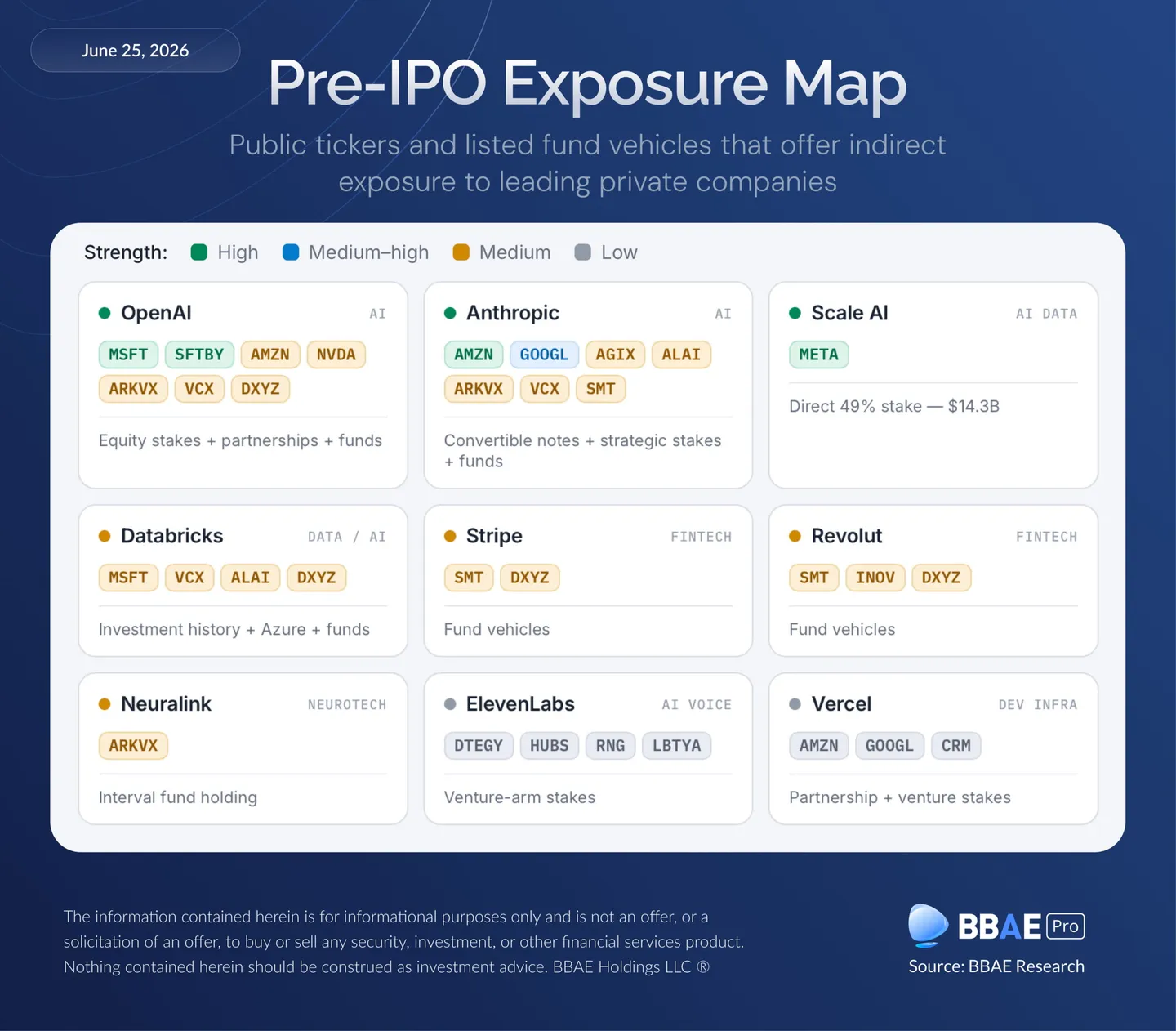
What Retail Investors Should Watch
The most important takeaway is that exposure usually fragments. For the largest names, the cleanest route is a big public company whose return is only partly driven by the private asset. Microsoft gives the cleanest OpenAI exposure, but OpenAI is one component of a far larger business. Meta gives unusually direct Scale AI exposure, but it is still embedded inside an advertising giant. The fund wrappers can be more concentrated, but they introduce their own complications.
Transferability and dilution are the next concern. Private shares often sit behind consent rights, preferred stacks, or SPV arrangements that do not map cleanly to common-equity economics. The SPV disputes around Anthropic- and OpenAI-related wrappers show that economic exposure can prove more fragile than retail investors assume, and future funding rounds can dilute existing holders.
In short, retail investors can get exposure to this year’s most valuable private companies, but they usually cannot get clean control of the cap-table economics. The strongest opportunities are concentrated in a relatively small set of names and vehicles. Much of the rest is better described as theme exposure than ownership exposure, and the difference is exactly what a disciplined, research-driven investor should be paid to understand.
This article is for informational purposes only and is not investment advice or a solicitation to buy or sell securities. The content is based on publicly available information and reflects the author’s opinions as of the publication date, which may change without notice. All investments carry inherent risks, including the potential loss of principal, and past performance is not indicative of future results. Readers should conduct their own research or consult a financial advisor before making investment decisions.