Memory Stocks in 2026: What’s Driving the Rally

Memory Stocks in 2026: What’s Driving the Rally
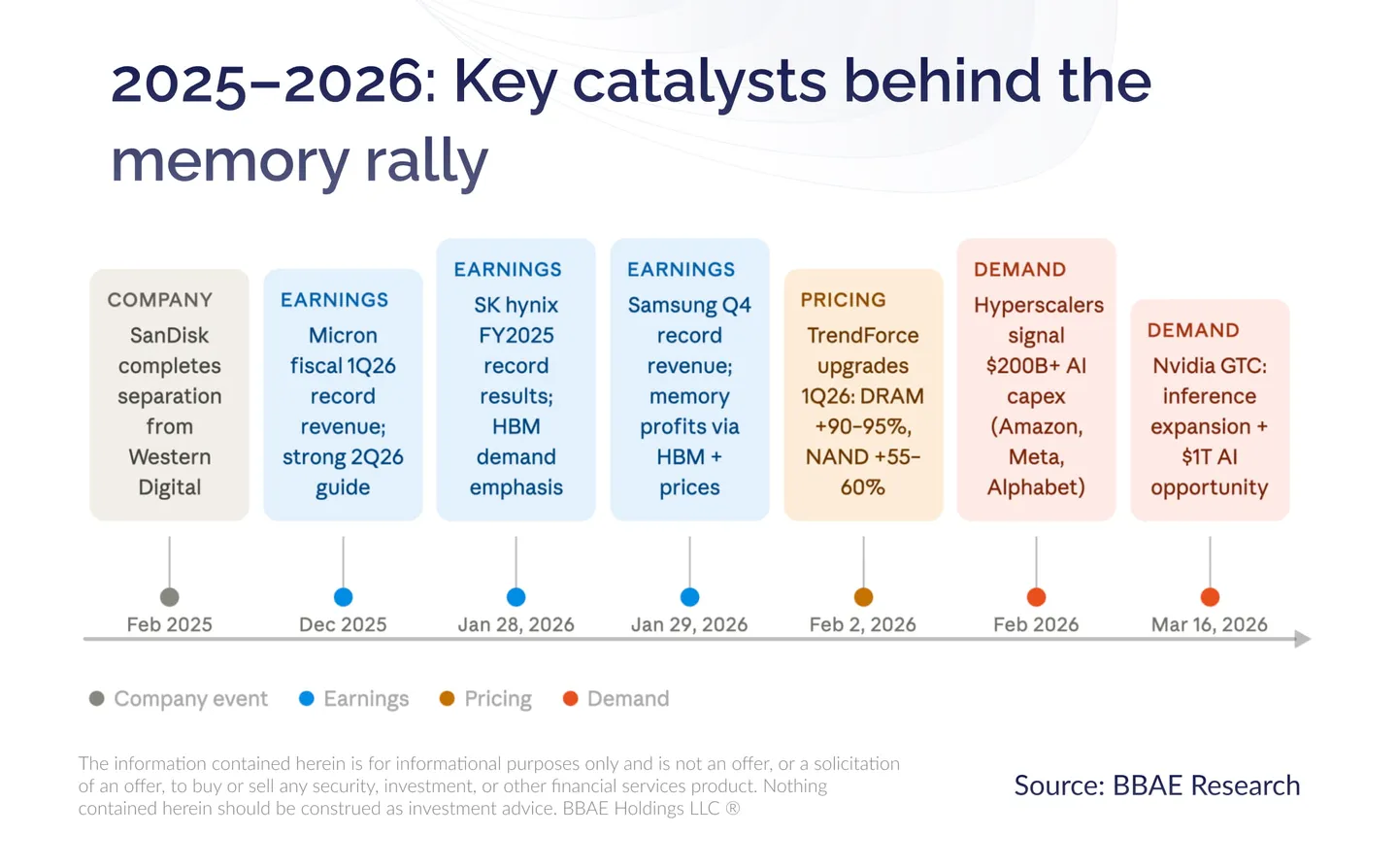
Memory has moved from a commodity-cycle story to an AI infrastructure bottleneck story. In early 2026, contract-price momentum is extreme: TrendForce upgraded its 1Q26 forecast to +90–95% QoQ for conventional DRAM and +55–60% QoQ for NAND flash contract prices, citing persistent AI/data-center demand and a worsening supply–demand imbalance. Gartner projects a 130% surge in combined DRAM + SSD prices by end-2026, enough to raise device prices and reshape upgrade cycles.
The equity rally has followed the pricing and earnings math: when memory prices rise faster than unit costs, gross margins tend to expand quickly. Company reports show that dynamic already underway. Micron posted record fiscal 1Q26 revenue and guided sharply higher revenue and margins for fiscal 2Q26, and the newly independent SanDisk reported a step-change in revenue, margins, and forward guidance. In Korea, Samsung Electronics and SK hynix both printed all-time highs in late February 2026.
Momentum can continue if hyperscaler capex keeps accelerating, HBM-related constraints keep crowding out conventional DRAM and NAND supply, and inventories stay lean enough that buyers accept higher prices. The main risk is the historical one: a sharp inventory correction once customers decide they have enough memory at today’s prices, exactly the behavior memory cycles are famous for.
Market Snapshot
Memory is a high operating-leverage business: pricing upswings create sudden earnings power, which markets tend to reprice rapidly. The three US-listed names at the center of this cycle are Micron ($MU), SanDisk ($SNDK), and Western Digital ($WDC) — each with a distinct exposure profile. For context, Korea’s Samsung Electronics and SK hynix, the other two major global players, have also hit all-time highs in early 2026.
Comparison Table (as of March 17, 2026)
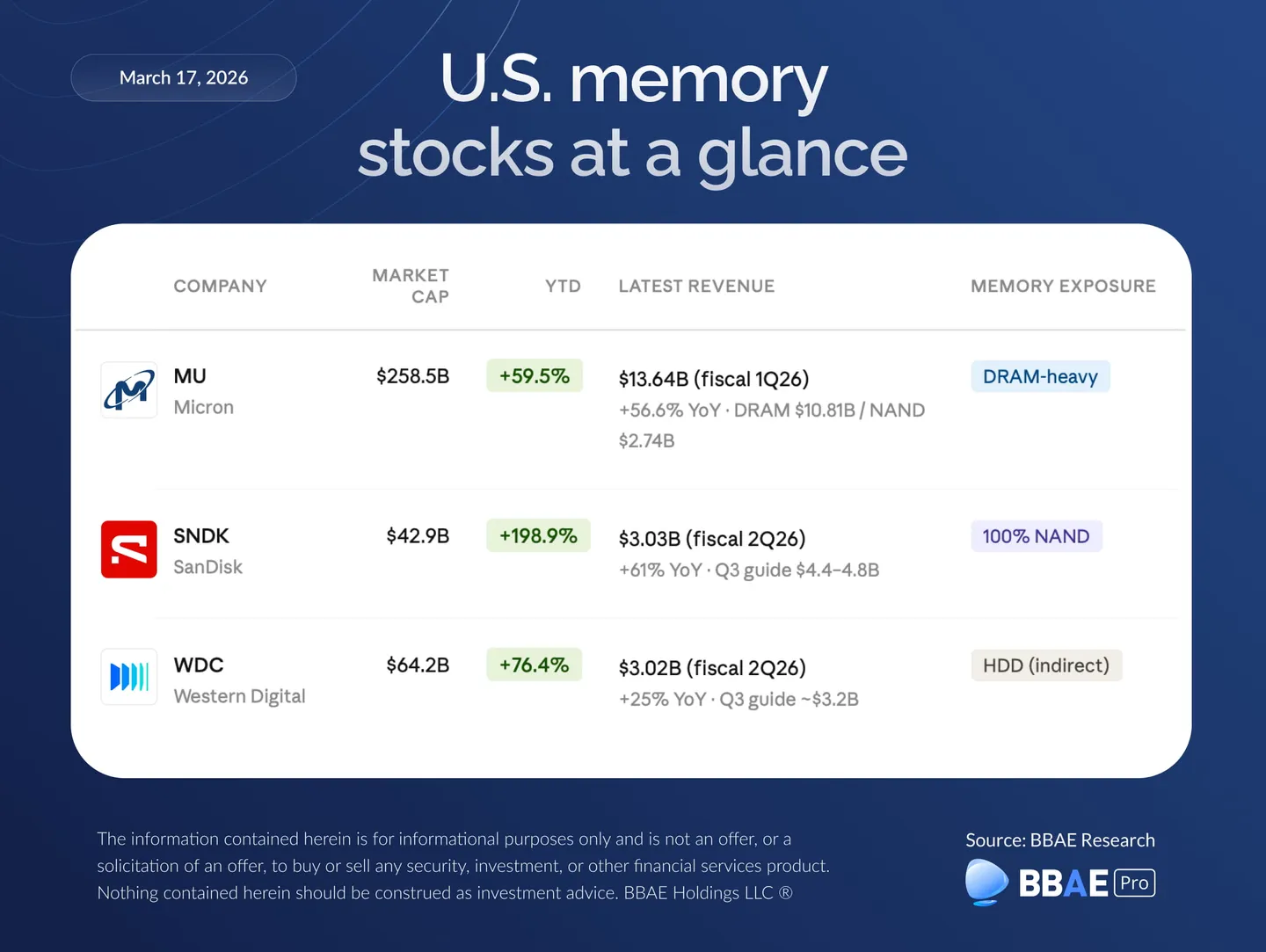
A few things stand out in the data. Micron is the only US pure-play with direct DRAM exposure, which matters most in the current cycle given DRAM prices are rising faster than NAND. SanDisk is the NAND pure-play — spun out of Western Digital in early 2025, with shares up over 800% in the past year as enterprise SSD demand accelerated. Western Digital, now purely an HDD business post-separation, has rallied on storage market tailwinds but is no longer a direct memory play.
Demand Drivers: AI Data Centers and “Memory Everywhere”
A key structural driver is that AI compute scales with memory bandwidth and storage throughput. Gartner’s 2025 semiconductor ranking identifies AI semiconductors, including HBM and networking, as a primary growth engine representing nearly a third of total sales, and estimates AI infrastructure spending may surpass $1.3 trillion in 2026. Hyperscaler spend isn’t just GPUs; it pulls in HBM, DDR5, enterprise SSDs, and high-capacity storage.
Recent capex guidance illustrates the scale of demand. Alphabet guided $175–185B of 2026 capex, Amazon projected roughly $200B, Microsoft reported quarterly capital spending of $37.5B with about two-thirds going toward computing chips, and Meta lifted 2026 guidance to $115–135B. Buyers across the board are reserving capacity and pulling forward procurement.
Memory content is also rising across end markets beyond hyperscalers:
Enterprise AI storage (NAND/SSDs): TrendForce reports a surge in enterprise SSD orders since late 2025, with enterprise SSD prices projected up 53–58% QoQ in 1Q26 as buyers stockpile amid a widening supply gap. SanDisk’s datacenter revenue grew 64% sequentially in fiscal 2Q26.
PCs and smartphones: Gartner notes that memory prices are high enough to expect PC shipments to fall 10.4% and smartphone shipments 8.4% in 2026, with demand concentrating toward premium configurations where vendors can absorb component cost increases.
Automotive, industrial, and edge/IoT: Micron’s segment reporting shows revenue in automotive and embedded alongside cloud, data center, and mobile, reflecting demand across a broader set of end markets.
Supply and Pricing Dynamics: Why This Cycle Feels Tighter
Memory supply can’t respond quickly, and AI is changing where supply gets allocated. Order volumes in 1Q26 are exceeding suppliers’ production capacity, and even incremental supply gains require process upgrades rather than simply turning on idle capacity. At the same time, manufacturers are reallocating some production lines toward DRAM given its stronger profitability, which further constrains NAND expansion. The result is a classic setup: demand pulling forward while supply expansion is slow and partially redirected.
Company disclosures tell a consistent story. SK hynix is scaling both front-end and advanced packaging capacity to meet AI memory demand, with HBM as its centerpiece. Samsung’s Memory Business posted record quarterly revenue and profit driven by HBM, high-value products, and a broad market price surge, and the company is prioritizing AI-related DRAM and NAND. SanDisk frames its post-spin strategy around a “structural reset” aligned to what it describes as sustained enterprise demand, with accelerating SSD deployments as the main evidence.
Consolidation also matters here. HBM alone represented an estimated 23% of the DRAM market in 2025, surpassing $30B in sales. A market where a large share of DRAM revenue is tied to a specialized, complex product tends to behave differently from older commodity cycles where supply could respond more quickly.
Pricing and Inventory: DRAM vs. NAND
The core reason memory equities have moved so sharply is that pricing is changing in large, fast steps, which tends to drive significant earnings revisions in a short window. The 1Q26 contract price upgrades for both DRAM and NAND represent some of the steepest quarterly moves on record.
Inventory dynamics remain the biggest swing factor. When buyers expect shortages, they sign long-term agreements and build inventory; when they feel adequately supplied, they pause purchasing and prices can fall quickly. Current buyer behavior, including annual DRAM long-term agreements being negotiated across North America and China and active enterprise SSD stockpiling, is consistent with the tightening stage of a memory cycle. Whether that behavior persists or reverses is the central question for the next phase.
One additional wrinkle: if component inflation becomes severe enough, it can destroy demand at the lower end of the market. Gartner’s forecast for PC and smartphone shipment declines in 2026 reflects that dynamic. Higher prices can still support strong near-term profits if supply stays tight, but they also raise the probability of an inventory correction later if vendors overbuild.
Earnings and Guidance: The Narrative in the Numbers
Micron’s fiscal 1Q26 results show why investors are rewarding memory exposure in this environment. Revenue came in at $13.64B versus $8.71B in the prior year period, with DRAM contributing $10.81B and NAND $2.74B of that total. The company guided fiscal 2Q26 revenue to $18.7B with gross margins in the high 60s, a step-change from recent history. DRAM, particularly AI server memory, is doing the heavy lifting.
SanDisk illustrates how powerful operating leverage can be in flash when pricing turns. Fiscal 2Q26 revenue was $3.03B, up 61% year over year, with non-GAAP EPS of $6.20. The company guided fiscal 3Q26 revenue to $4.4–4.8B and non-GAAP EPS of $12–14, a sharp acceleration driven largely by datacenter deployments.
Western Digital, now purely an HDD business following the SanDisk separation, reported fiscal 2Q26 revenue of $3.02B, up 25% year over year, with 3Q26 guidance of roughly $3.2B. It is no longer a direct memory play, but remains a beneficiary of the broader AI data storage buildout through high-capacity cloud HDDs.
Bottom line
The rally reflects three converging forces: AI-driven demand and hyperscaler capex, unusually tight supply allocation particularly around HBM and enterprise storage, and a pricing surge that is rapidly expanding earnings. How long that continues depends on whether pricing power holds and whether customers remain in “secure supply” mode. Memory has historically been a cyclical market, and that hasn’t changed — the current upcycle is unusually sharp, but inventory and demand dynamics can shift quickly.
This article is for informational purposes only and is not investment advice or a solicitation to buy or sell securities. The content is based on publicly available information and reflects the author’s opinions as of the publication date, which may change without notice. All investments carry inherent risks, including the potential loss of principal, and past performance is not indicative of future results. Readers should conduct their own research or consult a financial advisor before making investment decisions. BBAE holds no position in the securities mentioned, nor are they compensated by the companies mentioned.