
Quantum Stocks: Government Backing and the Race to Scale


Quantum computing has moved quickly since our April 2026 update, Quantum Computing Stocks: Where the Sector Stands in 2026.
At the time, the biggest change in the sector was that attention was moving away from simple qubit-count headlines and toward the infrastructure needed to make quantum computers useful: error correction, networking, calibration, foundries, and hybrid systems that combine quantum and traditional computing.
Five months later, that shift has become even clearer.
The U.S. government has committed billions of dollars to building a domestic quantum ecosystem and, unusually, is taking equity stakes in some of the companies it is funding. IonQ has completed its acquisition of semiconductor foundry SkyWater and unveiled a new 256-qubit platform. Quantinuum has become a publicly traded company. D-Wave and Rigetti have secured major government support for their next-generation systems.
Quantum computing is still far from a mature commercial industry, but the race is increasingly becoming about who can actually manufacture, scale and operate these machines rather than who can produce the most impressive laboratory demonstration.
The U.S. Government Is Now Investing Directly in Quantum Companies
The biggest development since our last update came from Washington.
In May, the U.S. Department of Commerce announced a $2.013 billion quantum computing initiative under the CHIPS and Science Act. The program covers seven quantum-computing companies and two semiconductor foundries, with the goal of solving technical bottlenecks standing between today’s machines and larger fault-tolerant systems.
The planned funding spans several competing approaches to quantum computing.
D-Wave, Rigetti, Quantinuum, PsiQuantum, Infleqtion and Atom Computing were each selected for up to $100 million, while silicon-spin company Diraq was selected for up to $38 million. GlobalFoundries was allocated $375 million toward a domestic quantum foundry, while IBM was selected for up to $1 billion to build manufacturing capacity for quantum-grade superconducting wafers. The full list and proposed funding amounts are detailed by Commerce here.
That matters because the government is not choosing one winning quantum architecture. Instead, it is effectively backing a portfolio of technologies including superconducting qubits, trapped ions, neutral atoms, photonics and silicon spin.
There is another unusual part of the program.
The Commerce Department said it would receive a minority, non-controlling equity stake in each funded company as a condition of providing the money. Rather than functioning purely as a research grant, part of the program therefore resembles strategic government investment.
On September 8, several of those awards moved from planned funding to final agreements.
D-Wave: $100 Million and a U.S. Government Shareholder
D-Wave ($QBTS) finalized an agreement for up to $100 million in CHIPS Act funding.
According to the official Department of Commerce announcement, the funding will support semiconductor-process technology for both annealing and gate-model superconducting quantum systems, including improvements in qubit counts, error rates, coherence, materials and advanced packaging.
This is notable because D-Wave is no longer solely a quantum-annealing story. Through its acquisition of Quantum Circuits, the company is also building gate-model superconducting systems.
The equity portion of the government agreement is already concrete.
D-Wave issued 7,095,721 shares to the U.S. Department of Commerce. A subsequent SEC filing registered those shares for potential resale by the government.
This makes the government more than a customer or research partner. It is now an actual shareholder in D-Wave.
Rigetti Gets Its Own $100 Million Agreement
Rigetti Computing ($RGTI) finalized a similar agreement for up to $100 million.
The Commerce Department’s official Rigetti award announcement says the program is aimed at several of the less visible but extremely important engineering problems involved in scaling superconducting quantum computers: readout electronics, next-generation cryostat architectures and fabrication capabilities for highly connected quantum chips.
These are exactly the kinds of problems that become more difficult as quantum systems grow.
Building a small processor with high fidelity is one challenge. Preserving those performance levels while adding substantially more qubits, wiring, control electronics and interconnections is another.
The Department of Commerce will also become a Rigetti shareholder as part of the agreement. Rigetti’s SEC filing on the definitive agreement provides the equity details.
Once again, the significance goes beyond the cash. The U.S. government is explicitly treating domestic quantum-computing capability as strategic infrastructure.
Quantinuum Becomes Another Major Public Quantum Stock
One company was missing from our April public-company overview because investors could not buy it yet.
That changed in 2026.
Quantinuum now trades publicly under the ticker $QNT, adding another major pure-play quantum company to the public market.
Quantinuum was created from the combination of Honeywell Quantum Solutions and Cambridge Quantum and uses trapped-ion quantum computers, the same broad qubit category used by IonQ.
Its arrival meaningfully expands the publicly traded quantum universe. Investors now have large pure-play companies representing superconducting systems, trapped ions, neutral atoms, photonics and quantum annealing.
Quantinuum also finalized a $100 million Department of Commerce award.
The official Commerce announcement for Quantinuum says the funding targets manufacturing bottlenecks involved in scaling fault-tolerant trapped-ion quantum computers, including low-loss integrated photonics, specialized semiconductors for cryogenic environments and reliable optical components.
The government also received 2,369,528 shares of Quantinuum Class A common stock under the agreement, according to the company’s SEC filing.
That puts $QNT alongside $QBTS and $RGTI as publicly traded quantum companies in which the U.S. government now owns equity.
IonQ Takes a Different Route
IonQ ($IONQ) was notably not included among the seven quantum-computing companies selected for this Commerce Department program.
That does not mean IonQ has been standing still.
One of the biggest developments discussed in our April article was IonQ’s planned acquisition of SkyWater Technology. That transaction has now closed.
On July 31, IonQ officially completed its acquisition of SkyWater Technology, bringing a U.S.-based semiconductor foundry directly inside the company. SkyWater continues serving outside customers, but IonQ now has internal access to manufacturing, advanced packaging and semiconductor-development capabilities that would otherwise require outside suppliers.
This creates an interesting strategic difference.
While the Commerce Department is spending hundreds of millions of dollars helping build shared domestic quantum-foundry infrastructure, IonQ has effectively acquired its own manufacturing platform.
The first visible result arrived in September with Superion 256, IonQ’s sixth-generation quantum computing platform.
IonQ says the first Superion 256 chips have already been fabricated at SkyWater and that ions have been trapped in a prototype system. The company is accepting orders and expects customer deliveries to begin in 2027.
The broader strategy is becoming clear: IonQ wants to control more of its own technology stack, from quantum processors and semiconductor manufacturing to networking, sensing and security.
The Quantum Foundry Is Becoming Part of the Investment Story
One of the clearest changes in 2026 is how often semiconductor manufacturing now appears in quantum announcements.
That was not always the case.
Early quantum-investing narratives were dominated by the number of qubits inside a machine. But producing one impressive processor in a laboratory is very different from repeatedly manufacturing thousands of high-quality devices with predictable performance.
That is why the foundry announcements matter.
The Department of Commerce has finalized up to $375 million for GlobalFoundries to establish a secure domestic quantum foundry supporting multiple architectures, along with cryogenic electronics, advanced packaging and heterogeneous integration.
IBM was separately selected for up to $1 billion in planned funding for a quantum foundry focused on quantum-grade superconducting wafers. Commerce announced the planned IBM funding as part of the broader May initiative.
IonQ now owns SkyWater.
D-Wave’s award involves semiconductor-process development and advanced packaging.
Rigetti’s award includes fabrication capabilities and integrated readout electronics.
Quantinuum’s award includes specialized semiconductors and photonic components.
The pattern is hard to miss.
Quantum computing is increasingly becoming a semiconductor-manufacturing story as much as a physics story.
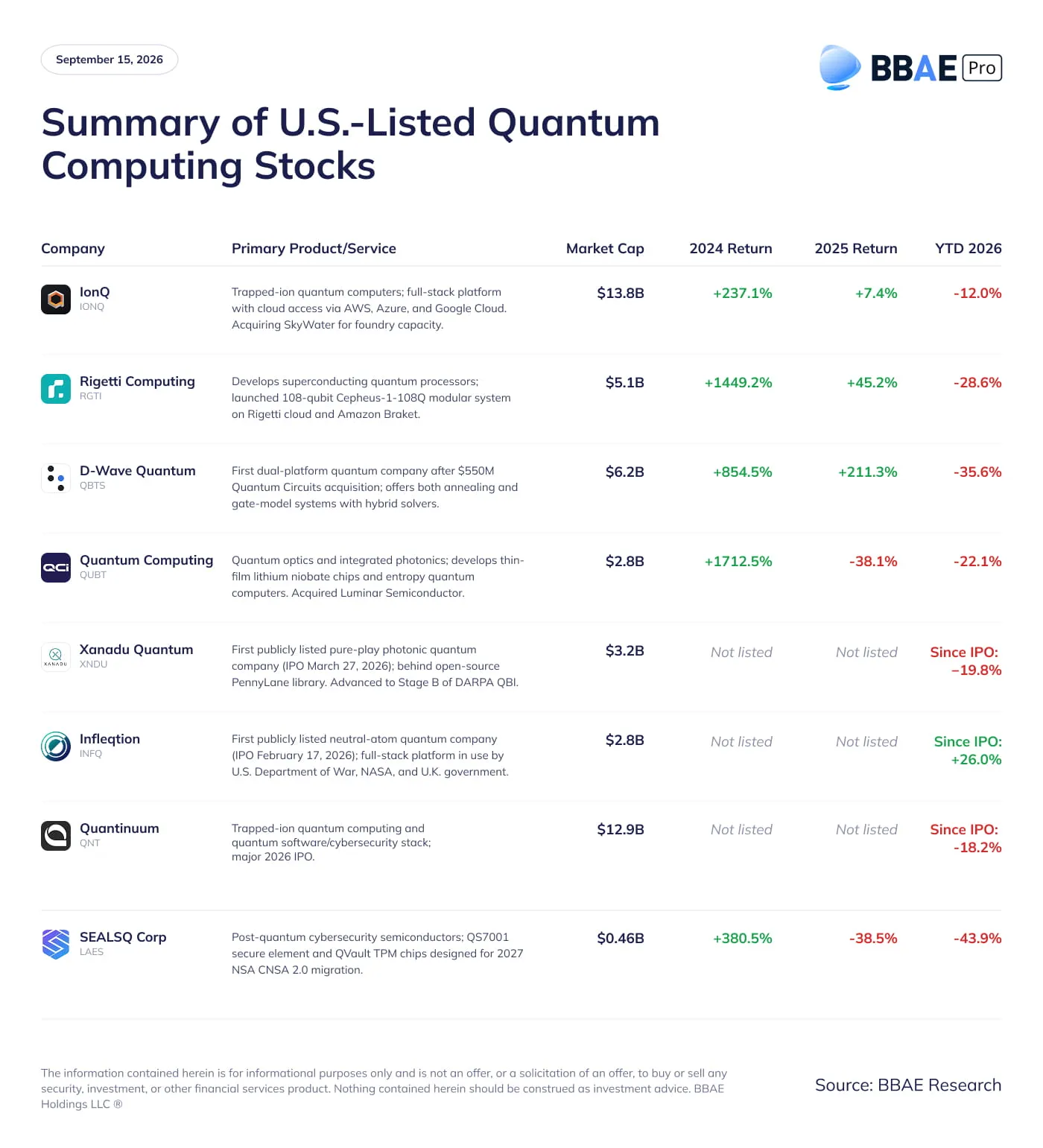
What Has Changed Since April?
When we looked at the sector in April, the main argument was that quantum computing’s center of gravity was moving toward the infrastructure surrounding the qubits.
That trend has accelerated.
Government funding is increasingly targeting manufacturing and engineering bottlenecks. Companies are investing in foundries and advanced packaging. Error correction is becoming more important than raw physical-qubit counts. Quantum networking is developing alongside computing. And the public market now includes more competing architectures than it did only a few months ago.
There is also a noticeable change in how the U.S. government views the sector.
Quantum computing is no longer being treated purely as long-term scientific research.
The Department of Commerce is putting substantial capital behind domestic manufacturing capacity, taking equity positions in funded companies and supporting several competing technological approaches at once.
That does not answer the industry’s biggest technological question: when fault-tolerant quantum computers will become commercially useful at scale.
It does, however, make the direction of travel much clearer.
This article is for informational purposes only and is not investment advice or a solicitation to buy or sell securities. The content is based on publicly available information and reflects the author’s opinions as of the publication date, which may change without notice. All investments carry inherent risks, including the potential loss of principal, and past performance is not indicative of future results. Readers should conduct their own research or consult a financial advisor before making investment decisions. BBAE holds no position in the securities mentioned, nor are they compensated by the companies mentioned.