SpaceX, OpenAI, Anthropic: A Record IPO Year?

SpaceX, OpenAI, Anthropic: A Record IPO Year?
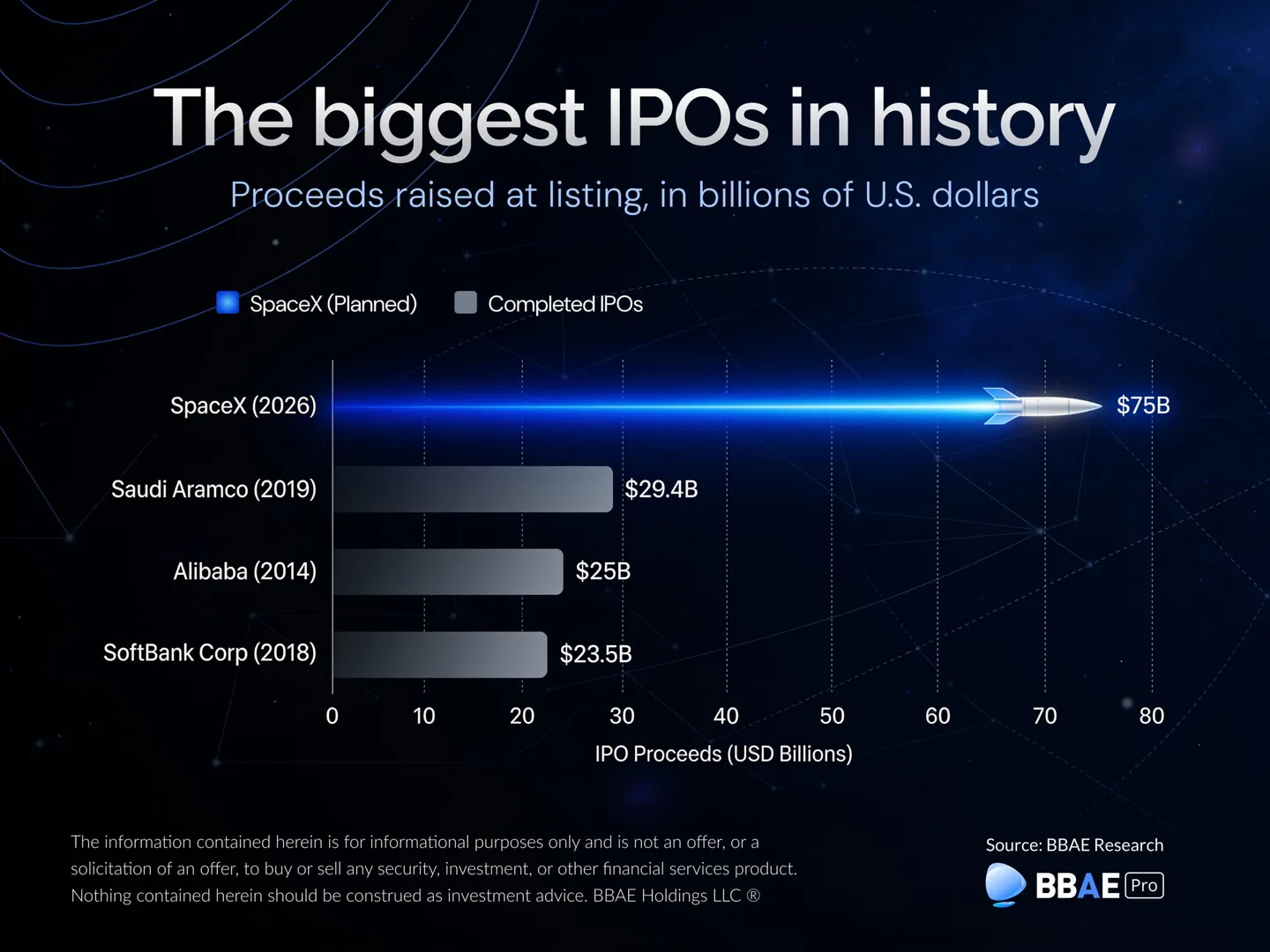
The IPO market just had its busiest two weeks in years. SpaceX is days away from listing on Nasdaq after confirming it will seek $75 billion in what would be the largest initial public offering in history. OpenAI announced on June 8 that it confidentially submitted a draft S-1 to the SEC, saying simply, “We expect it to leak so we’re just announcing it.” And that filing came just one week after Anthropic, the maker of Claude, disclosed its own confidential S-1 on June 1, fresh off a funding round at a $965 billion valuation.
Three of the most valuable private companies in the world are now officially in the IPO pipeline at the same time. The question for investors is no longer whether 2026 will be a strong IPO year. It is whether 2026 will break the all-time record. SpaceX is the deal happening right now, so let’s start there.
The SpaceX IPO: Terms of a Record Deal
SpaceX set terms to sell 555,555,555 shares of Class A stock at a fixed price of $135 each, raising roughly $75 billion at a valuation of about $1.75 trillion. The company plans to trade under the ticker $SPCX, listed on both Nasdaq and the new Nasdaq Texas exchange, with pricing expected June 11 and trading set to begin June 12. For context, the previous record for a single IPO was Saudi Aramco’s $29.4 billion debut in 2019. SpaceX is aiming to more than double it.
Inside the Prospectus: A Space Company That Is Now an AI Company
The prospectus gives investors their first full look at SpaceX’s financials, and it reads less like a rocket company and more like an AI infrastructure company with a rocket business attached. SpaceX posted revenue of $18.67 billion in 2025, up 33% from the prior year, but swung to a net loss of $4.94 billion. The first quarter of 2026 showed the same pattern: $4.69 billion in revenue and a $4.28 billion net loss.
The reason is spending. After absorbing Elon Musk’s xAI in February 2026, SpaceX poured $12.7 billion of capital expenditures into its AI segment in 2025 and another $7.7 billion in the first quarter of 2026 alone, more than its Space and Connectivity segments combined. The AI segment, which includes Grok, X, and the COLOSSUS data centers, generated $3.2 billion of revenue in 2025 against an operating loss of $6.4 billion. The company also carries about $29.1 billion of total debt as of March 31, 2026, and says it expects to receive roughly $74.4 billion in net proceeds from the offering, earmarked first for expanding AI compute infrastructure. According to the company, its total addressable market is $28.5 trillion, of which $26.5 trillion comes from AI.
Starlink Is the Profit Engine
If AI is where the money goes, Starlink is where the money comes from. The Connectivity segment generated $11.4 billion of revenue in 2025, up about 50% year over year, with $4.4 billion of operating income. SpaceX disclosed 10.3 million Starlink subscribers as of March 31, 2026, served by roughly 9,600 satellites, which the company says account for about 75% of all active maneuverable satellites in orbit.
One number worth watching is pricing. Starlink’s average revenue per user has fallen from $99 per month in 2023 to $81 in 2025 and $66 in the first quarter of 2026, meaning subscriber growth has to keep outrunning falling prices for the segment to keep expanding.
A $45 Billion Anthropic Deal, a Google Contract, and an Option on Cursor
Several disclosures around the filing stand out. In May 2026, SpaceX signed cloud services agreements with Anthropic, under which the Claude maker will pay SpaceX $1.25 billion per month through May 2029 for access to roughly 325,000 NVIDIA GPUs at the COLOSSUS data centers. That works out to a contract worth about $45 billion over three years, signed weeks before SpaceX’s listing, with one of the other companies racing toward its own IPO.
Then, just one week before trading begins, SpaceX announced a second mega-customer. On June 5, the company disclosed a cloud services agreement with Alphabet’s Google, which will pay SpaceX $920 million per month from October 2026 through June 2029 for access to approximately 110,000 NVIDIA GPUs, a deal worth roughly $30 billion over its term. Google described the arrangement as bridge capacity to meet surging demand for its Gemini AI products. Combined, the Anthropic and Google contracts are set to bring SpaceX about $26 billion per year, more than the company’s entire 2025 revenue, though both agreements can be terminated by either side with 90 days’ notice after an initial period.
SpaceX also disclosed an option to acquire Cursor, the AI coding startup, at an implied equity value of $60 billion, payable in SpaceX stock. If SpaceX walks away from the deal, Cursor is entitled to a $1.5 billion termination fee plus an $8.5 billion deferred services fee.
Musk’s Control and a Mars Colony Bonus
Governance is where the filing gets unusual. Each Class B share carries 10 votes, and Class B holders elect a majority of the board. Musk will control 82.4% of the voting power after the offering, making SpaceX a “controlled company” exempt from several Nasdaq governance rules.
His incentive package may be the most remarkable disclosure in the document. One billion of Musk’s restricted Class B shares vest only if SpaceX hits market capitalization milestones and establishes a permanent human colony on Mars with at least one million inhabitants. Another 302 million shares are tied to building non-Earth data centers capable of delivering 100 terawatts of compute per year. The company says it expects to begin deploying orbital AI compute satellites as early as 2028, with Starship expected to start delivering payloads to orbit in the second half of 2026.
Why 2026 Could Break the All-Time Proceeds Record
Now zoom out to the full year, because the scale of this one deal changes the math for the entire market. Using Renaissance Capital’s U.S. proceeds data, the $75 billion SpaceX raise alone equals about 52.7% of the entire $142.4 billion raised in the peak year of 2021. Add SpaceX to the roughly $35 billion already raised in U.S. IPOs this year, and 2026 sits at about $110 billion before OpenAI or Anthropic sell a single public share. That is already about 77% of the full 2021 record.
This is where the two AI labs become decisive. OpenAI’s confidential S-1 is now submitted to the SEC, putting the company formally in the IPO pipeline, though it has not published terms and says the filing simply gives it the option to go public sooner if that proves best. Earlier reporting pointed to a potential raise of at least $60 billion at the low end, with a possible debut as soon as the fourth quarter of 2026. If you add that hypothetical low-end OpenAI raise to current 2026 proceeds and the SpaceX deal, the total reaches about $170 billion. That would be roughly $27.6 billion above the 2021 proceeds peak, before counting any Anthropic proceeds at all.
Anthropic, meanwhile, has disclosed no raise target, so its contribution is pure upside that investors cannot yet model. The company filed less than a week after closing a $65 billion Series H round at a $965 billion valuation, and it has told investors it is approaching its first quarterly profit.
SpaceX is the deal that brings the record within reach. OpenAI and Anthropic are the names that could push 2026 past it. Investors will get the first answer on June 12, when $SPCX starts trading.
This article is for informational purposes only and is neither investment advice nor a solicitation to buy or sell securities. All investments involve inherent risks, including the total loss of principal, and past performance is not a guarantee of future results. Investing in initial public offerings (IPOs) carries additional risks, such as volatility, limited operating history, lack of liquidity, and potential overvaluation. IPO stocks may experience significant price fluctuations and may not perform as expected. Always conduct thorough research or consult with a financial expert before making any investment decisions. BBAE has no position in any investment mentioned.