U.S. CEOs in China: What Investors Need to Know About Each Company’s Stakes


U.S. CEOs in China: What Investors Need to Know About Each Company’s Stakes
When a U.S. president travels abroad with a roster of corporate leaders, investors naturally pay attention. President Trump’s May 2026 visit to China brought along one of the most commercially loaded business delegations in recent memory. Companies across semiconductors, aerospace, payments, life sciences, and consumer tech sent their top executives to Beijing. Each leader arrived with a specific business agenda tied to the world’s second largest economy.
A White House official noted that companies essentially needed a “tangible ask” to secure a spot on the trip. That requirement turns the guest list into a highly useful map of where American businesses see the biggest immediate opportunities or friction points in China. Seventeen executives made the journey. Below is a breakdown of what each delegation member is chasing and what the outcomes mean for the market.
The Aerospace Contingent: Boeing and GE Aerospace
Boeing ($BA) and the Push for Aircraft Orders
Boeing’s presence generated massive anticipation. U.S. officials and analysts had been watching closely for a large Chinese aircraft order following reports that Boeing and its Chinese counterparts were discussing a deal for roughly 500 737 MAX jets and widebody aircraft. Treasury Secretary Scott Bessent even publicly stated he expected an announcement involving major Chinese Boeing orders during the visit.
If Chinese carriers formalize an order, Boeing investors could see immediate benefits for production planning, delivery schedules, and cash flow. Since the company is still working through its recovery, its backlog remains a critical metric. Securing a steady stream of orders from China would be a massive commercial win.
GE Aerospace ($GE) as the Indirect Beneficiary
CEO Larry Culp joined the trip without a publicized specific request, but the commercial logic is clear. GE Aerospace supplies engines for Boeing jets. If Boeing secures meaningful Chinese orders, GE Aerospace sees a direct boost to its engine and services pipeline. The company is best viewed as an indirect play on the Boeing outcome. Its long term fundamentals are tied to global aviation demand, and China holds a massive share of that market.
The Semiconductor and Tech Heavyweights
Nvidia ($NVDA) and AI Chip Deliveries
Jensen Huang received a late invitation and attended the Beijing welcome ceremony in person, signaling just how important Nvidia’s China agenda has become. The core issue revolves around export approvals. Roughly ten Chinese firms had received U.S. clearance to purchase Nvidia’s H200 chips, but actual deliveries had not yet happened at the time of the summit.
The distinction between an approved sale and a completed delivery is crucial. Nvidia’s revenue in China has been constrained by export controls, yet the country remains a massive potential market for AI infrastructure. Any progress toward normalized deliveries would be a highly significant data point for a stock priced for extraordinary growth.
Qualcomm ($QCOM) and Automotive Ecosystem Friction
Qualcomm’s handset and automotive chip business relies heavily on Chinese manufacturing customers, who represent a huge share of global smartphone and electric vehicle production. While no specific request was detailed ahead of the visit, Chinese authorities recently raised concerns about Qualcomm’s acquisition of the automotive chip startup Autotalks without prior notification. This adds a live regulatory element to the relationship. A more stable bilateral environment would reduce the background friction that often weighs on the stock’s sentiment.
Micron ($MU) Navigating Supply Chains
Micron’s exact agenda was kept quiet, but the company’s exposure to China is well known. Chinese regulators previously scrutinized Micron’s memory chips on national security grounds and limited sales to certain infrastructure customers. Micron has also been active in talks regarding U.S. semiconductor trade policy to seek clarity on chip equipment export rules. Any improvement in Micron’s ability to serve Chinese customers without regulatory hurdles would be a positive step forward.
Coherent ($COHR) and Critical Materials
Coherent manufactures optical and photonic components that are essential to AI data centers. The company faces direct exposure to Chinese export controls on critical materials like indium. Coherent’s participation on the trip was explicitly tied to navigating those restrictions.
This creates a two way policy story. If China eases restrictions on critical material exports, Coherent benefits from lower input costs and less supply chain uncertainty. Conversely, the company’s own products could face separate U.S. export scrutiny.
Consumer Tech, Autos, and Life Sciences
Tesla ($TSLA) Scaling Autonomy and Energy
Tesla’s exposure in China is massive and concrete. The company operates both Gigafactory Shanghai for vehicle production and Megafactory Shanghai for energy storage, with a recently expanded working capital facility. Tesla sold a record number of vehicles in China in 2024. The outstanding issues for this trip included Chinese regulatory clearance for a wider rollout of Full Self-Driving (FSD) and securing Chinese solar manufacturing equipment for its energy business.
FSD approval would vastly expand Tesla’s software revenue opportunity, while scaling energy storage in Shanghai continues to lower production costs.
Apple ($AAPL) and Supply Chain Stability
Apple’s inclusion reflects the sheer scale of its operations in Greater China rather than any single pending approval. The region is one of Apple’s largest revenue segments, and its manufacturing network is deeply rooted in Chinese production capacity. In early 2026, Apple shareholders voted against a proposal requesting a report on the company’s manufacturing dependence on China, indicating that management prefers continued engagement over accelerated decoupling.
Apple’s presence is primarily a risk management story. The company is simply too large for a single diplomatic visit to drastically move its stock, but any improvement in the regulatory environment offers incremental reassurance.
Illumina ($ILMN) Rebuilding After Restrictions
Illumina was one of the smaller companies in the delegation but brought a very specific catalyst. The genomics company has been working to rebuild its China business after Beijing lifted an export ban imposed last year. The Chinese life sciences market is a substantial piece of Illumina’s global addressable market. A sustained regulatory thaw could allow the company to recapture lost revenue and customer relationships. Given its smaller market capitalization, a concrete reopening signal could have a proportionally larger impact on the stock.
Financial Services and Corporate Disputes
Mastercard ($MA) and Visa ($V) Seeking Network Access
Both credit networks share a clear objective: deepening their footprint in China’s domestic payments market. China has historically limited foreign card networks from operating independently, and both companies have spent years navigating that environment. Acceleration in licensing or operating approvals would meaningfully increase their long term addressable market.
Meta ($META) Managing the Manus Acquisition Dispute
Meta sent President and Vice Chair Dina Powell McCormick rather than CEO Mark Zuckerberg. China’s state planner recently ordered Meta to unwind its $2 billion acquisition of the AI startup Manus. This appearance was an effort to manage that specific regulatory conflict rather than pursue broad market access. A softer stance from Beijing on the Manus situation would be a welcome signal, though it is unlikely to drastically change Meta’s overall financial trajectory.
BlackRock ($BLK) and Blackstone ($BX) Pursuing Capital Flow
BlackRock arrived while its consortium’s planned $23 billion acquisition of CK Hutchison’s port assets was drawing Chinese regulatory attention. Blackstone, on the other hand, had already been publicly welcomed by China’s vice premier in 2025. The outcome of the trip matters more for future deal flow and fundraising confidence than immediate earnings.
Goldman Sachs ($GS) and Citi ($C) Positioning for Strategic Access
The banking giants attended for broader market access and capital markets discussions. Treasury Secretary Bessent mentioned the creation of a Board of Trade and a Board of Investment during the summit talks. Success here would not create an immediate revenue jump but could drastically improve the long term operating backdrop for cross border investments.
Cargill (Private) and Agricultural Frameworks
Cargill was linked to possible agricultural purchase agreements during the summit. Because Cargill is privately held, there is no direct stock impact. However, a major purchase framework could affect volumes and pricing across the entire listed agribusiness sector.
What Investors Should Watch
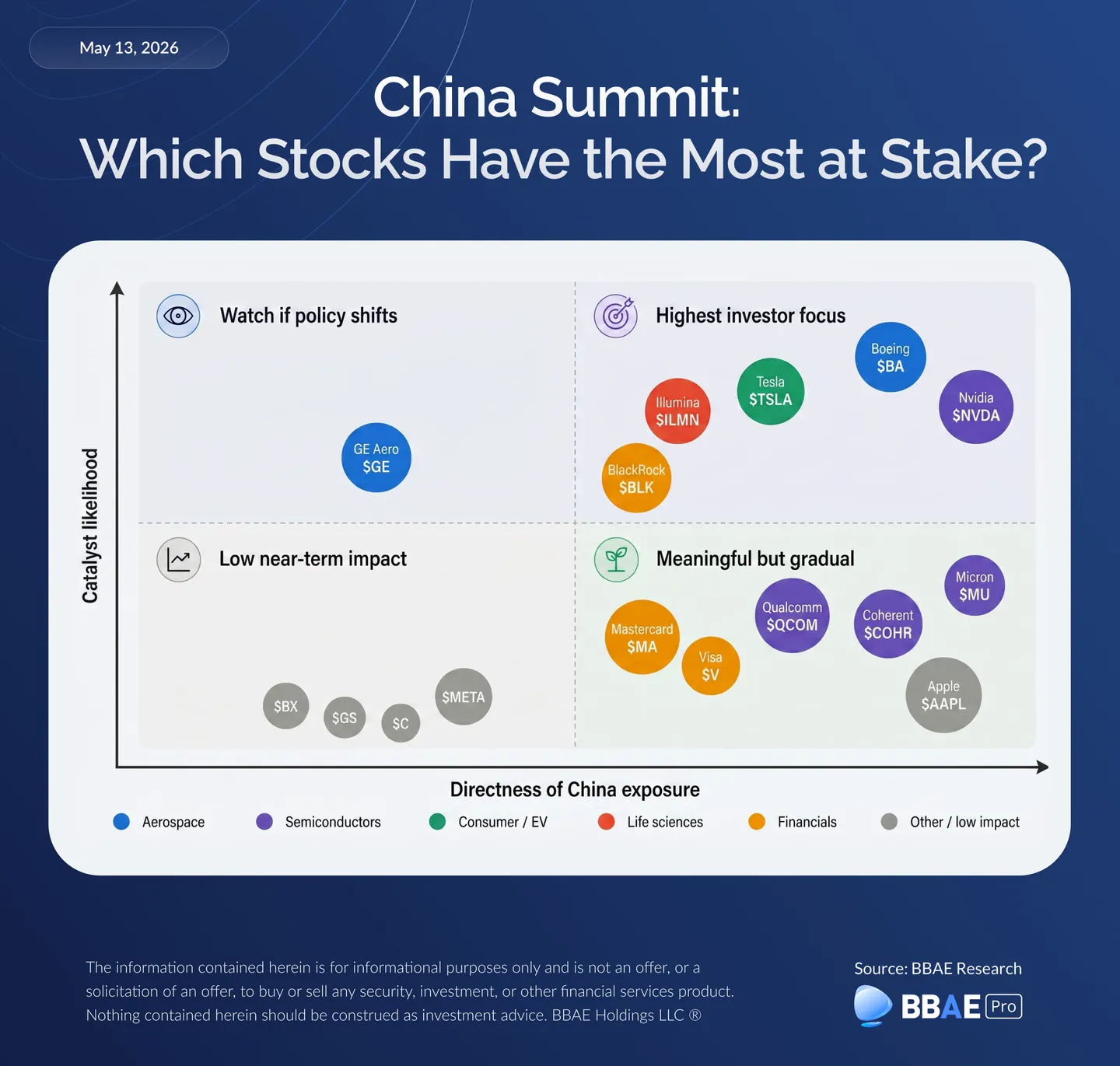
The companies with the most direct sensitivity to these events are Boeing, Nvidia, Tesla, and Illumina. Each is waiting on a specific commercial or regulatory development that Beijing can either accelerate or delay. Semiconductor names carry the highest policy sensitivity in both directions. Any clarity on how U.S. chip companies can sell to China, or how China releases critical materials, would be a category-defining outcome.
As of mid-May 2026, the summit was still unfolding. The distance between what is discussed and what gets formally approved remains the ultimate variable for every company involved.
Disclaimer: This article is for informational purposes only and is not investment advice or a solicitation to buy or sell securities. The content is based on publicly available information and reflects the author’s views as of the publication date. All investments carry inherent risks, including the potential loss of principal. Readers should conduct their own research or consult a financial advisor before making investment decisions. BBAE holds no position in the securities mentioned.