Why Investors Are Watching Leopold Aschenbrenner’s Portfolio, and What Changed in Q1 2026


Why Investors Are Watching Leopold Aschenbrenner’s Portfolio, and What Changed in Q1 2026
Investors have always paid close attention to the portfolios of famous money managers, whether it is Warren Buffett through Berkshire Hathaway, Bill Ackman through Pershing Square, or Stanley Druckenmiller through Duquesne Family Office. The reason is simple: 13F filings can offer a glimpse into how experienced investors are positioning their portfolios, what themes they are leaning into, and which stocks they may believe are underappreciated. We covered several of those major 13F filings last week, but sometimes retail investors become just as interested in smaller or less traditional portfolios, especially when the person behind them has a unique reputation or a history of seeing something others missed.
One example was Michael Burry’s Scion Asset Management. Even though Scion was relatively small compared with the largest hedge funds, it became one of the most watched portfolios by retail investors for years. The reason was simple: Burry became famous for his exceptional prediction of the 2008 housing bubble. Because of that, many investors looked at his trades as if he might have found something that more traditional hedge funds were overlooking. Scion was later shut down, but for years it showed how a relatively small portfolio could attract huge attention when the person behind it had a reputation for seeing major market risks early.
In recent months, another relatively small and unusual hedge fund has started attracting attention from retail investors. The fund is called Situational Awareness LP, and behind it is Leopold Aschenbrenner, a 24-year-old former OpenAI alignment researcher whose views on artificial intelligence have made him one of the more closely watched names in the AI investment conversation.
Who Is Leopold Aschenbrenner and Why Are Investors Looking at Him?
Leopold Aschenbrenner is a former OpenAI alignment researcher who worked on questions related to how future AI systems can be controlled, aligned, and made safe. Unlike many hedge fund managers, his background is not traditional Wall Street. That is part of what makes his fund interesting to investors.
He became widely known after publishing “Situational Awareness: The Decade Ahead” in June 2024. In that essay, he argued that AI progress could move much faster than many people expect. One of his central claims was that AI models could become capable of doing the work of AI researchers and engineers by around 2027. If that happens, AI could begin accelerating AI research itself, potentially leading to much more powerful systems and eventually what he describes as superintelligence.
That thesis is the main reason investors are paying attention to him. Aschenbrenner is not simply running a portfolio based on ordinary market trends. His fund appears to be closely tied to a specific view of the future: that AI development could accelerate dramatically in the next few years, and that some of the biggest winners may be companies positioned around compute, semiconductors, power, data centers, and AI infrastructure.
How Big Is Situational Awareness LP?
Situational Awareness LP started with a reported 13F portfolio value of $254.8 million, based on its first 13F filing for the end of 2024.
Based on the most recent filing, the fund reported $13.68 billion in 13F holdings, showing a very large increase in reported exposure in a short period of time.
It is important to note that 13F value is not the same as actual assets under management. A 13F filing only shows certain reportable U.S. securities and options positions. It does not show everything the fund owns, and options can make the reported value look much larger than the actual capital invested.
How His Holdings Changed Over Time
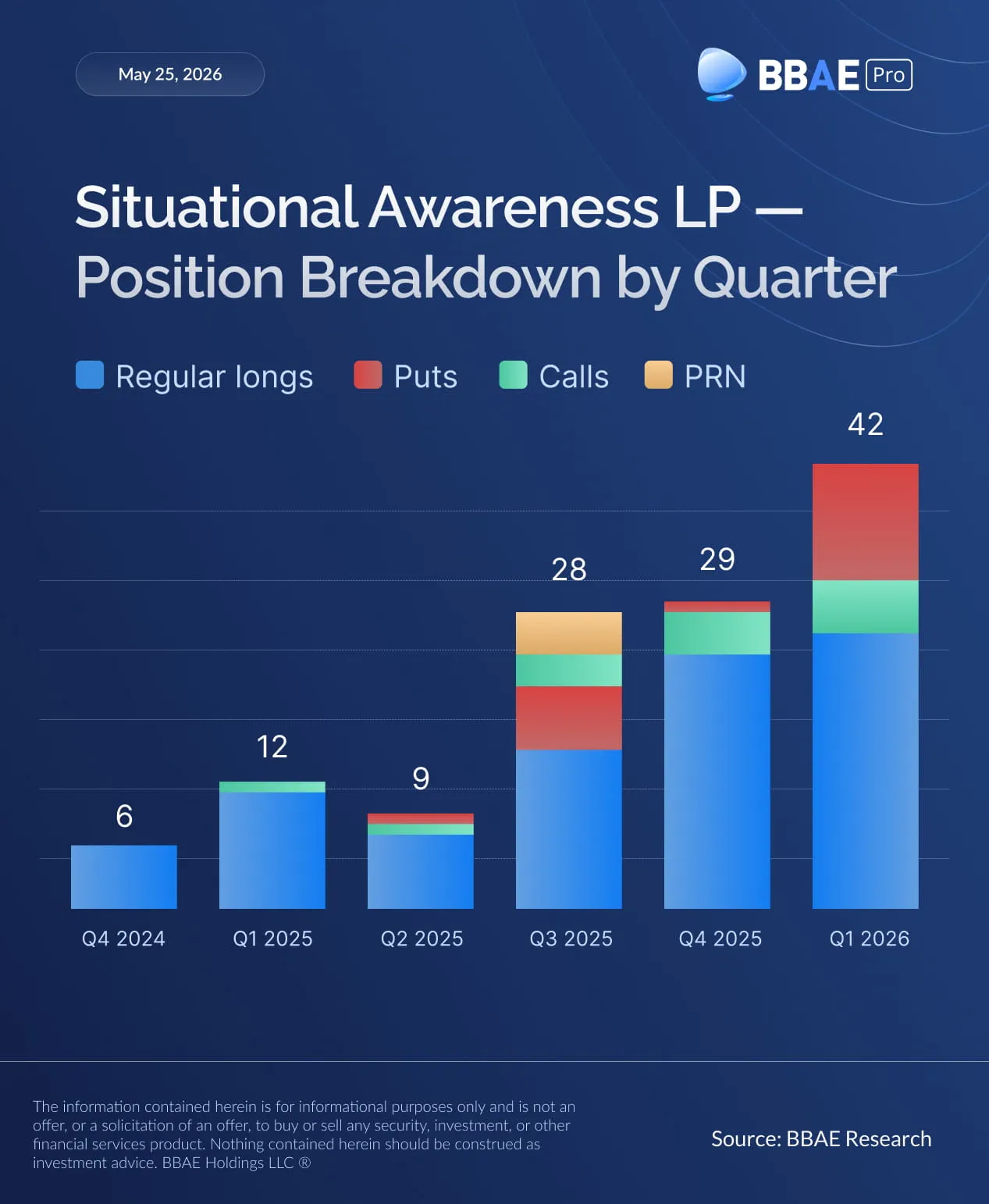
Situational Awareness LP’s first reported portfolio was small and highly concentrated. The fund held only six positions, all tied in some way to the physical infrastructure behind the AI boom, including chips, power, cooling, and data-center demand. Marvell Technology was the largest position at around 34% of the portfolio, followed by Vistra at 23%, Vertiv at 20%, Talen Energy at 11%, Constellation Energy at 8%, and Modine Manufacturing at 3%.
The next filing showed that the fund had already started to move beyond that initial basket. It added several new positions, but the biggest change was Intel. Situational Awareness LP reported a large call-options position on Intel, which grew to almost 46% of the reported 13F portfolio. That was the trade that really made Aschenbrenner famous among retail investors: a huge bullish bet on $INTC at a time when many investors were still skeptical of the company.
The timing made the trade even more interesting. Aschenbrenner appeared to hold the Intel calls through the first major part of the 2025 rally, when $INTC roughly doubled from the low-$20 range to around $40. By that point, Intel had become the position many retail investors associated most closely with Situational Awareness. In that filing, $INTC was clearly the main bet, followed by names such as Broadcom, Onto Innovation, Vistra, Modine, EQT, CoreWeave, Constellation Energy, Core Scientific, Talen Energy, Applied Digital, and IREN.
By the end of December 2025, the fund was still holding Intel calls, which made the next filing especially anticipated. Intel continued to rally in 2026, so many retail investors wanted to see whether Aschenbrenner had kept the position, increased it, or moved on to a new AI infrastructure idea. But when the May filing finally came out, showing the portfolio as of March 31, 2026, it told a very different story.
The famous $INTC call position was gone. In its place, Situational Awareness reported only a small regular Intel equity stake, worth about $8.9 million, alongside a much larger $159.1 million $INTC put position. So Intel did not disappear from the portfolio entirely, but the structure changed dramatically: from a signature bullish call-option bet into a small long stock position paired with a much larger downside bet.
That shift was one of the reasons some retail investors reacted with disappointment. Based on the filing snapshot, it looked as though Aschenbrenner may no longer have been positioned for one of Intel’s most important rallies in April. The important caveat is that 13F filings only show positions as of quarter-end, and they do not reveal what the fund did after March 31. So nobody knows whether he changed the trade during April. Still, from the filing alone, many investors read the change as a sharp reversal in the Intel thesis.
What Is in His Portfolio as of the Latest Filing?
The latest filing was not just about Intel. It showed a broader shift across the portfolio. Situational Awareness reported large put positions on several major AI and semiconductor names, including $SMH, $NVDA, $ORCL, $AVGO, $AMD, $MU, $TSM, $ASML, and $INTC. The largest disclosed position was a put position on the VanEck Semiconductor ETF ($SMH), followed by large puts on NVIDIA, Oracle, Broadcom, and AMD. Business Insider also described the filing as showing major bearish bets against some of the market’s biggest AI chip names.
At the same time, the fund did not abandon the AI infrastructure trade. Its largest regular equity long was Bloom Energy ($BE), valued at about $878.7 million, followed by SanDisk ($SNDK), CoreWeave ($CRWV), IREN ($IREN), and Core Scientific ($CORZ). That mix suggests the fund may still be betting on the physical buildout behind AI, including power, data centers, compute infrastructure, storage, and related suppliers, while using puts to express caution around parts of the semiconductor trade that may have become crowded or richly valued. Third-party 13F trackers also show that the fund’s Q1 2026 top holdings shifted toward $SMH, $NVDA, $ORCL, and $AVGO puts, compared with Q4 2025 top holdings that included Bloom Energy, CoreWeave calls, Intel calls, and Lumentum.
One important caveat is that 13F filings do not show the full picture. They do not reveal short positions directly, they do not show option strike prices or expiration dates, and they can be stale by the time investors see them. So the filing should not be read as a perfect real-time view of the fund’s positioning. But it does show a clear change in posture: Aschenbrenner’s fund appears to be separating the AI infrastructure names it still wants to own from the AI hardware names where it wants downside protection, or possibly a bearish bet.
This article is for informational purposes only and is neither investment advice nor a solicitation to buy or sell securities. All investment involves inherent risks, including the total loss of principal, and past performance is not a guarantee of future results. Always conduct thorough research or consult with a financial expert before making any investment decisions. BBAE has no position in any investment mentioned.